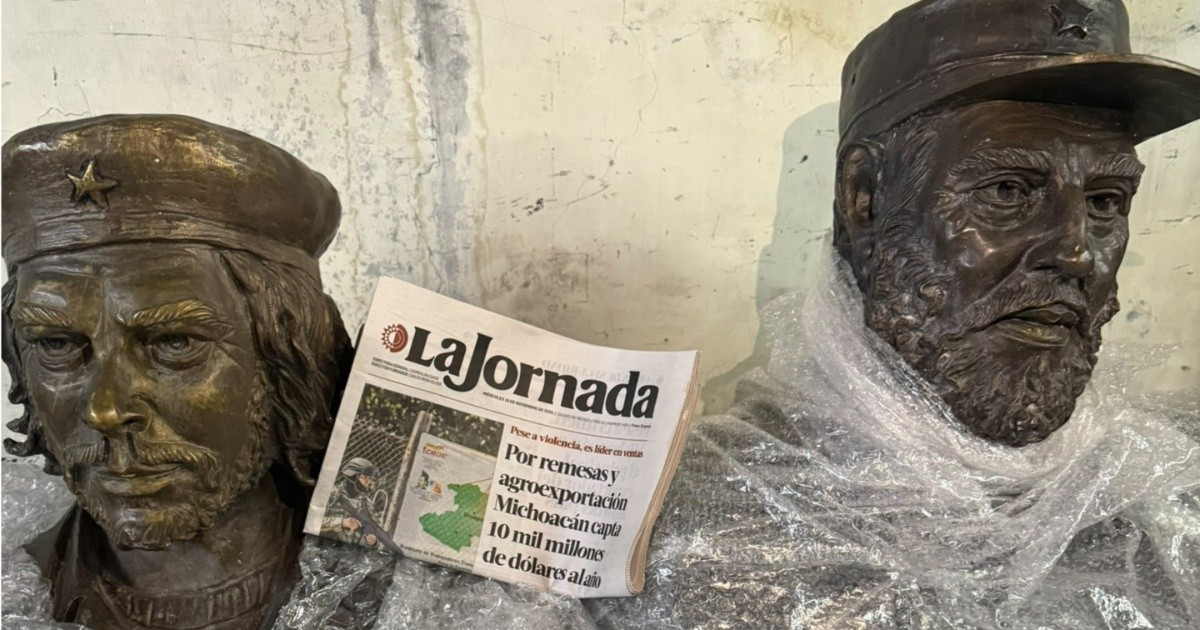
Cuauhtémoc's Mayor, Alessandra Rojo de la Vega, issued a response on Wednesday to Mexico City's head of government, Clara Brugada, following Brugada's dismissal of her proposal to exchange statues of Fidel Castro and Ernesto "Che" Guevara for street paving materials or garbage collection equipment in the district.
In a detailed thread posted on the social media platform X, Mayor Rojo de la Vega questioned MORENA's defense of the symbols associated with the Cuban Revolution and posed a direct question to the city's administration.
"Is Cuba the future that MORENA envisions for Mexico City and the country? Is the Cuban dictatorship a model for Mexico to follow?" she wrote.
Rojo de la Vega accused Brugada of prioritizing ideological beliefs over the needs of the borough's residents.
"She placed her ideological admiration for the Cuban model of governance above serving the local community," Rojo de la Vega asserted.
The mayor further labeled the Cuban regime as "murderous," backing her claim with figures from the organization Archivo Cuba.
"Sixty-seven years later, it's more than enough time for any democrat, regardless of political affiliation, to reject the human tragedy orchestrated by the so-called 'Cuban revolution.' By early 2026, Archivo Cuba records show 8,190 political murders by the Cuban regime: 5,775 executions and shootings, 1,231 extrajudicial killings, 200 disappearances, and 984 deaths of political prisoners, with thousands of unrecorded cases," she stated.
Rojo de la Vega described the dire conditions she believes Cubans currently face.
"While Cubans endure hunger and poverty, surviving on food ration cards that provide an average of 500 grams of chicken and five eggs a month—that's all the protein they get—the revolution's leaders squander money living in luxury," she wrote.
She also remarked that before the Revolution's triumph in 1958, Cuba was the third-strongest economy in Latin America and ranked 30th globally. She attributed the island's impoverishment and rising extreme poverty to the model established by Fidel Castro.
Roots of the Controversy
The controversy originated in July 2025 when Mayor Rojo de la Vega ordered the removal of the "Monument Encounter" sculpture set, featuring Fidel Castro and Ernesto "Che" Guevara, from the Tabacalera Garden.
The official cited administrative irregularities in the sculptures' installation and responded to complaints from local residents.
According to the mayor's office, the monument was initially placed in 2017 without the approval of the Committee of Monuments and Artistic Works in Public Spaces, and although it was reinstalled in 2020, the legal issues remained unresolved.
The decision sparked a strong backlash from both the federal government and the city's administration.
President Claudia Sheinbaum described the removal as "illegal," "intolerant," and "hypocritical," demanding the sculptures' return.
Meanwhile, Clara Brugada called for the statues to be relocated to a "symbolic and central" location in the capital.
Despite the refusal from Cuauhtémoc's mayor, Mexico City's government announced last week that it would commission a new set of sculptures.
Brugada assured that the project would not involve public funds.
"Not a single peso from public coffers will be spent on these sculptures, and they will be funded through the economic solidarity of social groups and activists," she declared.
El Financiero reported that a committee will be formed to gather resources to finance the artwork, although the location for the new statues has yet to be decided.
Beyond the Statues: A Broader Debate
The controversy has also rekindled discussions regarding MORENA's ties with the Cuban regime. In May 2025, the party's general secretary signed a cooperation agreement in Havana with the Communist Party of Cuba, in an event led by Miguel Díaz-Canel.
Despite her critical tone, Rojo de la Vega concluded by expressing openness to dialogue with the head of government.
"I respect her and her position, but Mexico City deserves much more: a sustainable model to address major crises in water, mobility, and housing access. Whenever she's ready to pursue that path, we will be waiting," she concluded.
Understanding the Controversy Over Cuban Statues in Mexico City
Why is the installation of Fidel Castro and Che Guevara statues controversial in Mexico City?
The controversy stems from political and ideological differences, as well as administrative irregularities in the installation of the statues. Mayor Alessandra Rojo de la Vega criticizes the installation as an endorsement of the Cuban regime, which she opposes due to its human rights record.
What actions did Mayor Rojo de la Vega propose regarding the statues?
Mayor Rojo de la Vega proposed exchanging the statues for materials that could be used to improve local infrastructure, such as street paving materials or garbage collection equipment, prioritizing practical needs over ideological symbols.
How did the Mexican federal government react to the removal of the statues?
The federal government, along with Mexico City's administration, reacted strongly against the removal, labeling it as illegal and calling for the statues to be returned to a central and symbolic location in the capital.