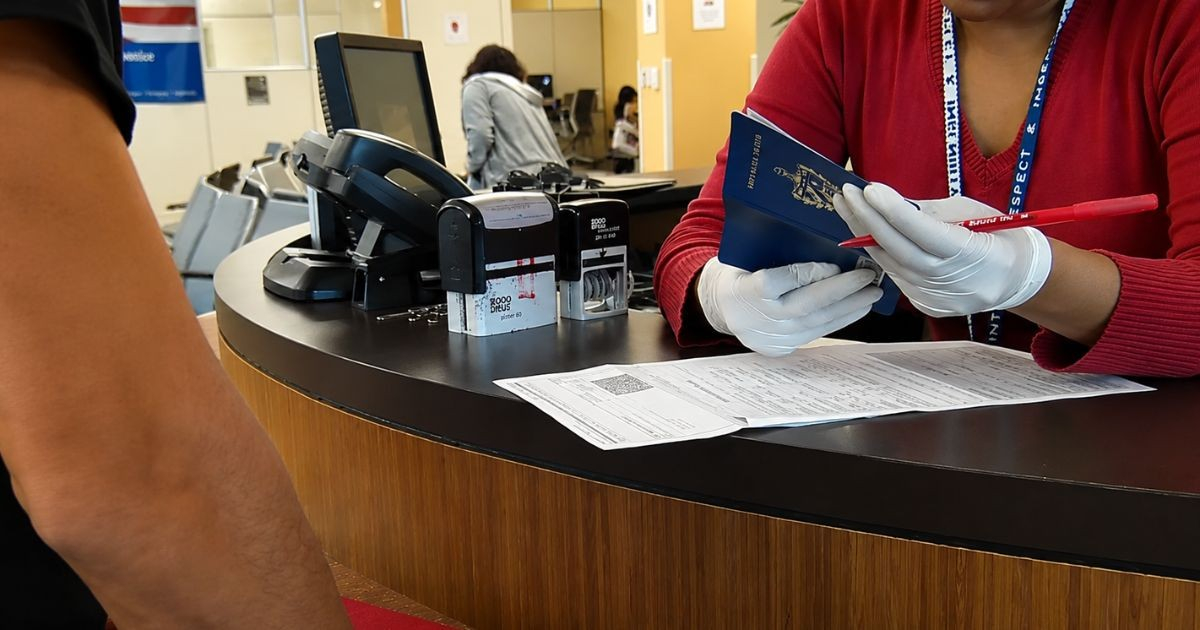
The United States Citizenship and Immigration Services (USCIS) announced on Wednesday a policy update that immediately tightens the evidence standards required for all immigration benefit applications. This move is aimed at curbing frivolous and incomplete submissions that have clogged the system for years.
Under this new directive, USCIS officers now have the full discretion to deny an application without first issuing a Request for Evidence (RFE) or a Notice of Intent to Deny (NOID) if the applicant fails to submit necessary initial documentation or prove eligibility at the outset.
Effective immediately, this policy change, outlined in Policy Alert PA-2026-05, applies to both pending applications and those filed from August 5, 2026, onward.
This marks a reversal of the policy from the Biden administration, which required officers to issue an RFE or NOID before denying any case, even when applications were incomplete or failed to establish eligibility.
According to USCIS, the previous guidance "allowed frivolous or substantially incomplete filings to slow down processing for other applicants waiting in line." The agency also mentioned that the Biden-era policy was exploited for submitting "placeholder" applications—those incomplete filings intended to secure associated benefits like work permits while waiting for a decision on the primary case—resulting in extended processing times and increased operational costs, which were passed on to all applicants through higher fees.
In addition to restoring the discretion to deny without an RFE, the new policy removes the extra 14-day response period previously granted for notices sent outside the United States. Now, only the standard three-day mailing period applies. Maximum response times remain unchanged: 12 weeks for an RFE and 30 days for a NOID.
The practical impact is clear: any applicant seeking an immigration benefit must provide all required documents as outlined in the form instructions from the outset, without expecting a second chance from USCIS to correct any deficiencies.
Immigration attorneys emphasize that every application should be treated as if there is no opportunity to fix errors after submission.
For Cubans processing residency under the Cuban Adjustment Act, this means submitting a complete Form I-485, photographs, identification, birth certificate, proof of Cuban nationality, and any applicable inadmissibility forms right from the start.
This update adds to a series of measures that have progressively tightened the immigration system in 2025 and 2026. In May 2026, USCIS redefined status adjustment as an "extraordinary discretionary relief" through memorandum PM-602-0199, also making residency interviews more stringent.
In July, a rule took effect allowing for the rejection of applications with invalid signatures without issuing an RFE or providing an opportunity for correction, a measure that directly impacts Cubans undergoing regularization.
The American Immigration Lawyers Association (AILA) confirmed the update and alerted its members about the changes in evidence standards, RFEs, and NOIDs.
For the Cuban community in the United States, which heavily relies on the Cuban Adjustment Act of 1966 to obtain permanent residency, the current adjudication environment is considerably more challenging than at any recent time.
Key Changes in USCIS Policy and Their Impact
What is the new evidence requirement from USCIS?
The new USCIS policy requires applicants to submit all necessary documentation at the time of filing, giving officers the discretion to deny applications without issuing an RFE or NOID if the initial requirements are not met.
How does this policy change affect Cuban applicants?
For Cuban applicants, particularly those using the Cuban Adjustment Act, it means they must submit a fully completed Form I-485 and all other required documents from the beginning, as there will be no additional opportunity to correct any deficiencies.
What is the impact of the removal of the 14-day extension for responses?
The removal of the 14-day extension means applicants now have only three days for mailing time in addition to the original response period, which remains at 12 weeks for RFEs and 30 days for NOIDs.