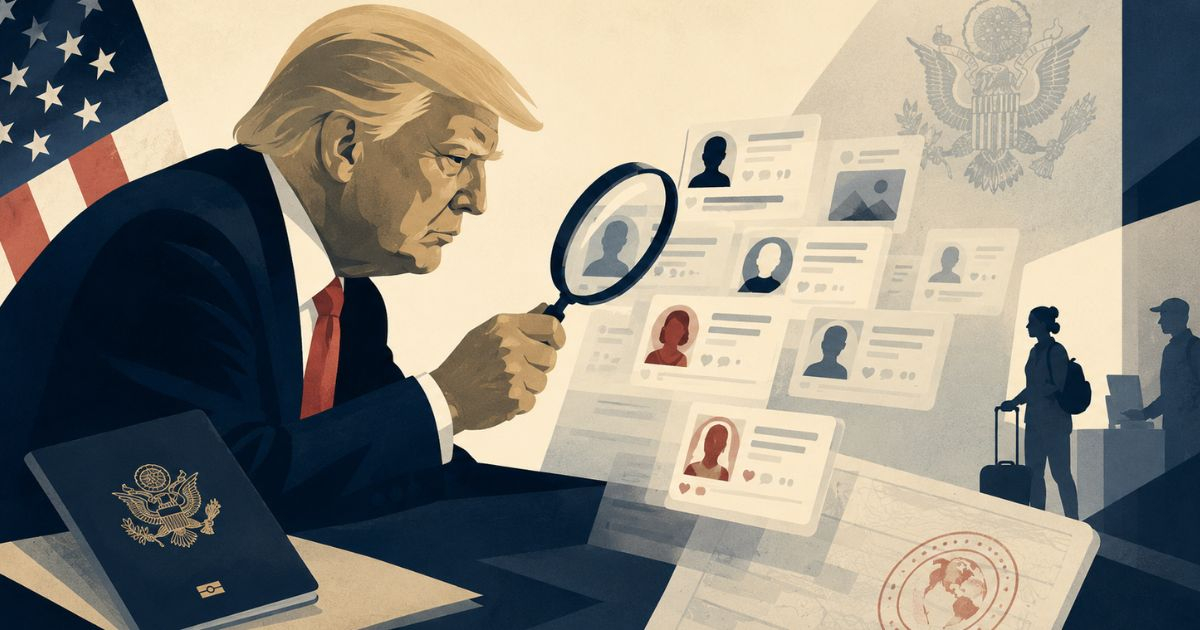
The Trump administration has expanded its scrutiny of social media activity to include new categories of visa applicants, such as foreign media representatives and professionals from Mexico and Canada traveling to the United States under the USMCA trade agreement.
This new policy was disclosed on Thursday by The Daily Signal, which accessed an internal State Department memo.
White House Press Secretary, Karoline Leavitt, publicly endorsed the information by sharing the report on her official X account.
Implications for Media and Professional Applicants
The updated requirements now apply to foreign media representatives and certain Mexican and Canadian nationals entering the U.S. for professional activities covered by the USMCA, along with their spouses and dependent children.
Applicants within these categories are required to adjust their social media profiles to remain "public" or "open," enabling consular officials to review their digital presence during the evaluation process.
Security Measures and Visa Eligibility
The memo indicates that the State Department utilizes all available information sources to identify individuals who might be inadmissible or pose a threat to national or public security.
The administration views each visa decision as a national security matter, asserting that applicants must prove their eligibility and genuine intent to comply with entry and stay conditions in the U.S.
For Cuban nationals, this new policy does not automatically trigger additional reviews for all applications. It may primarily impact those applying for visas as foreign media representatives or in other categories included in the State Department's expansions.
Visa Privilege and Broader Immigration Enforcement
"A U.S. visa remains a privilege granted at the discretion of the government, not a right," warns the document cited by The Daily Signal.
This measure is part of a broader policy aimed at tightening immigration controls.
In a recent Facebook post, the State Department listed several cases where visas were revoked for foreigners accused of serious crimes, affirming that it will use all available tools to prevent entry or stay of individuals posing a danger.
Historical Context and Recent Changes
The practice of social media review did not start with this new expansion. Since June 2019, the United States has required nearly all immigrant and non-immigrant visa applicants to report social media identifiers used in the previous five years, a step implemented to strengthen security checks and identity verification.
The latest change extends the obligation to maintain visible profiles for direct review to other groups.
In March, the State Department had already extended digital presence checks to numerous categories, beyond H-1B, H-4 visas, and F, M, and J visas used by students and exchange program participants.
By June 2025, the United States also mandated the review of social media for student visa applicants, requiring their accounts to be accessible to consular officials.
Understanding the Expanded Social Media Scrutiny for Visa Applicants
Who is affected by the new social media scrutiny policy?
The policy affects foreign media representatives and certain professionals from Mexico and Canada entering the U.S. under the USMCA, along with their spouses and dependent children.
What must applicants do under the new social media policy?
Applicants must ensure their social media profiles are "public" or "open" so consular officials can review their digital presence during the visa evaluation process.
Does this policy affect Cuban visa applicants?
The policy does not automatically impose additional reviews on Cuban applicants, but may impact those applying as foreign media representatives or in other expanded categories.
What is the broader aim of the policy?
The policy is part of a broader effort to tighten immigration controls and ensure that visa applicants do not pose a security threat to the United States.