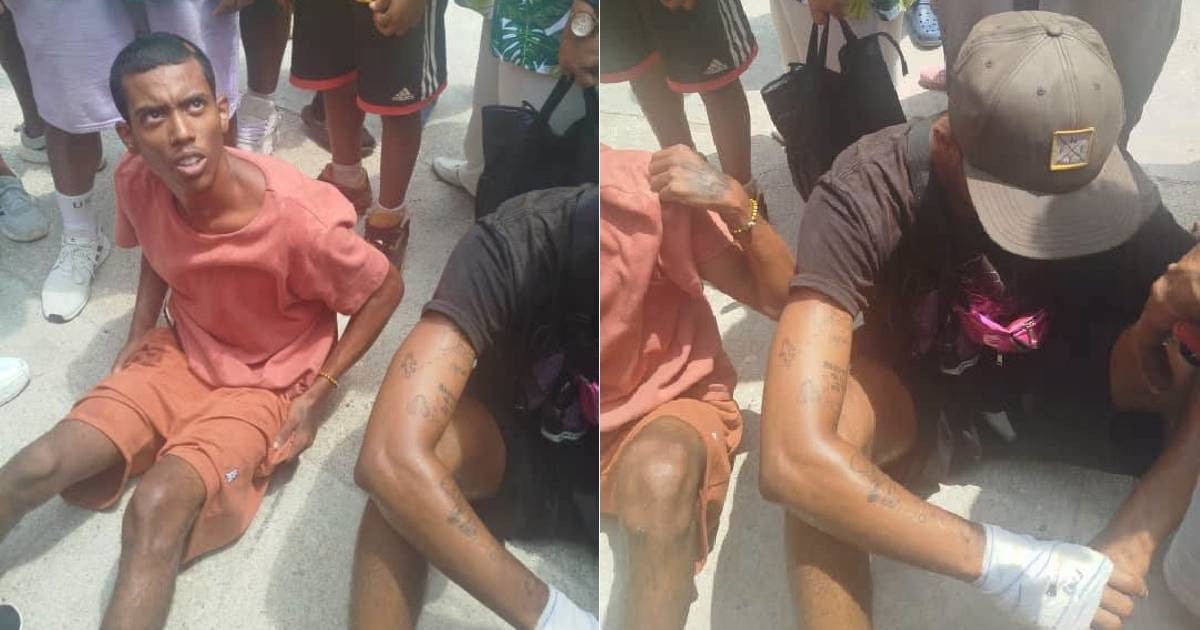
On Wednesday, the Plaza de la Revolución Administration Council released images of individuals allegedly caught stealing during the weekly fair at Villalón Park, located in El Vedado, a district in Havana's Plaza de la Revolución municipality.
The pro-government post on Facebook claimed that these suspects were attempting to pilfer items from attendees of the popular market held every Wednesday at the intersection of Calzada and C. The crowd reportedly subdued them and subsequently handed them over to the police. The authorities then transferred the detainees to a police station where, according to the post, they would face "the full extent of the law."
The post was accompanied by pictures of the apprehended individuals and concluded with the slogan: "In Plaza, the streets belong to the people, not to crime."
This message is part of a recurring communication strategy by the regime, aiming to portray a facade of law enforcement control by showcasing images of alleged criminals on social media. This comes amid a growing perception among citizens of a severe decline in public safety.
Nevertheless, the public display of detainees without any judicial proceedings has been criticized by human rights organizations as a violation of basic procedural guarantees.
Crime Statistics vs. Official Slogans
Despite the regime's proclamations, available data paints a different picture of Cuba's security situation. The Cuban Citizen Audit Observatory recorded 2,833 confirmed crimes in 2025, marking a 115% increase from 2024, with 1,536 of those being thefts, the most prevalent crime.
Havana ranks among the four provinces with the highest crime rates in the nation, with 398 incidents recorded that year, alongside Matanzas, Granma, and Santiago de Cuba.
In February of this year, the Ministry of the Interior acknowledged a 25% rise in property crimes, attributing this to the "complex economic situation," without acknowledging the decades of governance that have led to the current state of affairs.
Increasing Crime in El Vedado
The Plaza de la Revolución municipality and El Vedado have witnessed several similar incidents throughout 2026. In June, residents of Vedado detained a man who assaulted a woman to steal her electric scooter. That same month, over 30 home burglaries were reported in the Vedado area within just seven days.
In May, another individual was caught stealing container wheels in Jovellar, also in El Vedado, and was handed over to the National Revolutionary Police.
The practice of displaying detainees on social media by official accounts, district delegates, and MININT-affiliated profiles has intensified alongside the rise in criminal activity. This serves more as a propaganda tool than as a structural response to the problem.
The broader context of repression in Cuba exacerbates the situation. According to Prisoners Defenders, as of May 2026, the island reached a record of 1,281 political prisoners, illustrating that the regime's repressive machinery is applied with much greater severity against protesters than against the common criminals plaguing the population.
Understanding Crime and Repression in Cuba
How does the Cuban regime use social media in its crime control strategy?
The Cuban regime frequently uses social media to display images of alleged criminals to project an image of police control and respond to public concerns about safety. This approach is often criticized for bypassing judicial processes.
What are the criticisms of publicly displaying detainees in Cuba?
Human rights organizations criticize the public display of detainees as a violation of basic procedural rights, as individuals are showcased as criminals without undergoing proper judicial proceedings.
What is the crime situation in Havana and other Cuban provinces?
Havana is among the provinces with high crime rates, recording significant incidents alongside Matanzas, Granma, and Santiago de Cuba. The increase in thefts and other crimes reflects a broader rise in criminal activity across the island.