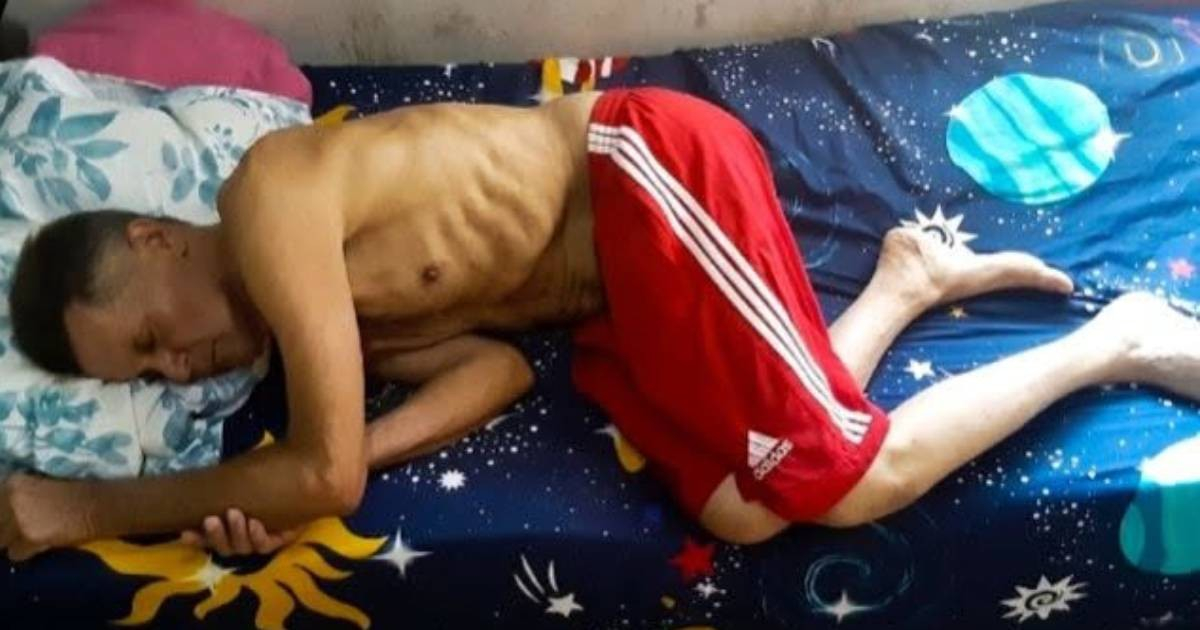
The Cuban activist and independent journalist, Guillermo del Sol Pérez, marked his 49th day on a hunger strike this Wednesday, as his health continues to decline. He has issued a poignant statement highlighting the dire nature of his situation: "I don't want to die."
In an interview with NTN24's program, La Noche, the 61-year-old dissident revealed that although his official hunger strike began on June 19, he has actually gone nearly 56 days without consuming solid food, having gradually reduced his intake beforehand in preparation for the protest.
"Honestly, I'm physically quite weak; spiritually, I feel very strong," he stated.
Del Sol explained that the aftereffects of previous hunger strikes, coupled with his chronic illnesses, have exacerbated his physical condition.
"Due to these hunger strikes, against a backdrop of type 2 diabetes, I've experienced two blood clots, one in my right jugular and another in my right leg," he detailed.
The activist also suffers from severe hypertension, bronchial asthma, and a heart condition. In 2019, he endured a left ventricular infarction after a 40-day hunger strike.
Eduardo Enrique Herrera Durán, a Cuban doctor now exiled in Brazil, has described the situation as a medical emergency, warning that prolonged fasting in a diabetic individual can lead to potentially fatal metabolic, cardiovascular, and renal complications.
His son, Adrián del Sol Alfonso, painted a grim picture of his father's physical deterioration.
"Drinking water is a struggle for him because he's almost completely devoid of muscle mass," he remarked.
Demand for Political Prisoner Release
The primary aim of Del Sol's hunger strike is to demand the release of 18 political prisoners, including Félix Navarro Rodríguez, Mayelín Rodríguez Prado, and Leonel Tristá García, the latter of whom was returned to the maximum-security prison in Guamajal in June after his parole was revoked.
During the interview, Del Sol emphasized that he is not the only dissident resorting to this extreme form of protest. He claimed that other Cuban prisoners and activists are also engaging in hunger strikes across various prisons in the country.
The dissident further asserted that the actual number of political prisoners in Cuba is much higher than what independent organizations report.
"We don't just have over 1,300 political prisoners. There are around 3,000; many families don't report them out of fear," he declared.
Threats and Living Conditions
Del Sol also reported that both he and other dissidents have faced threats from the authorities.
"Everyone has been threatened without exception... They've told us they'll erase us from the map and use us as human shields if the United States invades Cuba," he claimed.
The activist remains at his home in Santa Clara, where he contends with the everyday challenges of the Cuban crisis. He reported lacking regular access to potable water in his neighborhood and relies on a solar panel and portable energy station donated by Cubans in exile to cope with frequent power outages.
As his health continues to worsen, the organization Centro de Denuncias Defensa CD has requested urgent protective measures from the Inter-American Commission on Human Rights (IACHR) to ensure his life is safeguarded, calling for independent medical attention and an end to the harassment against him.
Despite his physical decline, Del Sol is steadfast in his resolve not to end his protest until the political prisoners for whom he started his hunger strike are freed.
"The night cannot last forever. Cuba must open itself to the world," he declared.
He concluded with a statement that encapsulates the spirit with which he approaches each day of his strike:
"That is my strength, that is my faith, and through Christ, I can do all things because he strengthens me."
Guillermo del Sol's Hunger Strike: Key Questions
Why is Guillermo del Sol on a hunger strike?
Guillermo del Sol is on a hunger strike to demand the release of 18 political prisoners in Cuba, highlighting the broader issue of political repression in the country.
What are the health risks associated with his protest?
The prolonged hunger strike poses severe health risks, especially for someone with existing conditions like type 2 diabetes, hypertension, and heart disease. These include potential metabolic, cardiovascular, and renal complications.
What has been the response from international organizations?
The organization Centro de Denuncias Defensa CD has appealed to the Inter-American Commission on Human Rights for urgent protective measures to safeguard Del Sol's life and stop the harassment against him.