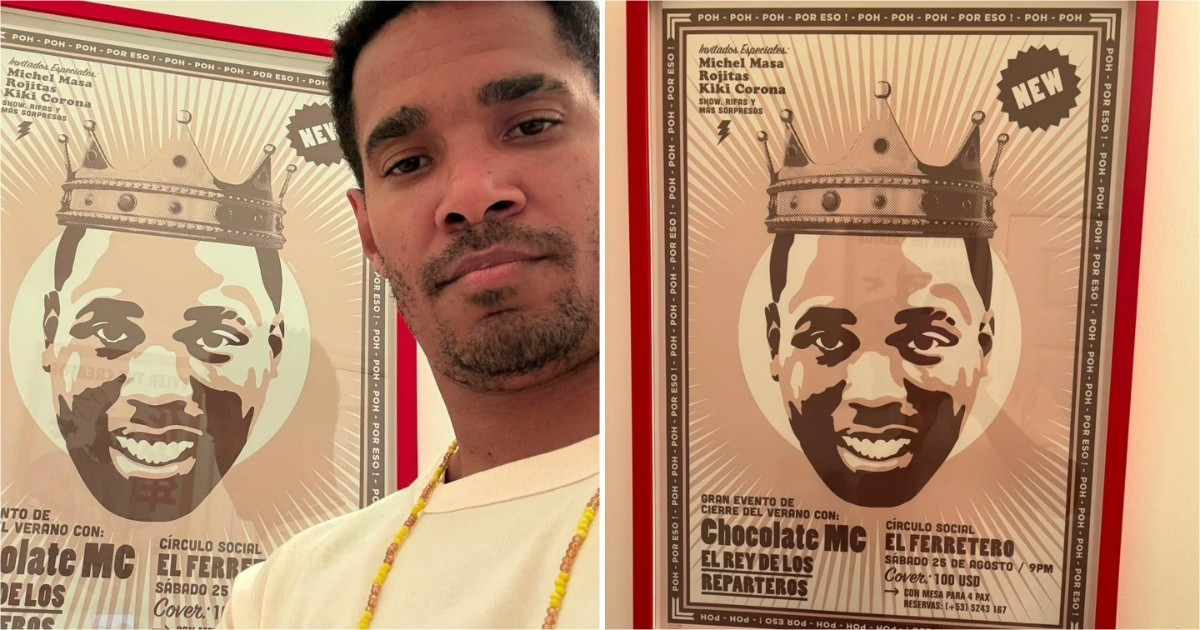
Just two weeks after arriving in Miami following five years of political imprisonment, Luis Manuel Otero Alcántara took to Instagram this past Sunday to express his admiration for Cuban rapper Chocolate MC and his song "Bajanda," which he hailed as a generational anthem against the Cuban regime.
"El Choco, the King of Reparto. Despite his mistakes and everything he's been through, his BAJANDA marked an entire generation and also became an anthem against the Cuban dictatorship," wrote Otero Alcántara, co-founder of the San Isidro Movement, on his social media account.
The post, featuring hashtags such as #SOSCuba, #EnCubahayUnaDictadura, and #LibertadParaLosPresosPoliticos, garnered over 1,000 reactions and 82 comments in just a few hours.
The Impact of "Bajanda"
The images accompanying the post depict a poster from an early concert by Chocolate MC—whose real name is Yosvani Sierra Hernández—at the Círculo Social El Ferretero in Havana. Released in 2018, "Bajanda" became one of the most viral urban music hits in Cuba, ultimately earning a gold record.
In 2021, amid the unprecedented July 11 protests in Cuba—the largest in decades—Chocolate MC released "Bajanda 2," which contained a direct political message: "Díaz-Canel, you’re going down."
Chocolate MC's Turbulent Journey
The artist proclaimed that his music and genre were "at the disposal of the Cuban people," aligning himself with the cause of demonstrators oppressed by the regime. However, after relocating to Miami, his personal journey became rocky. Between 2024 and 2025, he faced multiple arrests and charges, including first-degree solicitation, armed robbery, and death threats.
In 2026, Miami-Dade prosecutors offered him a plea deal for 12 years in prison, which he initially declined. Ultimately, he accepted a judicial agreement in March of that year, resulting in a 10-year sentence followed by five years of probation.
Otero Alcántara acknowledges this complicated history with his statement, "despite the mistakes and everything he's been through," before highlighting the cultural and political significance of "Bajanda."
Otero Alcántara's Continued Activism
Otero Alcántara was released by the Cuban regime on July 18, 2026, and arrived in Miami on the same day under the condition of permanent exile, having served a five-year sentence for his role in the 11J protests.
Since his arrival, the activist has resumed his public presence with statements and posts that maintain his critical stance against the Cuban dictatorship. "I'm going to keep fighting; that is my mission," Otero Alcántara declared upon his arrival in Miami, a sentiment that encapsulates his approach to this new chapter of exile.
Understanding the Cultural Impact of "Bajanda"
Why is "Bajanda" considered an anthem against the Cuban regime?
"Bajanda" is seen as an anthem against the Cuban regime because its lyrics resonated with a generation seeking change and expressed defiance against the political status quo in Cuba.
What challenges did Chocolate MC face after moving to Miami?
After moving to Miami, Chocolate MC encountered legal troubles, including arrests for first-degree solicitation, armed robbery, and making death threats, which led to a decade-long prison sentence.