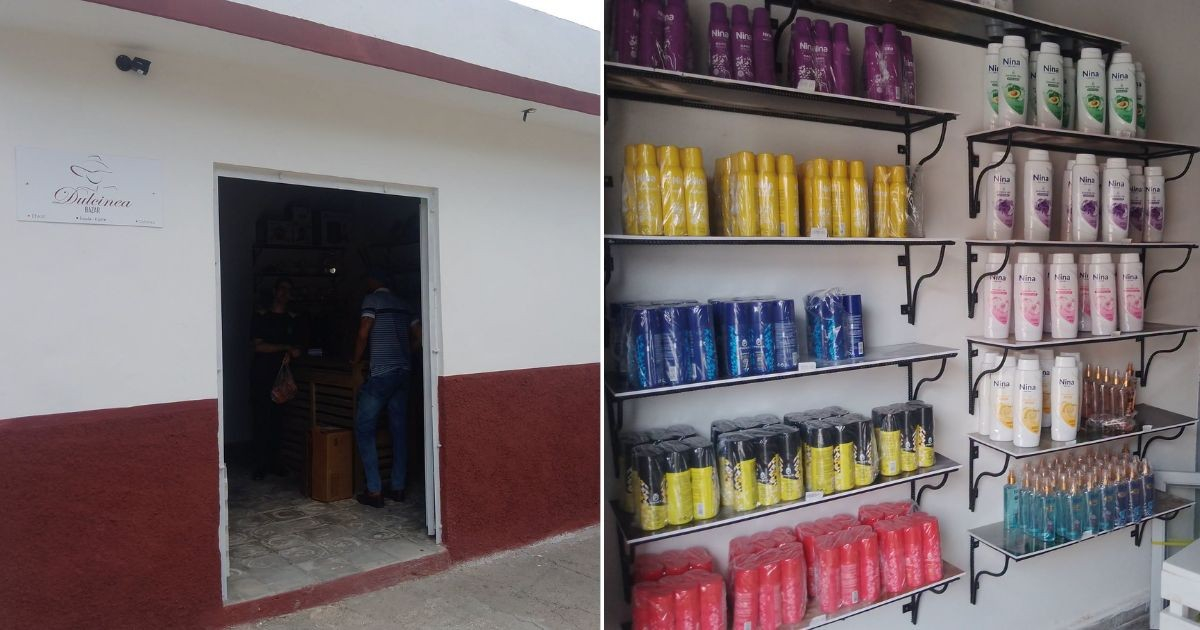
This past Saturday, the official pro-government broadcaster Radio Ciudad Monumento touted the opening of Dulcinea, a private bazaar in Bayamo located on Zenea Street, as a significant achievement. The store allows all products to be purchased using bank transfers, eliminating the need for cash transactions.
It's ironic that the regime is showcasing a private sector initiative as a city advancement when its own policies on banking have failed to address cash shortages or make bank transfers a widespread mode of payment.
Dulcinea is operated by the private microenterprise, Ínsula Quijote, which secured financing from the Banco de Crédito y Comercio (Bandec) through its Business Round developed in partnership with Empresa de Servicios Integrales Fénix.
Roberto Boza Blanco, the administrative director of the microenterprise, explained on the state-run broadcaster that this funding allows them to finance imports or purchase products from suppliers via transfers, later selling these goods in the store.
The bazaar offers a variety of goods including appliances, household items, toiletries, confections, meat products, clothing, tools, and plumbing materials, with plans to add essential items like oil.
Boza Blanco acknowledged that "the prices are not as affordable as we would like, but they provide another option for consumers who can pay by transfer, aiming to close a cycle that still has many loose ends."
He also mentioned that Dulcinea is "the first of a network of markets to be implemented in the city," hinting at the future opening of another store following the same payment principle.
However, the announcement has been met with skepticism. Jorge Luis Agüero commented, "They open a new store for transfer payments, yet they only have four types of shampoo and one kind of cologne."
Meanwhile, Cristhiam Rodríguez highlighted the "curious" aspect of this supposed achievement, posing a question that many are considering: "I want to see a foreign supplier accepting national currency in their accounts."
"This is just for the launch; we’ll see what happens when they need to restock without cash. That's the end of banking," stressed Alejandro Garcia Varona.
The official presentation overlooks the broader context. The banking policy, formally initiated in August 2023, has not succeeded in reducing cash usage or ensuring the stable operation of electronic payments.
Even state media admitted back in April that "cash remains the undisputed king of daily economics."
They also reported on businesses charging a 10% surcharge for electronic payments, while in some provinces, intermediaries demanded commissions of up to 20% to provide cash in exchange for transfers.
To combat these issues, the Central Bank announced new incentives in July for digital payments, including immediate crediting of certain transactions, reduced fees, and bonuses for consumers and businesses.
Moreover, Resolution 74/2026 indefinitely suspended the 5,000 CUP limit on cash transactions between economic actors, which was established in 2023, until "the conditions in the country permit," according to the official text.
In this scenario, the state media's portrayal of the opening of a private store accepting transfers as a "precedent" highlights the magnitude of the problem: a payment method that should be widely accessible is still being hailed as an extraordinary achievement.
The Impact of Banking Policies in Cuba
Why is the opening of Dulcinea seen as a significant achievement?
Dulcinea's opening is highlighted as a significant achievement because it represents a private initiative successfully implementing bank transfers for payments, amidst widespread cash shortages and limited success of banking policies.
What challenges do electronic payments face in Cuba?
Electronic payments in Cuba face challenges such as cash shortages, businesses imposing surcharges for digital transactions, and a lack of widespread acceptance and infrastructure for these types of payments.
What incentives has the Central Bank introduced for digital payments?
The Central Bank has introduced incentives like immediate crediting of certain transactions, reduced fees, and bonuses for both consumers and businesses to encourage the use of digital payments.