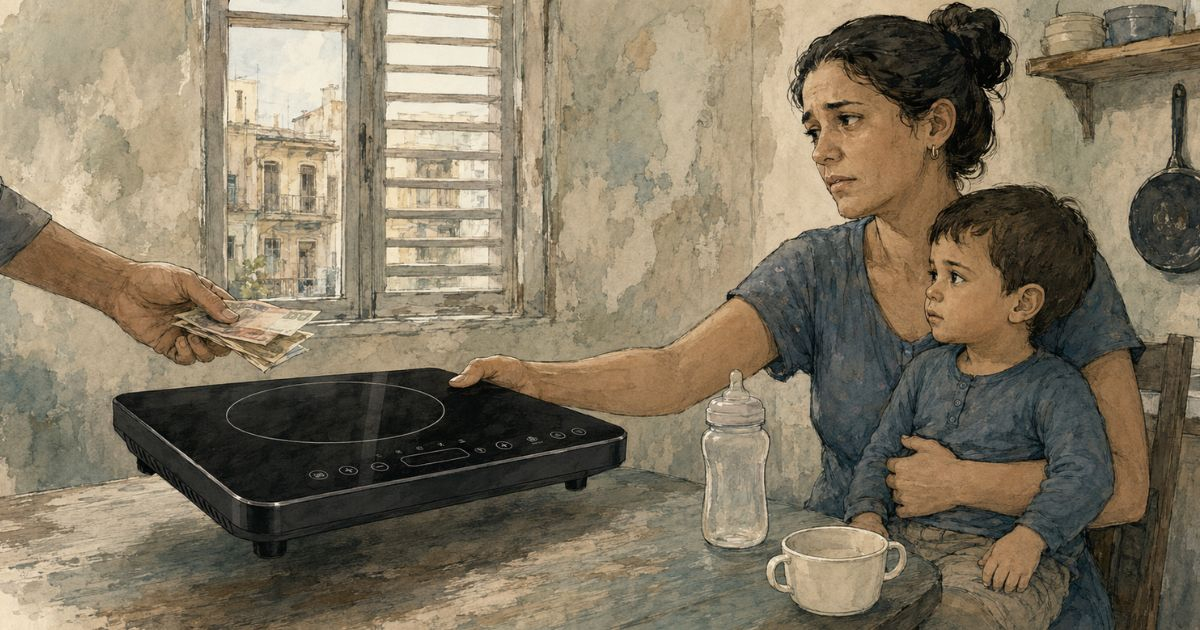
An anguished mother from Havana, Ani Vázquez, recently reached out to the Facebook group "Fierce Cuban Mothers 2" with a poignant plea that mirrors the plight of countless Cuban families: "Selling my Unisuki induction stove at a good price, urgent need, I have no milk for my child."
Residing in Luyanó Moderno in the San Miguel neighborhood, Vázquez set the price for her portable stove at 12,000 Cuban pesos, expressing openness to negotiation depending on the buyer's offer.
In a gesture of community support, Yaquelin López, a neighbor from Camilo Cienfuegos, offered Vázquez a small supply of milk, urging her to reconsider the sale of her appliance.
Ani's response was heartfelt: "Thank you so much, Mima, but I have no other choice. May God bless your kind heart."
When another member suggested selling something of lesser necessity, Ani encapsulated the harsh reality faced by many Cuban households: "It's not easy in this country, no wallet can handle it."
The Widespread Struggle
Vázquez's situation is far from unique. In the comments of her post, other mothers shared similar stories of hardship.
One woman was selling a brand-new Reina pot still in the box for 45 dollars or its equivalent in local currency, as she wrote, "I have nothing left to feed my children."
Iriannis Álvarez recounted even more drastic measures: "I've sold even my hair, my clothes, appliances—I don't know what to do anymore, how long, my God?"
Maisu Unquid summed it up succinctly: "So many mothers are selling everything for their kids."
Lucero Miel Canela captured the silent struggle many endure: "We are all mothers who aren't receiving remittances."
Ani herself expressed the collective anxiety: "We are at a desperation level where we don't know where our nerves will end up."
A Broken System Acknowledged
This episode unfolds amid a critical shortage of infant milk that even the regime admits is severe.
In June, the Minister of Food Industry, Alberto López Díaz, confessed that over 100,000 children do not receive their daily milk ration, and the official plan—milk powder for 331,000 minors and fluid milk for another 200,000—remains unfeasible.
The government claims to ensure milk only for 15,026 children with chronic illnesses and over 16,000 pregnant women.
The rest are left to fend for themselves in the informal market, where half a kilo of powdered milk cost 2,333 Cuban pesos in May, according to the ONEI.
National milk production has plummeted by 65% over five years, and by 2025, Cuba only received 30% of the planned milk powder imports.
In Matanzas, officials admitted to weeks-long distribution delays due to fuel shortages, while in Guantánamo, the energy crisis forced authorities to distribute unpasteurized milk and extend the delivery cycle from three to four days for children aged two to six.
A Recurrent Pattern of Sacrifice
The trend of selling household items to afford basic necessities is all too common in Cuba. In June, a father in Santiago de Cuba sold electrical outlets to buy spaghetti for his four children.
Similarly, in 2024, another mother parted with her television and appliances—"the only things of value"—to feed her daughters on a pension of 3,492 pesos.
Understanding Cuba's Milk Crisis
What is the current situation with milk shortages in Cuba?
Cuba is experiencing a severe shortage of milk, with over 100,000 children unable to receive their daily milk ration. The government's plan to provide milk powder and fluid milk to hundreds of thousands is not being met.
How is the milk shortage affecting Cuban families?
Many Cuban families are resorting to selling household items, including appliances, to afford basic necessities like milk. The informal market prices are extremely high, making it difficult for families to meet their needs.
What measures are Cuban authorities taking to address the milk crisis?
While the government guarantees milk for children with chronic illnesses and pregnant women, the majority of the population must rely on the informal market. There are significant delays in distribution due to fuel shortages.