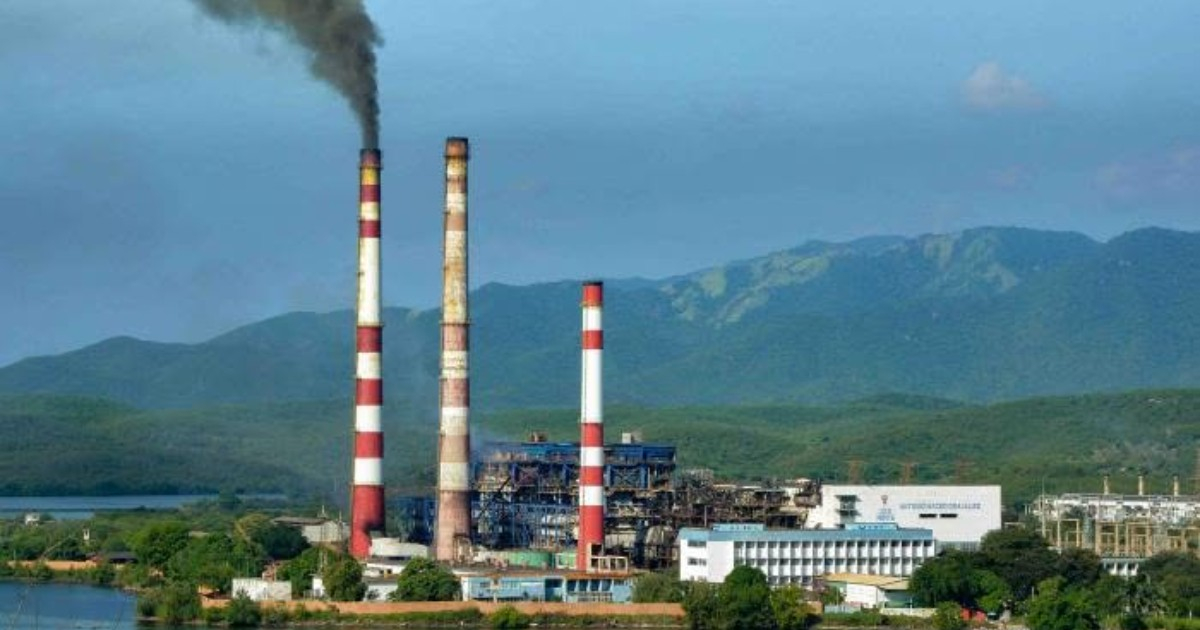
The Cuban Electric Union (UNE) reported on Saturday that Unit 3 of the Antonio Maceo Thermoelectric Plant, also known as CTE Renté, was successfully brought back online at 12:25 PM. This announcement was made via an official statement on the state agency's Facebook page.
This development followed a significant failure of the National Electric System (SEN) that disrupted power in the western region of Cuba.
At 6:07 PM, a simultaneous failure on the 220 kV transmission lines linking Matanzas with Cienfuegos and Matanzas with Santa Clara caused a division in the SEN, plunging provinces including Pinar del Río, Artemisa, Mayabeque, Havana, and Matanzas into darkness.
The collapse occurred under already strained conditions. Earlier that day, at 6:00 AM, only 895 MW of power was available to meet a 2,825 MW demand, with 1,930 MW already out of service prior to the breakdown.
The UNE assured that essential services, such as hospitals, were prioritized and had power restored during the recovery process.
"Efforts to restore power continue as per the established procedure. Hospitals and vital centers are currently receiving electricity. Generating units in the western region are being prepared for gradual integration into the SEN," the agency stated in its update.
The Electric Company of Matanzas confirmed that power had been restored to the Faustino Pérez Hospital and the Bello water pumping circuit, marking initial steps in the recovery strategy. The plan included energizing the 110 kV Guanábana substation and linking it with other parts of the grid.
The synchronization of Unit 3 at the Antonio Maceo plant, located in Santiago de Cuba and operational since 1966, is noteworthy due to its history of instability.
The SEN report from August 1 cited the unit as out of service that morning, with an expected output of just 45 MW. The plant's recent history includes a series of failures: a breakdown in September 2025, resynchronization in November 2025, another failure in March 2026, and intermittent operations during July 2026.
This latest collapse is part of a series of total disconnections that have plagued 2026. A widespread blackout on March 16 lasted over 29 hours, another on July 6 extended nearly 24 hours, and the system failed twice more in July, on the 11th and 14th.
The root causes remain unchanged: aging thermoelectric plants lacking proper maintenance, a chronic shortage of fuel, and decades of underinvestment in the electrical grid—all direct results of the Cuban government's mismanagement.
For peak hours on Saturday, UNE anticipated a supply of 1,080 MW against a demand of 3,200 MW, projecting a shortfall of 2,120 MW and an impact of 2,150 MW.
Understanding Cuba's Electric Grid Challenges
What caused the recent power collapse in Cuba?
The recent collapse was triggered by simultaneous failures on transmission lines connecting key provinces, which split the National Electric System and caused widespread outages.
What measures are being taken to restore power in Cuba?
Efforts include restoring electricity to essential services first, synchronizing generating units, and connecting substations to stabilize the grid.
Why does Cuba's electric grid face frequent failures?
Cuba's electric grid suffers from aging infrastructure, inadequate maintenance, fuel shortages, and long-term underinvestment, largely due to the regime's ineffective management.