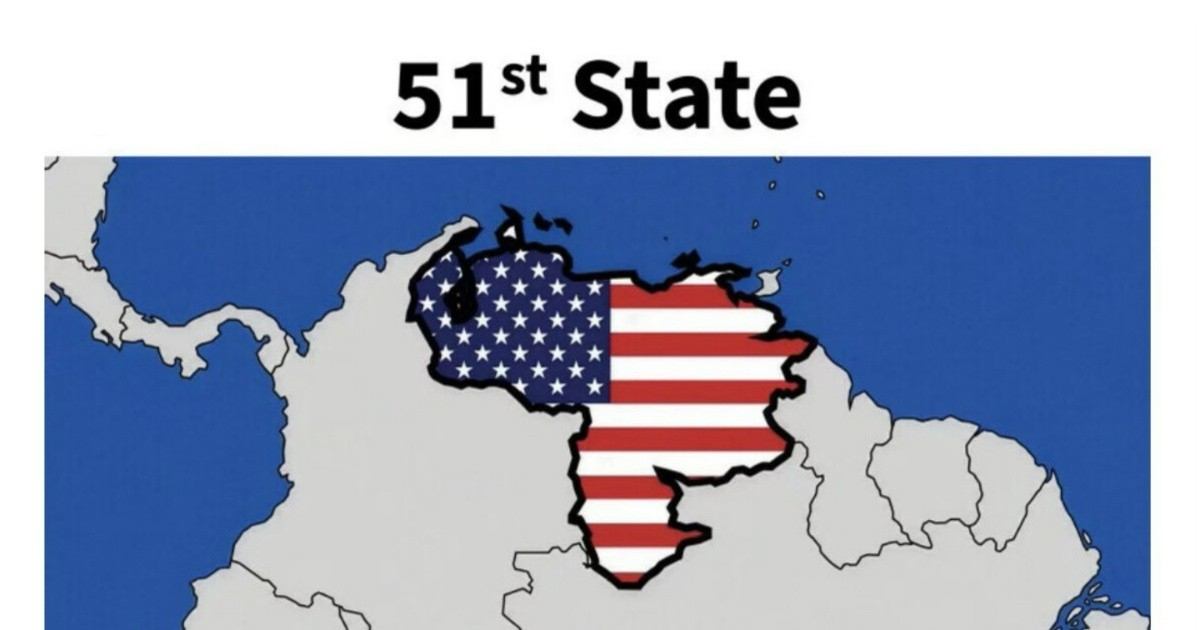
On Saturday, Donald Trump took to his social media platform, Truth Social, to share an image depicting Venezuela draped in the American flag, labeled as the "51st State." This move is yet another rhetorical gesture hinting at the potential annexation of the Caribbean nation, as reported by EFE.
This isn't the first instance of Trump using such imagery. On May 13, he had already posted an identical illustration on the same platform, shortly after mentioning in a phone interview with Fox News that he was "seriously considering" making Venezuela the 51st state.
The post from Saturday, which went live at 2:11 PM, garnered 572 retruths and over 2,210 likes on Truth Social.
Historical Context of Trump's Expansion Rhetoric
Trump's pattern of alluding to Venezuela as the "51st state" dates back to March when he made a humorous reference following Venezuela's triumph in the World Baseball Classic. This rhetoric is part of a broader expansionist narrative that also includes Canada and Greenland.
The backdrop to these discussions involves the capture of Nicolás Maduro by U.S. military forces on January 3, 2026, after which Delcy Rodríguez assumed the role of interim president of Venezuela.
Since that pivotal event, Washington has taken a supervisory role over Venezuela's government, aiming for a democratic transition, although a specific election timeline has not been established.
Political Dynamics and U.S. Influence
Just last Friday, Trump remarked that Venezuela is not yet "ready" for elections, although he acknowledged "progress" has been made. In the same statement, he praised interim President Delcy Rodríguez, noting the benefits that the Venezuelan oil market brings to both American businesses and the Venezuelan populace.
The timing of Trump's Saturday post aligns with the onset of formal talks between the Chavista-controlled National Assembly and a segment of the Venezuelan opposition, a dialogue that Washington has both prompted and supported.
Leading the Chavista side is Jorge Rodríguez, the President of the Parliament, while Dinorah Figuera represents the participating opposition.
The more prominent opposition, led by María Corina Machado and Edmundo González Urrutia, is not directly engaged in these negotiations.
Trump had seriously contemplated the idea of making Venezuela the 51st state back in May, and his recent comments on the transition process indicate that Washington continues to wield significant influence over Venezuela's political future, though this has yet to lead to specific electoral commitments.
Understanding the Implications of Trump's Statements on Venezuela
What prompted Trump's recent post about Venezuela being the 51st state?
Trump's post is part of a series of rhetorical gestures regarding the potential annexation of Venezuela, following previous similar posts and statements about the country's political status.
How has the U.S. influenced Venezuela's political landscape since 2026?
Since the capture of Nicolás Maduro in 2026, the U.S. has taken a supervisory role in Venezuela, promoting a democratic transition without specifying an election timeline.
Who are the key figures in the current Venezuela-U.S. political dialogue?
Jorge Rodríguez leads the Chavista side, while Dinorah Figuera represents a participating opposition faction. Meanwhile, María Corina Machado and Edmundo González Urrutia lead the more prominent opposition, which is not directly involved in the talks.