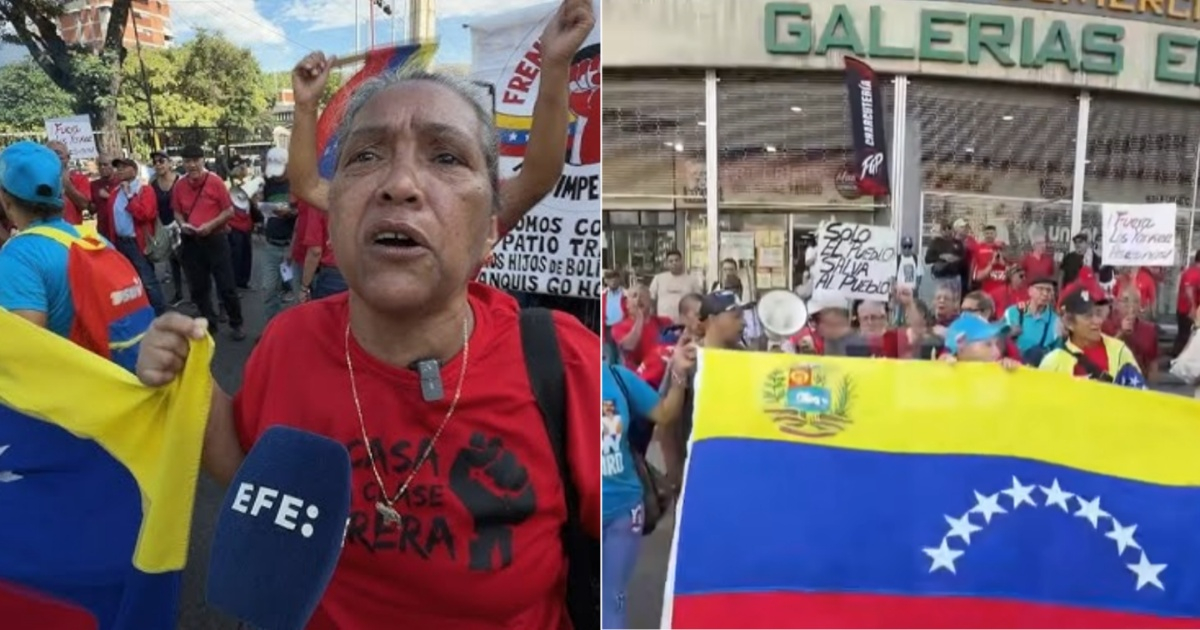
On Saturday, numerous supporters of the Chavismo movement took to the streets of Caracas in protest against the dialogue initiated between Venezuela's ruling party and a faction of the opposition, a process encouraged by the United States.
The gathering was organized by the Anti-Imperialist Popular Front. Participants, clad in red—the symbolic color of Chavismo—waved Venezuelan flags as they expressed their opposition. The group labeled the dialogue as part of a "machiavellian transition scheme devised by imperialists to dismantle" the legacy of the late President Hugo Chávez.
Furthermore, the demonstrators warned that the real aim of these talks is to place "puppets of the U.S. government" in control of the judicial system and the electoral body, paving the way for what they see as unconstitutional elections.
Rubén Gutiérrez, a 67-year-old protester, told EFE news agency that the dialogue is "nothing more than an imposition by the United States" and a "surrender of sovereignty." Gutiérrez accused the Trump administration of attempting to "override" the Venezuelan Constitution and enforce "a transitional government that serves their interests alongside far-right lackeys." He urged acting President Delcy Rodríguez to "uphold the sovereignty."
Another protester, Aidé Romero, refused to negotiate with those she termed "traitors" and described the dialogue as "another political earthquake." Although she expressed her trust in the acting president, she emphasized the need to "tell the Americans that they have no right to govern here."
The division displayed by Chavismo on the streets highlights a deeper rift within the ruling party. Figures such as Elías Jaua had previously rejected the dialogue, advocating for talks "among Venezuelans, for Venezuelans, and by Venezuelans" without foreign involvement. Meanwhile, Diosdado Cabello had dismissed any negotiations with María Corina Machado and the Democratic Unitary Platform back in June.
The discussions prompting these protests are being led by Jorge Rodríguez, the acting president's brother and the head of Parliament, representing Chavismo, and by former opposition deputy Dinorah Figuera, who leads a group of ex-lawmakers defending the authority of the National Assembly elected in 2015. As the talks got underway, crucial details such as the timing, location, complete delegations, and specific agenda items remained undisclosed.
Figuera stated this week that the talks "should proceed with good faith, transparency, clear objectives, and a genuine commitment to reach concrete agreements that will lead to the restoration of democracy through free and fair elections."
The process was formally confirmed by U.S. Secretary of State Marco Rubio on July 20 and occurs in a politically altered landscape following Nicolás Maduro's capture by U.S. forces on January 3, 2026. María Corina Machado and Edmundo González Urrutia have conditionally supported the process, demanding the release of political prisoners and a presidential election timetable.
The dialogue commences against the backdrop of the humanitarian disaster caused by the June 24 earthquakes, which, according to official Venezuelan figures, resulted in over 5,500 deaths and approximately 16,740 injuries across the nation.
Key Questions on Venezuela's Political Dialogue
What is the main goal of the dialogue between the Venezuelan government and opposition?
The dialogue aims to restore democracy through free and fair elections, with an emphasis on reaching concrete agreements in good faith.
Who is leading the discussions on behalf of Chavismo and the opposition?
Jorge Rodríguez is representing Chavismo, while Dinorah Figuera leads the opposition faction in the talks.
Why are some Chavismo supporters against the dialogue?
They believe the dialogue is a U.S.-imposed scheme to undermine Venezuela's sovereignty and install puppet leadership in key government bodies.