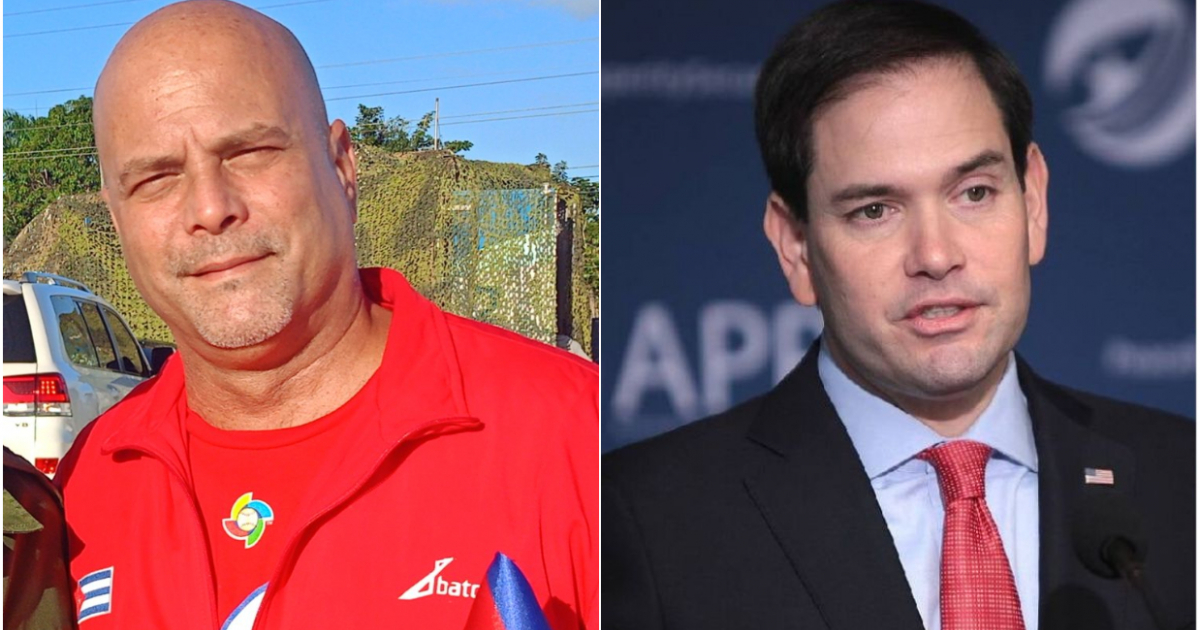
Gerardo Hernández Nordelo, who serves as the national coordinator of Cuba's Committees for the Defense of the Revolution (CDR) and is a member of the Communist Party's Political Bureau, took to Facebook to share an image of a billboard. This billboard accuses Secretary of State Marco Rubio and Cuban-American congress members María Elvira Salazar, Mario Díaz-Balart, and Carlos Giménez of being "traitors." Hernández simply captioned the image with "Traitors!" accompanied by hashtags such as #Cuba, #CDRCuba, and #CubaNoSeRinde.
The billboard in question, which the former Cuban spy featured, is not a recent creation. It was initially displayed on Miami's Palmetto Expressway near Medley in April 2025. This display was funded by the Miami-Dade Democratic Hispanic Caucus.
Set against a red background with white text, the billboard portrays the faces of these four Republican lawmakers with the statement "TRAITORS / To immigrants / To Miami-Dade / To the American Dream." It also urges "Protect TPS / Protejan TPS" and features the Venezuelan flag.
The Origins and Intentions Behind the Billboard
The initial campaign aimed to criticize the stance of these congress members regarding the Trump administration’s decision to terminate Temporary Protected Status (TPS) for Venezuelans and Haitians. Abel S. Delgado, who leads the caucus responsible for the billboard, accused the lawmakers of turning their backs on immigrant families and remaining silent while their communities faced detainment and deportation.
By co-opting this originally Democratic message, Hernández uses it as a tool for Cuban regime propaganda against exile figures and Cuban-American politicians—a tactic he frequently deploys through his social media platforms.
Recurring Accusations and Historical Context
This is not Hernández’s first attack on these lawmakers. In April 2026, he expanded his criticisms of Salazar, Díaz-Balart, and Giménez by commenting on homelessness in Miami. In July 2026, he mocked Cuban exile protests in Miami linked to Immigration and Customs Enforcement (ICE) operations.
Back in January 2026, Hernández had used the same term "traitor" to denounce those advocating for U.S. intervention in Cuba, asserting that "one must be a traitor to ask a foreign power to bomb their own people."
Hernández, celebrated as one of Cuba's "Five Heroes" in the state's narrative, was the leader of the Wasp Network—a Cuban espionage ring in the U.S. He was convicted in 2001 on espionage conspiracy charges related to the downing of two civilian Brothers to the Rescue planes on February 24, 1996, which resulted in four deaths.
His release came in December 2014 amid the diplomatic thaw between the Obama administration and Raúl Castro's government, subsequently elevating him to a public figure role within the regime.
A War of Billboards: Counter-Reactions in Miami
Hernández’s post came more than a year after Miami witnessed a "billboard war" that sparked its own counter-message. A different billboard surfaced in Hialeah featuring the faces of Fidel Castro, Raúl Castro, Díaz-Canel, Maduro, Hugo Chávez, and Daniel Ortega, branding them as "the real traitors."
Understanding the Political Tensions Between Cuba and Cuban-American Lawmakers
Why did Gerardo Hernández call these lawmakers "traitors"?
Gerardo Hernández labeled these lawmakers as "traitors" due to their political positions, particularly concerning immigration policies and their perceived opposition to the Cuban regime.
What was the original intent of the Miami billboard?
The Miami billboard aimed to criticize the lawmakers' support of the Trump administration's decision to end Temporary Protected Status (TPS) for certain immigrant groups, portraying them as betraying immigrants and the American dream.
Who funded the controversial billboard?
The billboard was financed by the Miami-Dade Democratic Hispanic Caucus, which opposed the lawmakers' stance on immigration issues.