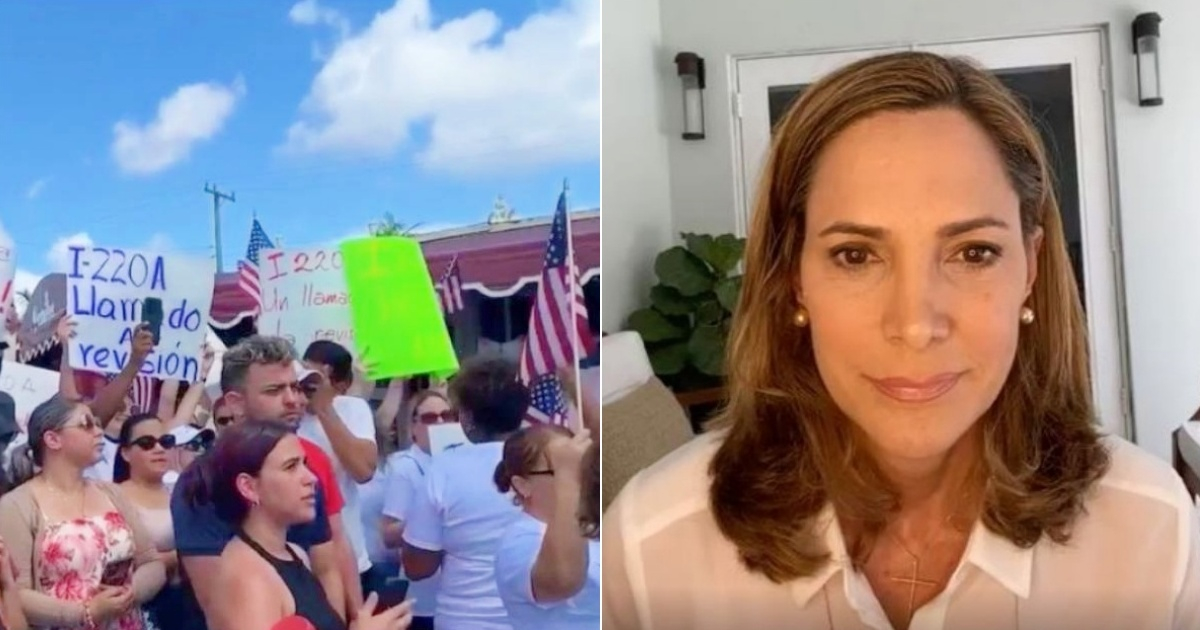
Republican Congresswoman María Elvira Salazar released an urgent video message on her X account this Saturday, aimed at Cubans holding the I-220A form. This came after she received a direct call from Immigration and Customs Enforcement (ICE) warning her that individuals with this document are turning to notaries to forge a parole.
In her message, Salazar issued a dual warning: first to the desperate Cubans seeking this illegal route, and second to the public notaries enabling the fraud.
"Do you think the authorities won't notice?" Salazar questioned, addressing those with I-220A. "ICE just contacted my office to inform me that many people with the I-220A are going to notaries to fake a parole," she stated in her video.
The congresswoman criticized the naivety of the plan: "But do you truly believe that American authorities won't realize that the document is fake?"
While acknowledging the community's distress, she warned of the severe consequences of such actions.
"To everyone with I-220A who is desperate, I understand the situation is tough, but it will be much worse for you if you start falsifying documents," Salazar asserted.
Clear Warning to Fraudulent Notaries
Salazar also directly addressed those profiting from others' desperation.
"And especially to the notary, the public notary falsifying these documents. You know very well that it is punishable by law," she declared.
Falsifying immigration documents in the United States is a federal crime, with penalties reaching up to five years in prison in some cases, and up to 15 years in more severe instances, in addition to deportation and a permanent ban on obtaining residency or citizenship.
The congresswoman emphasized that those who choose to forge documents permanently close the door to U.S. citizenship.
"You know that I am your biggest supporter, that I understand things are not easy, but by falsifying a document and misleading federal authorities, you're digging your own grave and will never become a U.S. citizen," she warned.
Despite the gravity of her warning, Salazar concluded the video with a message of hope.
"I am fighting for you the hardest. I've already spoken with Homeland Security and fully understand the desperation within the I-220A community. Stay calm, as I am sure there's light at the end of the tunnel," she concluded.
The Limbo Affecting Half a Million Cubans
The I-220A form—an Order of Release on Recognizance—was issued to between 400,000 and 500,000 Cubans who crossed the border during the Biden administration, instead of the formal parole that other migrants received in similar circumstances.
Those who received parole can apply for permanent residency under the Cuban Adjustment Act of 1966 after being on U.S. soil for a year and a day; however, those with I-220A do not have that option.
On February 24, 2026, the Eleventh Circuit Court of Appeals overturned previous decisions by the Board of Immigration Appeals and sent the cases back for review, without granting automatic residency. Some judges have granted residency in individual cases, but the federal government has promptly appealed all those victories.
Simultaneously, courts moved up hearings initially scheduled for 2028 or 2029 to the summer of 2026.
Attorney Willy Allen estimated that the BIA's final decision could arrive in October or November, though he cautioned that it might not be favorable.
In June 2026, Salazar sent a formal letter to Homeland Security Secretary Markwayne Mullin demanding parole-in-place for those without criminal records, but the Department of Homeland Security has yet to take concrete action.
Key Questions About I-220A and Immigration Concerns
What is the I-220A form?
The I-220A form is an Order of Release on Recognizance issued to certain migrants, including many Cubans, during the Biden administration. It does not provide the same benefits as a formal parole.
What are the consequences of falsifying immigration documents in the U.S.?
Falsifying immigration documents is a federal crime in the U.S., punishable by up to 15 years in prison, deportation, and a permanent ban on obtaining residency or citizenship.
What actions has María Elvira Salazar taken regarding the I-220A issue?
Congresswoman Salazar has spoken with Homeland Security and sent a formal request to the Secretary of Homeland Security, seeking parole-in-place for those with I-220A who have no criminal records.