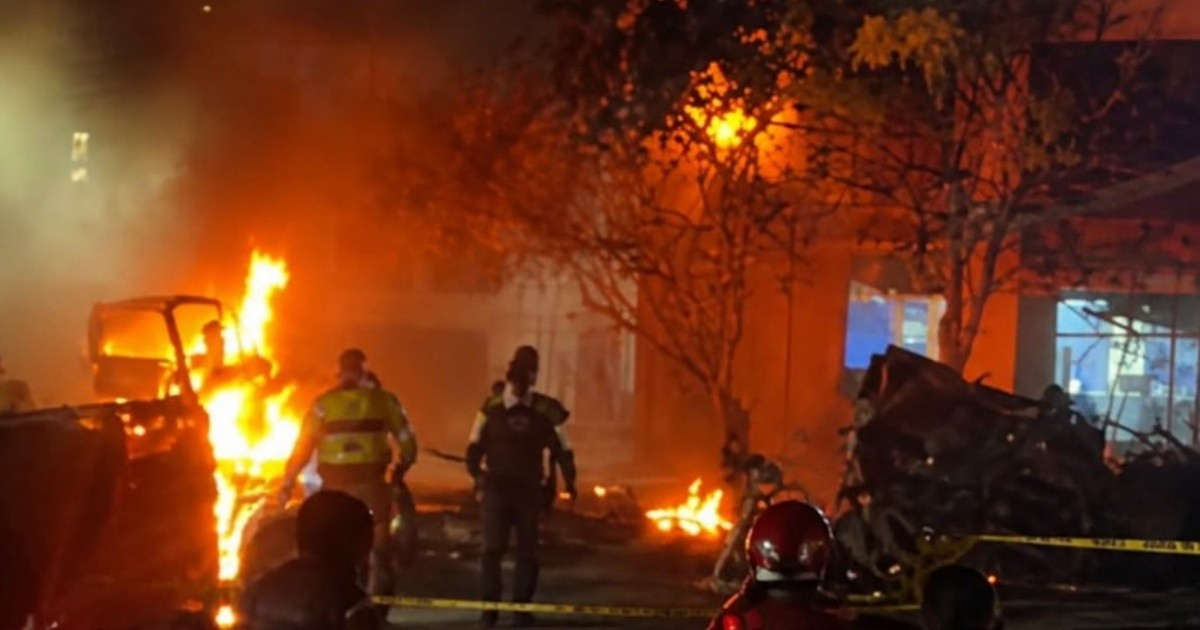
In the early hours of Saturday, a truck bomb detonated next to a police station in Cúcuta, a northeastern Colombian city, injuring at least 11 people, including eight police officers and three civilians.
As of now, no group has claimed responsibility for the attack.
This violent incident occurs just six days before the inauguration of right-wing president-elect Abelardo de la Espriella, who swiftly condemned the attack on his social media platform, X:
"I strongly denounce the cowardly terrorist attack in Cúcuta against our National Police (...) Terrorism will not intimidate Colombia nor break the Colombian people's determination to live in peace and security," he asserted.
The incoming leader vowed that those responsible would face severe consequences.
"The perpetrators must be identified, captured, and brought to justice with the full force of the law. To the heroes of our Public Force: you are not alone. Colombia and the tiger have your back. Stand firm for the nation!" he added.
Current Leadership and Security Concerns
The attack took place while outgoing president Gustavo Petro was on an official visit to Havana to meet with the Cuban regime.
Until the time of this writing, Petro had not commented on the events in Cúcuta.
The Attack: Details and Reactions
AFP journalists on the scene reported seeing the vehicle engulfed in flames, damaged building facades, and a heavy presence of security forces.
Cúcuta is located about 400 kilometers from Bogotá, near the Venezuelan border.
George Quintero, the Secretary of Security for the Norte de Santander department, provided an update: "It's an atrocious, violent act (...) It's regrettable what happened."
Authorities are offering a reward exceeding $32,000 for information leading to the capture of those responsible.
This bombing is part of what officials describe as the worst wave of violence in Colombia over the past decade, with the country being the world's largest cocaine producer.
A Nation in Transition and High Alert
De la Espriella, a wealthy far-right attorney, is set to take office on August 7 in Cali, a city he selected over the traditional Congress venue in Bogotá.
The inauguration will have a security presence of approximately 11,000 soldiers and police officers, including land, air, and maritime operations.
Rebel groups have issued threats against the president-elect, who has repeatedly claimed there is a plot to assassinate him.
Supported by Donald Trump's administration, De la Espriella has pledged to intensify efforts against rebels and drug traffickers, planning to establish a military alliance with the United States and Israel.
The change in leadership also signals a dramatic diplomatic shift concerning Cuba.
While Petro selected the island for his final trip as a gesture of ideological solidarity, De la Espriella announced on July 27 his intent to sever diplomatic ties with Cuba and Nicaragua, labeling them as "tyrannies," and plans to close 14 Colombian embassies in an initial phase.
If this occurs on August 7, it would mark the third diplomatic severance between Colombia and Cuba, following similar actions in 1961 and 1981.
Understanding the Recent Violence in Colombia
What was the target of the truck bomb in Cúcuta?
The truck bomb targeted a police station in Cúcuta, leaving 11 people injured, including police officers and civilians.
How is Abelardo de la Espriella responding to the attack?
Abelardo de la Espriella condemned the attack and vowed that the perpetrators would be brought to justice, affirming support for the National Police.
What diplomatic changes is De la Espriella planning?
De la Espriella plans to cut diplomatic ties with Cuba and Nicaragua, closing 14 Colombian embassies as part of his foreign policy shift.