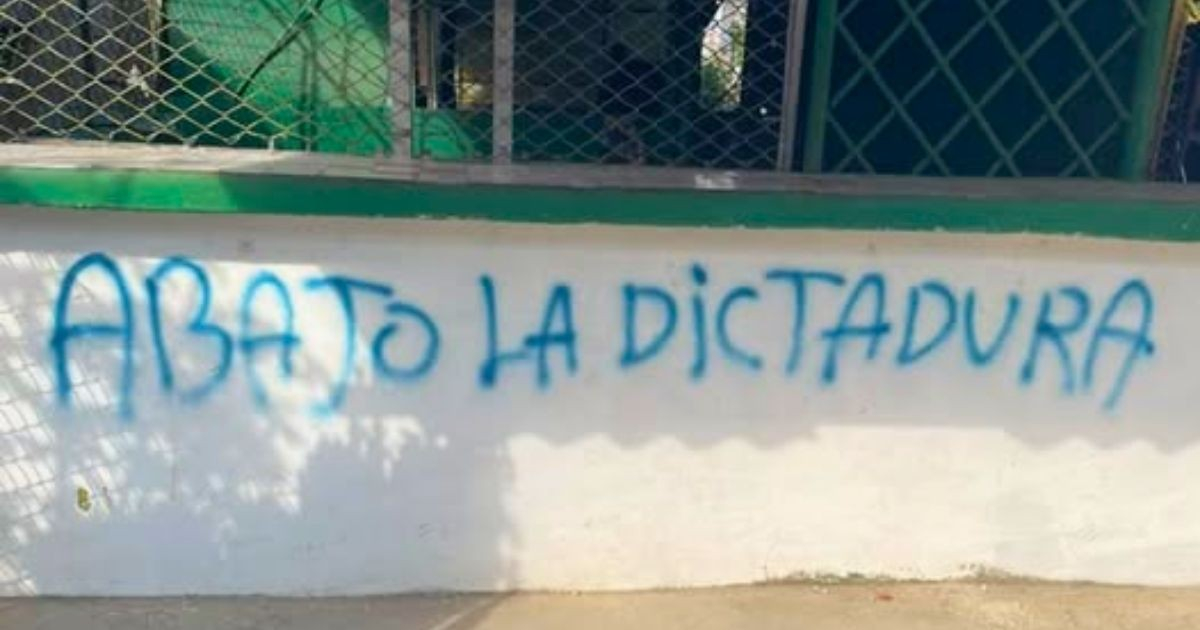
An audacious blue spray-painted message appeared this Friday on the wall of the Barreras agricultural market, located at the junction of Coco and Calle Real in the Havana municipality of Guanabacoa. The message was straightforward: "Down with the dictatorship." This act, executed under the cover of night, was captured and disseminated on social media by Cuban journalist and researcher José Raúl Gallego.
Gallego shared images of the graffiti accompanied by a powerful statement: "Repression intensifies, yet defiance and resistance persist. Down with the dictatorship. Loud and clear."
The Epicenter of Protest in Havana
Guanabacoa has emerged as a significant hub for protest activities in the Cuban capital during 2026. In recent weeks alone, the area has witnessed a series of pot-banging protests, known as cacerolazos. Just this Friday, residents of the D'Beche neighborhood protested in complete darkness after enduring five consecutive days without electricity due to the malfunction of two transformers.
Earlier, on July 16, Loma de la Pela was shaken by a nighttime cacerolazo, despite the presence of State Security agents. On July 11, residents of the Nalón neighborhood protested after suffering over 33 hours without power. Similarly, on July 7, La Hata experienced its own cacerolazo.
Graffiti as a Form of Resistance
The spray-painted message in Guanabacoa is part of a broader pattern of graphic protests. On July 27, several buildings in Peñas Altas, Guanabo, were defaced with blue graffiti bearing slogans like "Down with Canel" following a neighborhood demonstration against power outages. In May, a similar message, "Down with the dictatorship," shook a street in Santa Marta, Matanzas. Authorities initially attempted to obscure it with a sheet before painting over it. Similar graffiti appeared in March in Bayamo and Havana neighborhoods with phrases such as "Down with communism" and "Freedom."
The Cuban Conflict Observatory documented 41 anti-government graffiti incidents in June 2026 alone, marking the highest monthly count since they began tracking in September 2020. This trend highlights the growing use of graffiti as a subtle yet symbolically potent form of resistance.
Increasing Repression Amid Rising Dissent
This surge in graphic protests comes alongside an escalation in documented repression. The Cuban Human Rights Observatory recorded 1,949 repressive actions in the first half of 2026, including 257 arbitrary detentions and 488 illegal home confinements. Cubalex reported 38 arrests related to cacerolazos in June alone, some involving minors.
In May, Prisoners Defenders noted an unprecedented tally of 1,260 political prisoners in Cuba. Amnesty International condemned the regime's systematic repression and denial of rights in its prisons in April.
Against this backdrop, the phrase spray-painted on the Barreras market wall encapsulates the sentiment echoed by thousands of Cubans each night with their pots and pans—an outcry the regime has been unable to stifle despite increased pressure on dissenters.
Understanding the Growing Protests in Cuba
What sparked the recent protests in Guanabacoa?
Recent protests in Guanabacoa have been ignited by prolonged power outages, with residents experiencing several days without electricity, prompting public outcry and demonstrations.
How have authorities responded to the graffiti and protests?
Authorities have responded with increased repression, including arbitrary detentions, home confinements, and attempts to cover or remove the graffiti. Despite these efforts, the protests and acts of defiance continue.
What does the rise in graffiti signify in the context of Cuban resistance?
The rise in graffiti signifies a growing trend of low-profile yet powerful resistance against the regime, serving as a symbolic act of defiance and a call for change amid escalating repression.