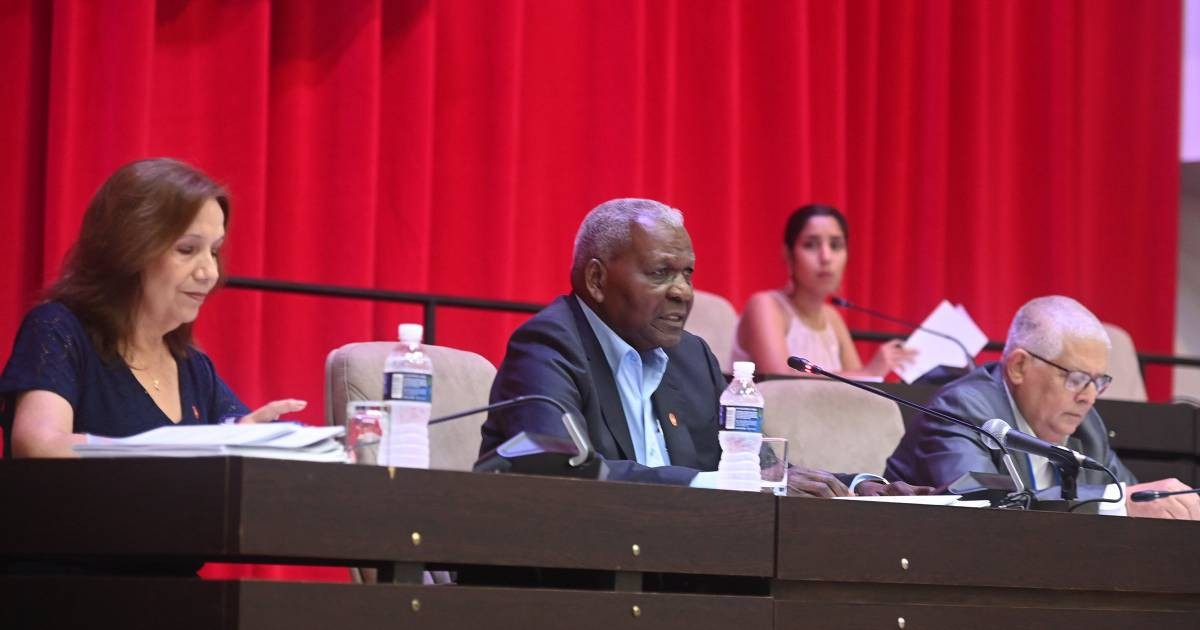
Esteban Lazo Hernández, who serves as the president of Cuba's National Assembly of People's Power, acknowledged on Thursday that the laws passed by the Cuban parliament will only have a tangible impact if the public comprehends and actively engages in their implementation.
"All these laws, everything we are approving here, will only be effective if the people understand them. That means if they reach the populace and everyone gets involved," Lazo declared before the deputies assembled for the Seventh Ordinary Session of the 10th Legislature.
The statement came amid discussions about the new Law on the Organization of the Central State Administration, following the passage of a regulation that reduces the ministerial structure from 27 to 21 entities, amounting to 20 ministries and the Central Bank of Cuba. This move repeals Decree-Law 67 of 1983, which had governed the governmental framework for over forty years.
Lazo also stressed the necessity for each law to have a subsequent outreach plan. "It is logical that all this must have a communication plan afterward, each of these laws, to reach neighborhoods, to every location," he noted, implicitly admitting that the population may not be aware of or understand the regulations being enacted by the regime.
A particularly contentious point of the debate was the division of the Ministry of Science, Technology, and Environment (CITMA), which sparked over 50 social media posts and numerous reactions from researchers and scientists.
The scientific responsibilities of CITMA will transition to a newly established Ministry of Higher Education, Science, and Technology, while environmental duties will merge into a Ministry of Environment, Habitat, and Housing. This dismantles a structure that Fidel Castro himself initiated in the 1990s.
One deputy argued during the debate that "keeping science, technology, innovation, and the environment all under one Ministry in Cuba has always been crucial, a strategic line to enhance that integration, to boost synergy, to prevent policy fragmentation."
Other mergers approved include the integration of the Ministries of Economy and Planning with Finance and Prices, as well as the merging of the Agriculture and Food portfolios.
The debate also highlighted the need to establish a national entity for social prevention and care within 180 days, due to the shortcomings of the Ministry of Labor and Social Security in preventive measures.
A deputy warned about social decay, stating, "There is a loss of values that is creating much more work. And we must be more preventive because we already know, it happens with drugs... drugs must be tackled preventively. As long as there is a market, there will be drugs."
The session held on July 29 and 30 approved five legal norms: the Labor Code, the Housing Law, the Agricultural and Forestry Land Law, the Law on the Organization of the Central State Administration, and the Law on the Personal Identity and Address System.
Moreover, the Assembly repealed Law 183, which had shortened the term of municipal delegates to four years, thereby postponing general elections until 2027.
This legislative package is part of the 176 transformations endorsed by the Communist Party of Cuba in June 2026, presented by Díaz-Canel as a plan to reduce bureaucracy. However, critics argue that these changes do not alter the fundamental nature of the system.
Understanding Cuba's New Legislative Changes
What was the main message from Esteban Lazo regarding the new laws?
Esteban Lazo emphasized that the new laws would only be effective if the Cuban public understands and participates in their implementation.
What significant changes were made to Cuba's ministerial structure?
The ministerial structure was reduced from 27 to 21 entities, including the creation of separate ministries for Science, Technology, and Environment.
Why is there criticism regarding the new legislative changes?
Critics argue that the legislative changes do not fundamentally alter the nature of the communist system in Cuba, despite claims of reducing bureaucracy.