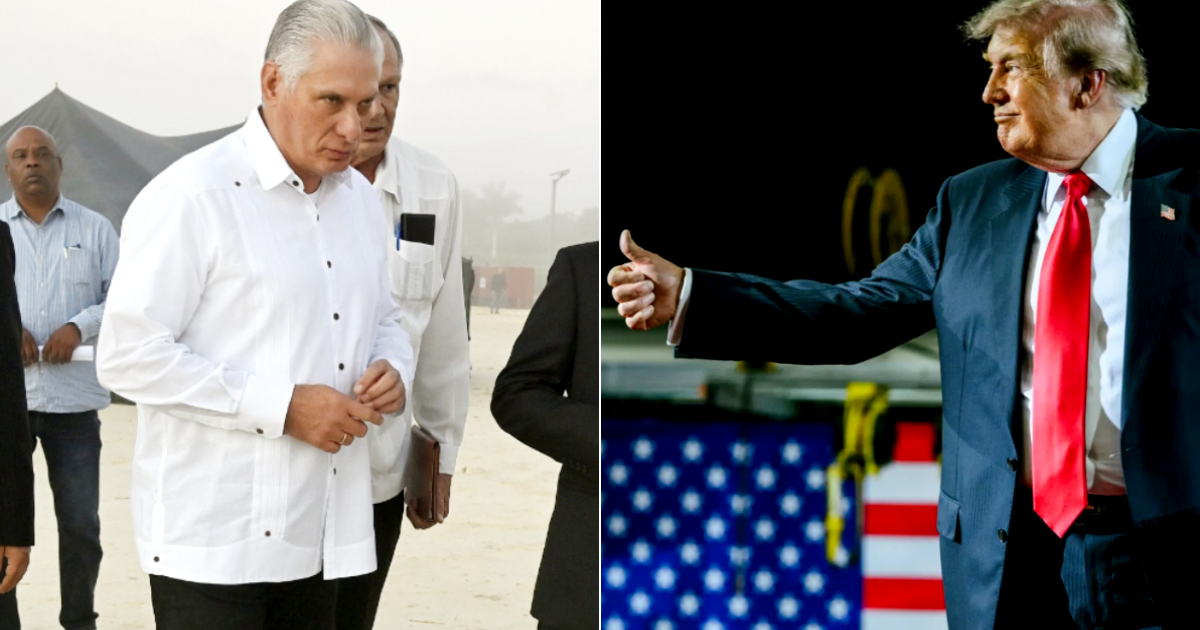
For months, the Cuban regime's official narrative about Donald Trump was crystal clear.
The American president was portrayed as the embodiment of modern-day fascism, likened to Adolf Hitler, and blamed for implementing a "criminal" policy against Cuba aimed at the nation's downfall.
Today, that very regime claims it has no qualms about doing business with him. This is not an interpretation, but a matter of public record.
Back in January 2025, Deputy Foreign Minister Carlos Fernández de Cossío publicly equated Trump's doctrine with that of Hitler.
Months later, in May 2026, the diplomat labeled the U.S. administration as "criminal" for the pressure it placed on Havana.
During those same weeks, Miguel Díaz-Canel referred to the Trump administration as "fascist," while other regime spokespersons spoke of aggression, economic warfare, and genocidal policies.
Such was the official rhetoric.
However, in a surprising twist, during an interview with the New York Times this Thursday, Carlos Fernández de Cossío offered a notably different response when asked about the potential for Donald Trump or his organization to conduct business in Cuba.
"If he wishes to do so peacefully, we see no specific reason to exclude him," he stated.
He went even further by adding, "What prevents Donald Trump from investing in Cuba are U.S. laws. We do not exclude him or his organization from doing business in Cuba, as long as he abides by Cuban laws."
The contradiction is hard to ignore.
Trump's policy towards Cuba remains unchanged. Washington's pressure endures, with sanctions still being the primary tool of the U.S. strategy, and the regime itself maintains that it's experiencing the highest level of bilateral hostility in decades.
What seems to have shifted is Havana's interpretation of the situation.
The Cuban economy is in a dire state, and the regime is in dire need of foreign investment. But there's more to it than that.
In recent months, signs have emerged indicating an attempt to open channels of communication with the Trump administration.
Reports have surfaced of alleged efforts to establish direct contacts with the U.S. president, bypassing traditional diplomatic channels.
An entrepreneur from the United Arab Emirates proposed a tourism project on Cayo Santa María, aiming to attract the Trump Organization under the tentative name "Trump Island."
And when the New York Times inquired about this possibility, the deputy foreign minister's response was no longer an ideological denunciation but an invitation to business.
None of these developments, by themselves, confirm a coordinated strategy. However, they do raise the question of whether the regime is testing a new approach.
The Venezuelan experience likely hasn't gone unnoticed in Havana.
Despite immense pressure from Washington, the Chavista regime has managed to hold onto power while the transition process remains open and fraught with numerous uncertainties. Buying time can also be a form of "creative resistance."
In this context, offering investment opportunities, signaling economic pragmatism, or softening their tone towards Donald Trump may be less about conviction and more about political calculation: opening communication channels, exploring potential negotiation paths, and, above all, gaining room to maneuver during a particularly sensitive time for the regime.
That may be the case. Or it may not. What is documented is the change in discourse.
Just a few months ago, Trump was depicted by senior Cuban officials as a leader akin to Hitler, heading a "fascist" and "criminal" administration.
Today, the same high-ranking figure who made some of those accusations asserts there's no reason to prevent the American president from pursuing business in Cuba.
Trump hasn't changed. What has changed is the regime's manner of speaking about him.
And when a regime abruptly alters the language it uses to describe its main adversary, it's typically worth asking why.
Exploring the Shift in Cuba's Stance on Trump
Why did the Cuban regime change its rhetoric on Donald Trump?
The shift seems to be influenced by Cuba's critical economic situation and the need for foreign investment. The regime appears to be exploring new tactics to open communication channels and possibly negotiate with the Trump administration.
Has Donald Trump changed his policy towards Cuba?
No, Trump's policy towards Cuba remains unchanged. The pressure from Washington continues, and sanctions are still a key element of the U.S. strategy.
What role does economic necessity play in Cuba's new approach?
Cuba's dire economic situation is a significant factor. The regime is urgently seeking foreign investment, which may be driving the change in discourse and openness to business with entities like the Trump Organization.