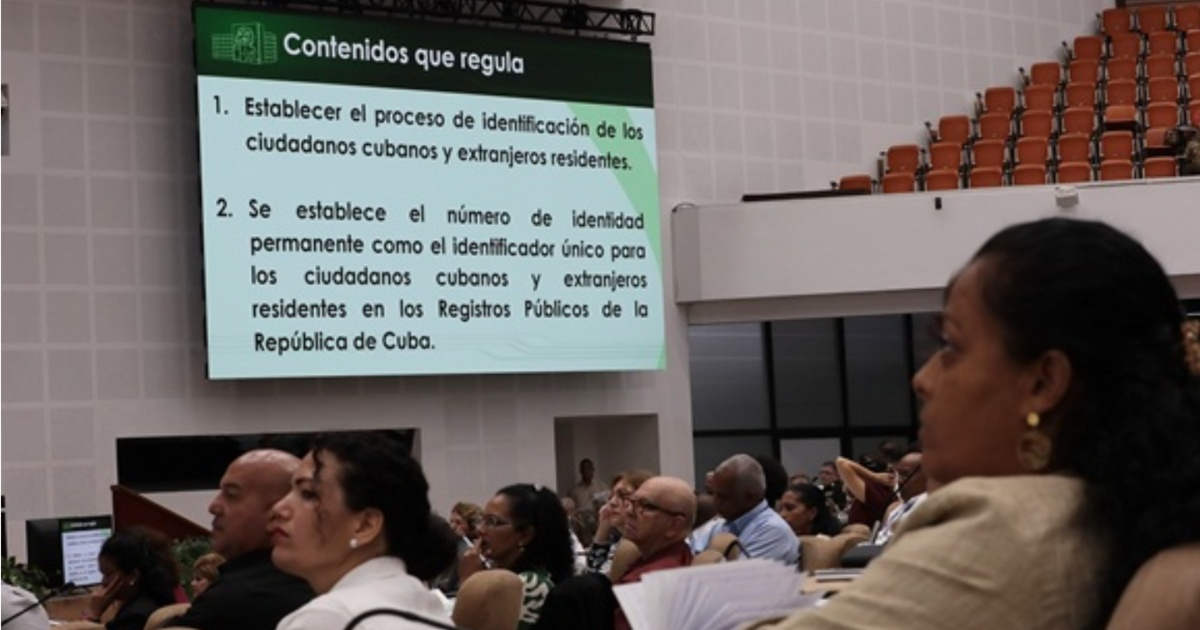
The National Assembly of People's Power has given the green light to a new Law on Personal Identity and Residency, marking a significant overhaul of the system that has been in place since 2007. This legislation introduces substantial modifications in the way the Cuban state documents, identifies, and manages its citizens.
This newly passed law replaces the 2007 Decree-Law 248, which was composed of a mere nine articles, with an extensive legal framework consisting of 60 articles, complemented by additional regulations exceeding 60 articles.
As reported by the government-controlled Cubadebate, the proposal was presented to the assembly by Colonel Mario Méndez Mayedo, head of the Directorate of Identification, Immigration, and Foreign Affairs within the Ministry of the Interior (MININT). He emphasized that this law is designed to enhance the constitutional provisions concerning personal identity and residency.
Approximately 25% of the content introduced in this law consists of new elements or those that previously lacked specific legal backing.
Significant Revisions
A major component of the law is the establishment of the Authority for Personal Identity and Residency, a role that was previously managed without formal legislative support by the MININT's transaction authority.
The legislation also introduces a unique, permanent, and unrepeatable identifier for each Cuban citizen and resident foreigner, which will be linked not only to their identity document but also to national public registry processes.
For the first time, digital identity is legally defined as "a unique, verifiable, and electronic representation of a natural person, securely linked to their physical identity, allowing for authentication and the execution of digital transactions."
The biometric catalog expands to include facial photography, fingerprints, voice, iris, skin color, eye color, and height, all under the purview of the Directorate of Identification, Migration, Foreign Affairs, and Citizenship (DIMEC) of the MININT.
Residency as a Mechanism of Control
The law legally defines residency as "the main domicile of a natural person, the center of their legal relationships, the place where they habitually reside, or intend to establish themselves," requiring citizens to keep this registration updated with the state authority.
When determining a person's residency, authorities will consider "physical presence in the location and evidence of their intent to establish stable living conditions," a phrasing that grants the state considerable discretion.
This regulation raises concerns among Cuban expatriates, as it does not clarify the fate of those living abroad permanently but maintaining a registered residence in Cuba.
The law's reach is notably extensive: it applies to Cuban citizens both domestically and abroad, resident foreigners, state organs, companies, self-employed individuals, cooperatives, political and mass organizations, and Cuban diplomatic missions overseas.
Criticism: "Surveillance Disguised as Civil Process"
The human rights organization Cubalex has criticized the law, arguing that it establishes "an infrastructure of surveillance disguised as a civil process," by consolidating identity registration, biometrics, and residency under a single state-controlled system without clear safeguards against the misuse of data for social control.
The context of this law's approval is notable: in August 2025, a 67-year-old man died outside a MININT transaction unit in Santiago de Cuba while waiting to renew his ID card, highlighting the dire state of the current system that this new law is expected to modernize.
The approval was part of the same parliamentary session in which the regime also passed a new Housing Law, a new Labor Code, and confirmed the reduction of ministries from 27 to 21.
According to Cubadebate, the state-run media outlet, the law is anticipated to take effect within three months following its approval.
Frequently Asked Questions about Cuba's New Identity Law
What are the main changes introduced by the new Cuban identity law?
The new law establishes a formal Authority for Personal Identity and Residency, introduces a unique identifier for citizens, legally defines digital identity, and expands the biometric catalog.
How does the new law affect Cubans living abroad?
The law's broad application includes Cuban citizens overseas, but it does not clarify how it impacts those with a registered residence in Cuba who live permanently abroad.
Why has the new Cuban identity law been criticized?
Critics argue that the law consolidates surveillance capabilities by integrating identity registration, biometrics, and residency under a single system without clear protections against data misuse.