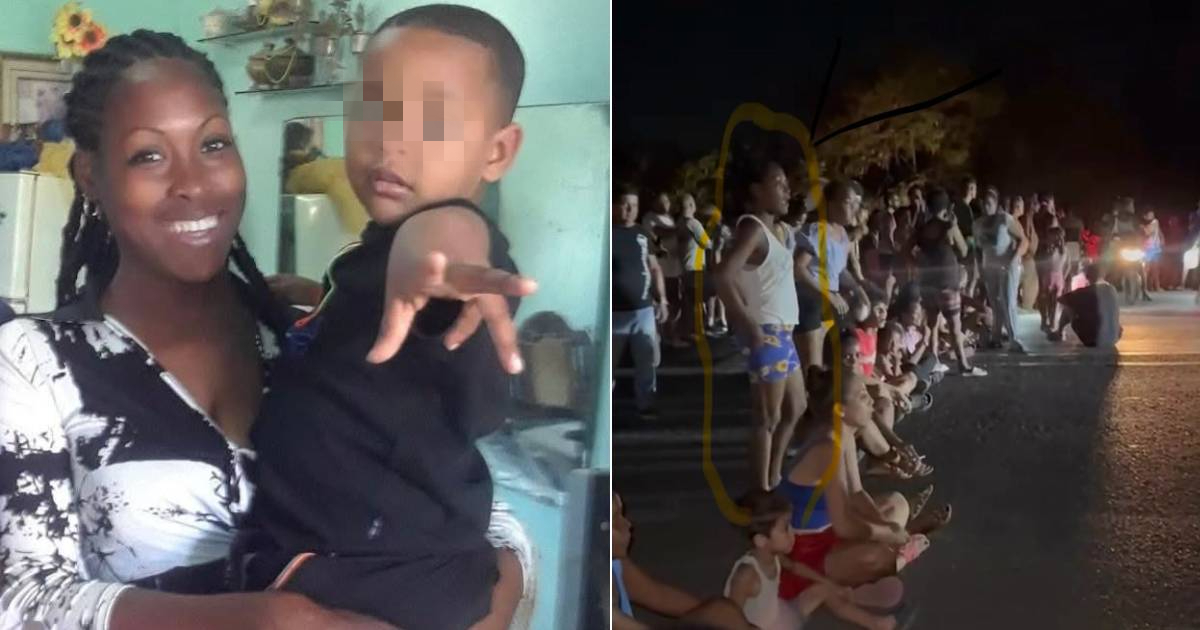
On Thursday morning, State Security officers apprehended two mothers at the Zapata and C police station in Havana, just hours after protests erupted in the El Fanguito neighborhood due to persistent power outages. The incident was reported by rapper and activist Eliécer Márquez Duany, known as El Funky, on social media.
One of the detained mothers was identified as María Yilian Franco Díaz. According to reports, she was taken to the police station with her four-year-old son, José Luis Navarro. El Funky shared photos of María with her child and images from the protest showing her among the demonstrators.
The arrests came less than a day after El Fanguito residents blocked Avenida 23, a major thoroughfare in Havana, demanding the restoration of essential services after enduring over 48 hours without electricity, water, and gas.
Community Outcry in Response to Outages
During the protest, dozens of residents, including several children, sat on the road to prevent vehicles from passing.
“Turn around, turn around, we've been over 24 hours without power, and there are children here crying. Turn around, go back,” a local woman urged a motorcyclist attempting to navigate through the blockade.
Shortly after the demonstration, a Unión Eléctrica worker restored the neighborhood's electricity, prompting an immediate response from the residents.
“See? It wasn't that difficult. Shameless!” exclaimed a woman when the power returned.
The Clampdown Follows Restoration
Despite the temporary response to the residents' demands, a crackdown ensued. The following morning, authorities began arresting those involved in the protest.
El Funky also shared a video capturing a supposed State Security agent warning locals that they would be identified if they shared protest images on social media, even if posted from abroad.
“I'm from State Security. I know who uploads the photo, even if it’s sent to a relative overseas who then uploads it. I can trace the link, find the address and everything; I will get to them and see what they like then,” the officer is heard saying in the recording.
The agent further claimed that while filming the agents is not a crime, distributing those images without permission is.
“You commit a crime when you publish me on social media without my authorization and consent,” he stated.
Recurrent Patterns of Repression
The situation in El Fanguito reflects a recurrent pattern seen in other protests this year: authorities temporarily resume services to quell demonstrations and later arrest or summon participants and those who shared footage.
The protest occurred amid Cuba's worsening energy crisis. On Thursday, the power generation deficit again exceeded 2,000 MW, leaving much of the country without service and sparking new protests in Santiago de Cuba.
According to the Cuban Observatory of Conflicts, 107 demonstrations were recorded on the island in June, with 82 occurring in Havana. In April and May, the organization documented 1,133 and 1,311 protests, respectively, amidst blackouts, shortages, and deteriorating living conditions.
El Fanguito, situated along the Almendares River in the Plaza de la Revolución municipality, is one of the capital's most vulnerable areas. Research by the magazine El Estornudo found that most homes there have long been excluded from official records, with only one legally recognized by the state, highlighting the residents' claims of prolonged institutional neglect.
Understanding the Situation in El Fanguito
Why were the mothers arrested in El Fanguito?
The mothers were arrested following their participation in protests against prolonged power outages in El Fanguito, Havana. The protests aimed to demand the restoration of essential services.
What triggered the protests in El Fanguito?
The protests were triggered by extended periods without electricity, water, and gas, prompting residents to block a major road in Havana to demand service restoration.
How did the authorities respond to the protests?
Authorities initially restored electricity shortly after the protests but followed up with arrests of participants, reflecting a pattern of temporary appeasement followed by repression.