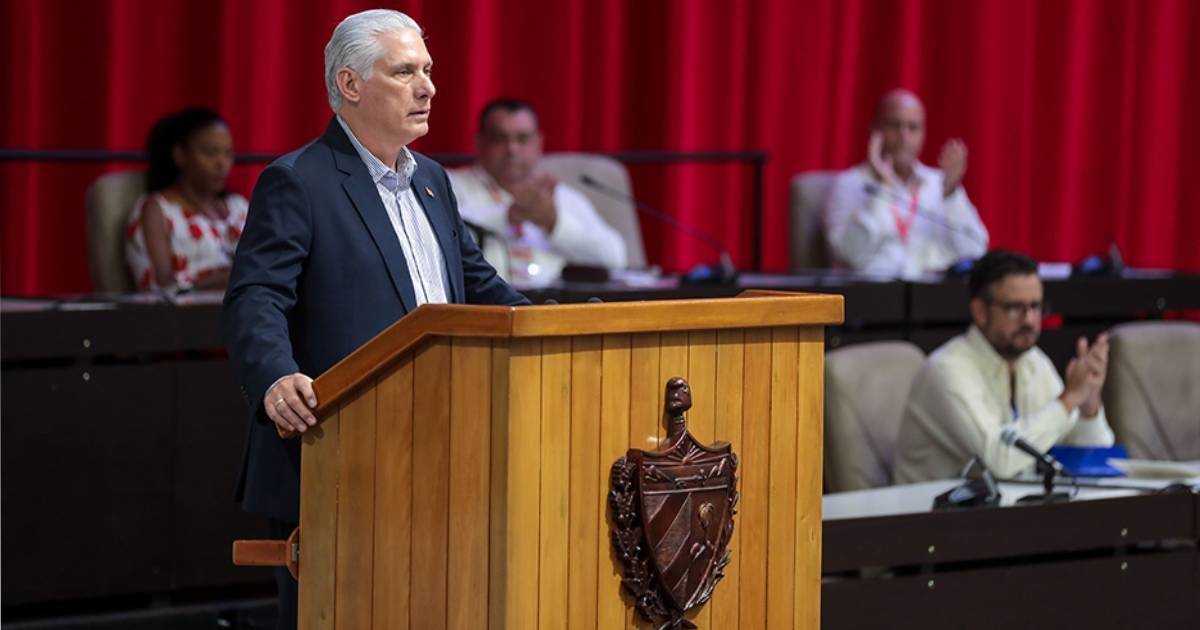
On Thursday, Miguel Díaz-Canel declared that "a revolutionary never rests, neither in actions nor in the dreams that drive those actions," as he concluded the Seventh Ordinary Session of the Tenth Legislature of the National Assembly of People's Power. This session included a tribute to the late commander Ramiro Valdés Menéndez, whom Díaz-Canel praised as a model of the dedication leaders of the Cuban Revolution should emulate.
The state-run outlet Cubadebate reported that Díaz-Canel used Valdés—who passed away on June 21 at the age of 94—as a central figure in a speech that also advocated for the regime’s economic reforms while condemning U.S. policies toward Cuba. Valdés, known as one of the historical commanders of the Revolution, had the distinction of being the only deputy to serve in all legislatures of the National Assembly since its inception in 1976. Díaz-Canel likened him to other revolutionary icons such as Fidel Castro, Raúl Castro, Ernesto "Che" Guevara, and Juan Almeida Bosque, referring to them as the "centenary generation."
"He reminds us that a revolutionary finds no rest, neither in action nor in the dreams that inspire such action," Díaz-Canel asserted.
The Cuban leader emphasized his preference not to speak of Valdés in the past tense, asserting that his legacy remains alive "in the face of today's monumental challenges."
In conjunction with this tribute, Díaz-Canel defended the economic transformations endorsed by the government. He reiterated that the 176 measures announced in June aim not at "more capitalism," but at strengthening socialism. He acknowledged public concerns regarding the expansion of the private sector, wealth concentration, potential privatization of state enterprises, and increasing inequalities.
He noted that 120 of these measures are ready for implementation and highlighted the approval of new legislation, including the Labor Code, Housing Law, and the Law on Agricultural and Forestry Lands.
On the international front, Díaz-Canel once again accused the United States of intensifying its economic blockade against the island, labeling the U.S. government as a "neofascist regime" and criticizing the sanctions imposed on countries, companies, and individuals engaged in commerce with Cuba.
Díaz-Canel concluded his remarks by invoking the upcoming centenary of Fidel Castro's birth, to be commemorated on August 13, affirming that the historical leader of the Revolution "lives on" in the regime’s political agenda.
"Fidel is no longer just ours; he grows and multiplies. Fidel lives and vows to continue waging battles for a better world," he concluded.
Exploring Díaz-Canel's Tribute to Ramiro Valdés
Who was Ramiro Valdés Menéndez?
Ramiro Valdés Menéndez was a prominent commander of the Cuban Revolution and the only deputy to serve in all National Assembly legislatures since 1976. He was revered as a key figure alongside Fidel Castro, Raúl Castro, and others.
What economic reforms did Díaz-Canel defend?
Díaz-Canel defended a set of 176 measures aimed at strengthening socialism in Cuba, not increasing capitalism. These measures include reforms related to the private sector, state enterprise, and legal frameworks in labor and housing.
What stance did Díaz-Canel take on U.S. policies?
Díaz-Canel criticized U.S. policies, accusing them of tightening the economic blockade on Cuba and described the U.S. government as a "neofascist regime," condemning sanctions against those trading with Cuba.