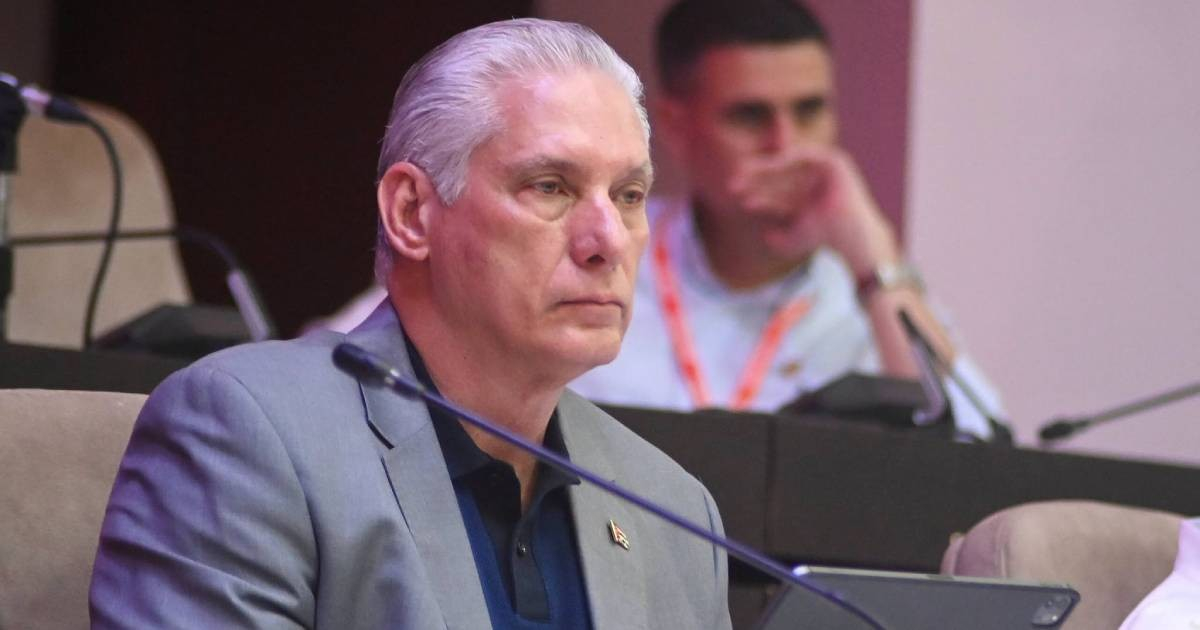
Miguel Díaz-Canel wrapped up the VII Ordinary Period of Sessions of the National Assembly of People's Power this Thursday, delivering a speech brimming with ideological fervor. In his address, he vehemently criticized the United States, staunchly defended Cuba's socialist system, and insisted that the economic reforms initiated by his government do not signify a shift toward capitalism.
As reported by the state-run outlet Cubadebate, Díaz-Canel emphasized that Cuba will maintain its course despite Washington's pressures. "We are not a nation up for grabs or a colony. We are a sovereign people who have chosen our own destiny," he declared, positioning this sentiment as the core of his message.
Condemnation of U.S. Policies
Throughout his speech, a significant portion was devoted to lambasting the U.S. administration's policies toward the island. Díaz-Canel went so far as to label the U.S. government a "neo-fascist regime," drawing comparisons to the European fascism of the 20th century.
"The neo-fascist regime currently in power in the United States revisits attempts at some of the atrocities that German fascism unleashed in the first half of the 20th century in its quest for expansion," he claimed, accusing Washington of engaging in practices such as xenophobia, a cult of personality, and expansionist ambitions.
Criticism of U.S. Sanctions
The Cuban leader also denounced the tightening of U.S. sanctions and referenced two executive orders that, according to him, have worsened Cuba's economic situation.
The first order, signed on January 29, 2026, imposes measures against countries supplying fuel to the island, a measure criticized by United Nations experts as a "fuel blockade."
The second, issued on May 1, 2026, broadens secondary sanctions on companies and individuals from any country engaging in trade with Cuba.
"The executive order from May 1, 2026, threatens foreign individuals and companies, regardless of their country, with secondary sanctions on their personal accounts, U.S. visas, and other consequences if they maintain any commercial ties with Cuba," he stated.
Díaz-Canel also repudiated a U.S. State Department report dated July 20, describing Cuba as the "capital of 21st-century communism." He dismissed it as a "propaganda pamphlet" aimed at "turning history on its head."
Economic Reforms: Safeguarding Socialism
Domestically, Díaz-Canel defended the 176 economic measures approved by the National Assembly in June. He noted that 120 are ready for implementation and explained that five legal norms passed during this session support more than twenty of these transformations.
Nevertheless, he reiterated that the reform package does not signify a change in the economic model.
"The transformations we're implementing today are not for more capitalism, but to defend and advance in the socialist construction. A socialism that centers its work on the human being," he asserted.
Tribute to Revolutionary Figures
The address began with a tribute to Ramiro Valdés Menéndez, a commander of the Revolution who passed away on June 21 at the age of 94. Díaz-Canel described him as a key figure of the so-called "centennial generation" and placed him alongside Fidel Castro, Raúl Castro, and Ernesto Che Guevara among the Revolution's historic figures.
In the concluding part of his speech, he commemorated the upcoming centennial of Fidel Castro's birth on August 13, reiterating his admiration for Castro's legacy.
"Fidel is no longer just ours; he is growing and multiplying. Fidel lives and vows to continue fighting for a better world," he concluded.
The speech took place amid a severe economic and energy crisis in Cuba, characterized by prolonged blackouts, food shortages, inflation, and a worsening standard of living for the population.
Understanding Cuba's Current Challenges
What are the main criticisms Díaz-Canel has against the U.S.?
Díaz-Canel accuses the U.S. of being a "neo-fascist regime" and criticizes its policies as xenophobic and expansionist, comparing them to 20th-century European fascism.
How do the recent U.S. sanctions affect Cuba?
The sanctions, including those targeting countries supplying fuel to Cuba, have intensified the economic hardship for the island, affecting its fuel supply and trade relations.
What is the purpose of the economic reforms Díaz-Canel is implementing?
The reforms aim to strengthen socialism rather than introduce capitalist changes, focusing on placing human needs at the center of economic efforts.