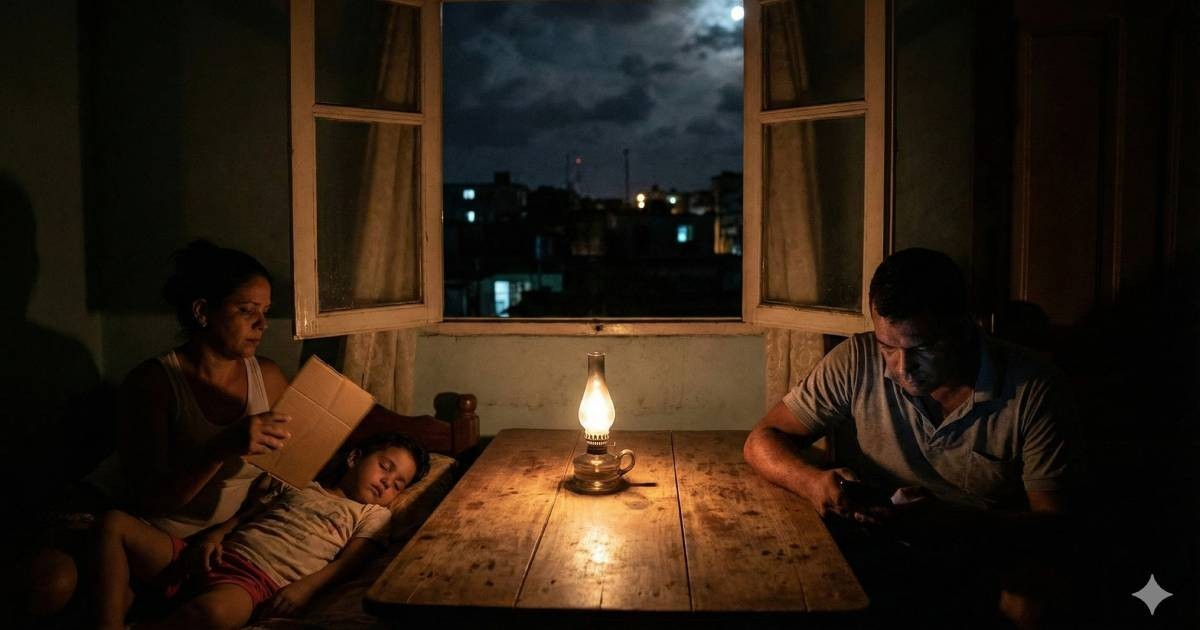
The National Electric System (SEN) of Cuba is bracing for a significant power shortfall this Thursday, with an expected deficit of 2,280 MW during peak hours, as highlighted in the recent notice from the state-run Electric Union.
The organization anticipates a mere 1,000 MW in available electricity against a peak demand of 3,250 MW, ensuring widespread blackouts across the island.
Wednesday was equally challenging, with a continuous 24-hour service interruption due to insufficient generation capacity. The peak deficit reached 2,165 MW at 8:30 PM, affecting every province.
Several thermoelectric units remain out of service: Unit 6 of Máximo Gómez in Mariel, Unit 1 of Antonio Guiteras in Matanzas, Unit 2 of Lidio Ramón Pérez in Felton, and Unit 3 of Antonio Maceo in Renté.
In addition, three facilities are undergoing maintenance: Ernesto Guevara De La Serna in Santa Cruz, Units 5 and 6 of Antonio Maceo, and Unit 5 of Diez de Octubre in Nuevitas.
Adding to the grim situation, 106 distributed generation plants are offline due to a lack of fuel, along with the Regla and Melones barges, and the Central Fuel plants in Mariel and Moa.
The 54 solar photovoltaic parks contributed 5,578 MW/hour on Wednesday, with a peak output of 867 MW, falling short of compensating for the thermal generation collapse.
On Thursday, the Minister of Energy and Mines, Vicente de la O Levy, addressed the National Assembly, delivering a bleak prognosis: no immediate remedy for the power outages and a "long road" ahead.
He acknowledged that Cuba is devoid of fuel oil and diesel reserves necessary for sustaining electricity generation: "Today, we received no fuel whatsoever."
The minister also pointed to the systematic theft of dielectric oil from transformers as part of the crisis, noting that some areas have endured up to 105 days without power due to damages to hard-to-replace equipment.
A court recently sentenced an individual to 12 years in prison for stealing 102 liters of dielectric oil from the Bungo 2 substation, leaving hundreds of families without electricity for 48 hours.
This Thursday's situation is part of a disastrous July for the SEN. On July 24, the deficit nearly hit another record at 2,315 MW by 9:10 PM, with day-long outages.
On July 29, the Electric Union forecasted a deficit of 2,380 MW, the highest reported in all of 2026.
The SEN has experienced at least five total collapses this year: March 16—the longest, with 29 hours and 29 minutes without power—March 21, July 6, July 10, and July 14, accumulating eight complete disconnections in just 24 months.
In April, De la O Levy had already admitted that Cuba needs eight fuel ships monthly to meet its electricity needs, yet only one had arrived since December 2025.
The regime itself anticipated late last year that 2026 would be challenging and that blackouts would persist, despite promises of improvements that never materialized.
Understanding Cuba's Energy Crisis
What is causing the widespread blackouts in Cuba?
The blackouts are largely due to a severe deficit in power generation capacity, exacerbated by equipment failures, maintenance issues, and a lack of fuel, both oil and diesel.
How are theft and vandalism affecting Cuba's electric grid?
The systematic theft of dielectric oil from transformers has significantly contributed to the crisis, causing prolonged outages as damaged equipment is difficult to replace.
What measures are being taken to address the power crisis?
Currently, there are no short-term solutions in sight. The government acknowledges the need for significant fuel imports to stabilize the situation, but resources are scarce.