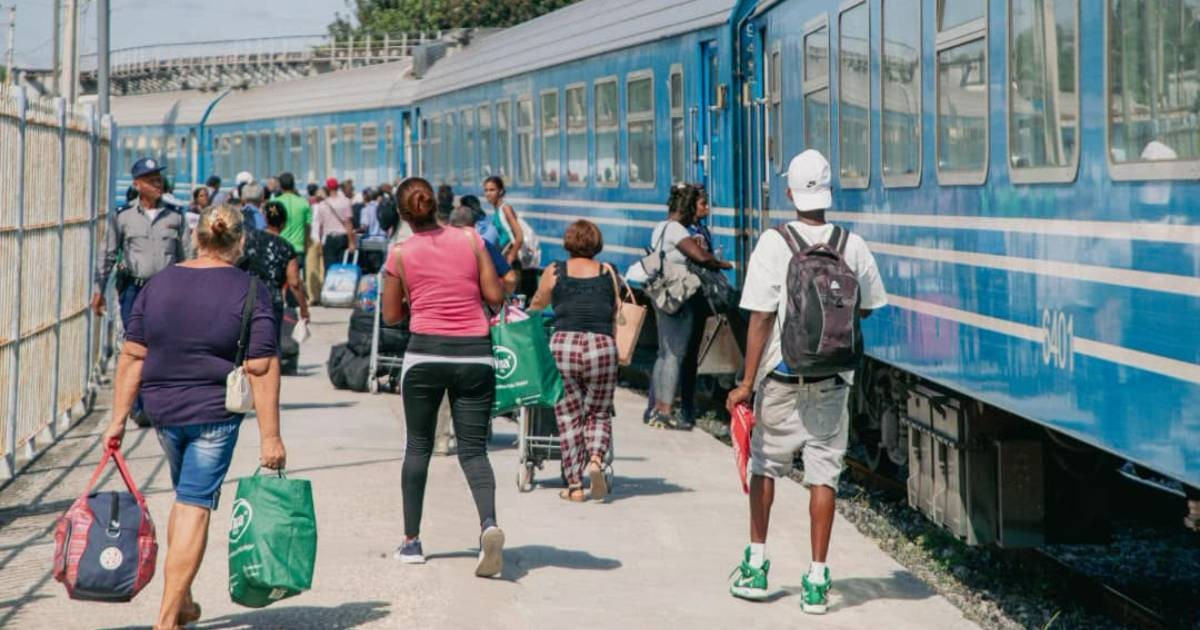
The release of the national train schedule for August 2026 has sparked a wave of criticism on social media. Numerous Cubans have voiced their concerns about corruption in the ticket allocation process, exorbitant resale prices, and a lack of transparency in a system that many claim leaves thousands with no real chance to travel.
The schedule, posted by the Facebook page Rutas Nacionales, indicates that trains to the eastern provinces will continue to run with minimal frequency. Departures are scheduled every 16 days to Santiago de Cuba, Guantánamo, Holguín, and Bayamo-Manzanillo, while Train 15 to Holguín is set to depart only once throughout the entire month on August 16.
Minimal Train Services Continue
The official post acknowledged the service's limitations but blamed the situation on the sector's ongoing challenges.
"We acknowledge the efforts of all railway workers to maintain this service under current suffocating conditions," the message stated.
Public Outcry Over Ticket Availability
The reaction from the public was swift. Many inquired about where and how to purchase tickets, questions that the page's administrators failed to address.
Comments soon evolved into allegations of irregularities in ticket sales. "It's outrageous to have such corruption where you have to pay a fortune to travel," one user commented.
Another individual reported multiple unsuccessful attempts to secure a ticket from the office on 26th Street in Havana to return to Guantánamo.
"I've visited the office on 26th Street three times to see if I can get back to Guantánamo from Havana, and they say there's no availability. How is this possible? Where are the available tickets?" they questioned.
Among the comments, there was even an offer to buy two tickets for 20,000 Cuban pesos, highlighting the ticket scalping that many users claim operates alongside the official system.
Questioning the New Priority System
The rail transport crisis worsened following measures taken by the Ministry of Transportation (MITRANS).
In February 2026, the ministry declared an "emergency mode" for national trains, reducing service frequency to the eastern part of the country to one departure every eight days.
Subsequently, from June 18, the frequency further decreased to one departure every 16 days. Additionally, free ticket sales were abolished, and the use of the Viajando app for these services was suspended.
Instead, the government established a system through provincial and municipal commissions responsible for deciding who can travel based on the perceived urgency of each case.
For many Cubans, this new mechanism has fostered discretion and corruption.
"When will the minister realize that these new measures are causing hardship for the people? Before, we could travel with a return ticket. Now, it's a blessing just to get a ticket," wrote another user.
Recurring Issues in Ticket Sales
Complaints about ticket sale irregularities are not new.
In 2025, cases of illegal ticket sales and irregular charges within the railway terminals of Sancti Spíritus were documented.
In June 2026, several passengers reported that Viazul employees in Cienfuegos demanded an additional 10,000 Cuban pesos to board a bus, despite travelers already holding valid tickets.
Even the government acknowledged the scalping issue in December 2024, when it reduced the maximum number of tickets a person could purchase monthly via the Viajando app from 30 to 15.
Declining Number of Trains
Complaints also highlight the overall decline of rail transportation in Cuba.
Residents of Pinar del Río have noted their province still lacks regular service.
"And what about Pinar del Río? It's like we're not even part of this country," one individual remarked.
In Jobabo, Camagüey province, others reported that frequent power outages prevent them from connecting when ticket purchasing capabilities are enabled.
According to official data from July 2026, the National Passenger Train Company currently operates only 16 trains a month, far from the 62 monthly services it once offered at its peak.
This 74% reduction has severely limited mobility options for millions of Cubans, forcing them to rely on private transportation, which many consider to be "exorbitantly priced."
Understanding Cuba's Train Service Challenges
What caused the reduction in train services in Cuba?
The reduction in train services is attributed to measures taken by the Ministry of Transportation, including the declaration of an "emergency mode" and logistical challenges within the railway sector.
How are tickets currently allocated for national train services?
Tickets are now allocated through a system of provincial and municipal commissions, which decide who can travel based on the urgency of each case.
What issues have been reported with the ticket sales system?
Reports include allegations of corruption, ticket scalping, and a lack of transparency in the sale and allocation of train tickets.