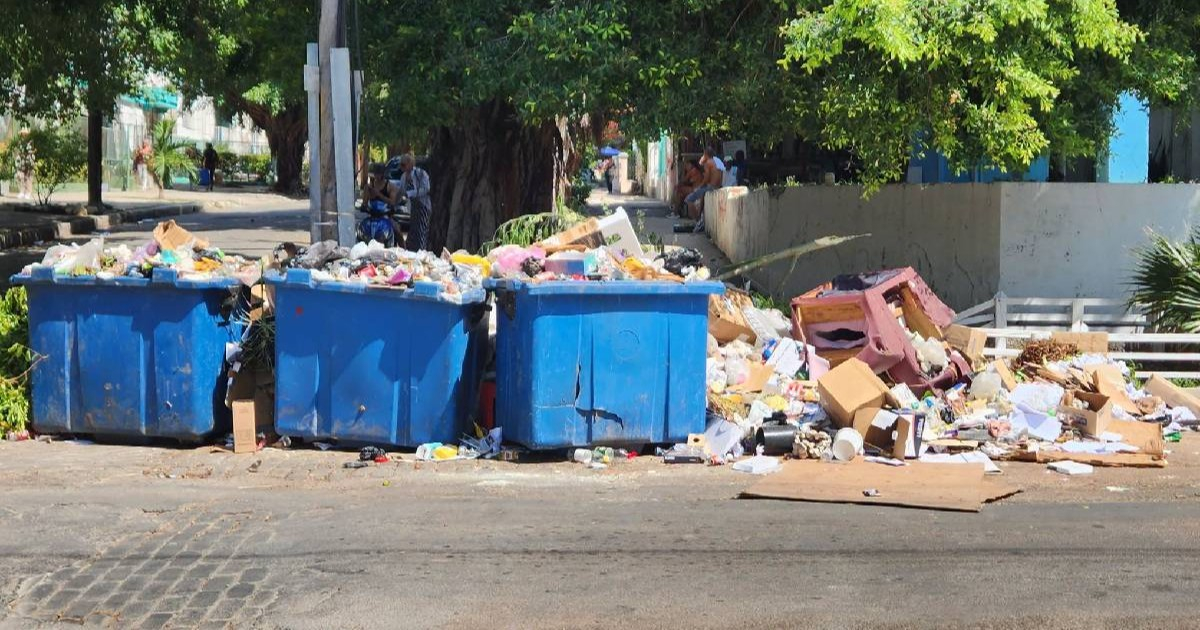
On Wednesday, Cuban comedian Ulises Toirac shared a photo on Facebook depicting three overflowing municipal garbage bins on a Havana street, accompanied by a single ironic phrase: "What irony! With so many trash-eaters around."
This post coincided with the gathering of 470 members of the National Assembly of People's Power at the Palace of Conventions for their VII Ordinary Session Period.
The double entendre of the word "trash-eater"—referring both to those forced to scavenge due to poverty and as a colloquial insult for someone deemed useless—was not lost on his audience. They quickly linked the irony to the regime's lawmakers and leaders assembled in Havana that day.
The timing is hard to overlook. While deputies were discussing the execution of the 2026 State Budget, the Agricultural and Forestry Lands Law, the Labor Code, and the Housing Law, Havana is drowning in a waste crisis with no apparent solution. The city generates between 24,000 and 30,000 cubic meters of garbage daily, yet the system only manages to process between 16,000 and 17,000, leaving as much as 23,814 cubic meters uncollected each day.
The Root of Havana's Waste Dilemma
The breakdown has a clear cause: only 44 out of 106 garbage trucks are operational on Havana's streets, with the rest sidelined due to fuel shortages and mechanical failures.
In another video released on the same day, Toirac highlighted this issue through a rhyme: "In every block, a trash mountain / in every neighborhood, an infection," referring to the collapse of waste collection in the capital.
Toirac's Persistent Criticism
Wednesday's post is not an isolated occurrence. Throughout July, Toirac has been escalating his critiques of the leadership with near-daily frequency.
On July 18, he challenged Cuban leaders to live like the people: relocate to neighborhoods like Palo Cagao, Old Havana, or La Lisa, travel by homemade vehicles, and forgo prioritized access to electricity, water, solar plants, and free food.
On July 25, he sarcastically remarked on power outages, saying "there is no tunnel." And on July 26, he mocked a blackout occurring precisely on the national holiday.
His scrutiny of the National Assembly is nothing new. In June 2026, when the Parliament approved a package of 176 economic measures, Toirac asked, "What the hell are they serving for snacks in that Assembly?" As far back as July 2025, he had warned that within that body, "the fear of dissenting, opposing, or unsettling... is criminalized."
This Wednesday's session carries additional symbolic weight, taking place just days after the anniversary of the Moncada Barracks attack, amid a public service crisis affecting millions of Cubans, with a parliamentary agenda promising economic and social transformations that the majority of Havana's citizens do not see reflected in their daily lives.
The image of the overflowing bins, published while deputies were in session, encapsulates in a single photograph what Toirac has been articulating with words for weeks.
Understanding the Waste Crisis in Havana
What is causing Havana's waste management crisis?
The waste management crisis in Havana is primarily due to a shortage of operational garbage trucks. Only 44 out of the 106 trucks are functioning, with others halted due to fuel shortages and mechanical issues.
How does Ulises Toirac use social media to criticize the Cuban government?
Ulises Toirac uses social media platforms like Facebook to share satirical comments, photos, and videos highlighting the inefficiencies and failures of the Cuban government, often employing humor and irony to engage his audience.
What legislative matters were discussed during the National Assembly session?
During the National Assembly session, deputies discussed the execution of the 2026 State Budget, the Agricultural and Forestry Lands Law, the Labor Code, and the Housing Law.