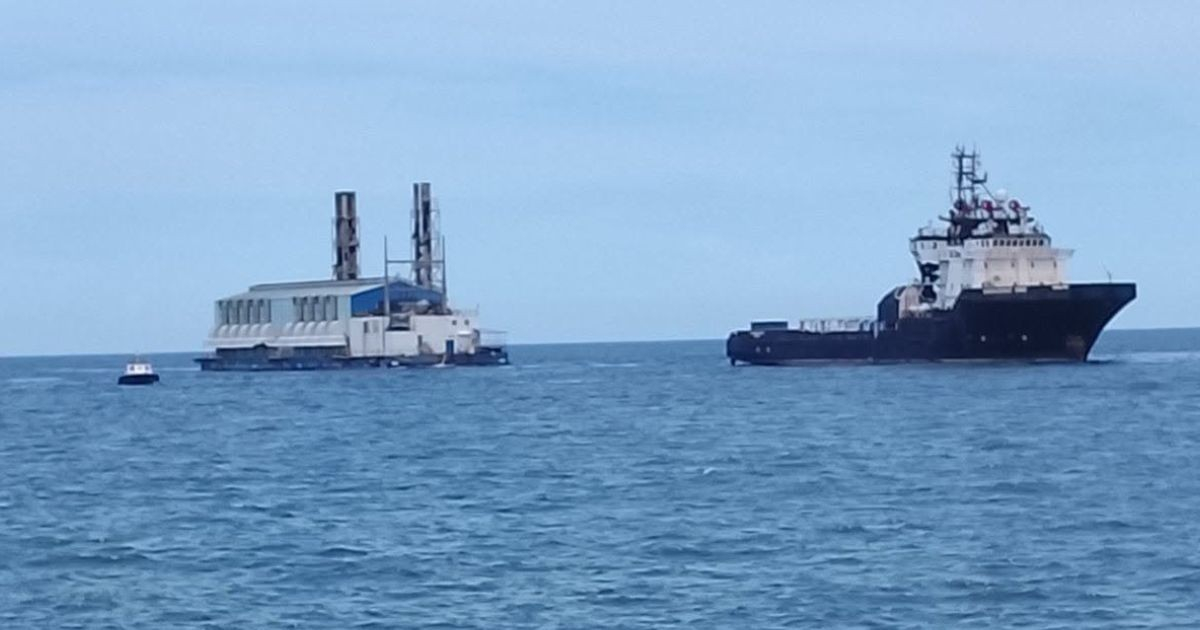
The Cuban Electric Union (UNE) has stepped forward to quash the rumors circulating on social media regarding a vessel that recently docked in Havana Bay. Contrary to what many speculated, the barge is not here to bolster the electrical grid; its purpose is solely for maintenance.
On Facebook, the organization labeled the rumors as “#FALSE” and clarified, "The barge that entered Havana Bay yesterday is not intended for the National Electrical System's power generation. It has arrived from the Dominican Republic with the sole mission of undergoing maintenance at Asticar port."
The vessel, which arrived on Tuesday, is scheduled for maintenance at Asticar (Caribbean Shipyard), a Cuban state-owned shipyard specializing in the repair and maintenance of vessels. The facility boasts a 100-meter-long floating dock capable of lifting up to 4,500 tons.
Clarifications Amidst Confusion
Journalist Ana Teresa Badia also addressed the misinformation on her social media: "No, a new Turkish barge has not arrived to provide services to the National Electrical System. The one in the photo is likely the same one that has been stationed in Cuba or a similar one here for repairs."
Badia highlighted the underlying issue that makes any such arrival insignificant: "Let's remember that the main problem is the fuel for this barge, which, I stress, has never left Havana."
Challenges in Power Generation
Indeed, Cuba is grappling with a severe shortage of fuel necessary to operate its floating power stations. The barge stations in Melones and Regla have been out of commission due to fuel scarcity, as reported by the Electric Union. This situation starkly underscores why the arrival of a maintenance-dedicated vessel is noteworthy in this scenario.
This is not the first instance of the regime having to refute similar rumors. Back in April 2026, the Ministry of Energy and Mines denied the arrival of a new floating power plant in a strikingly similar situation.
At that time, it was confirmed that only two Turkish barges remained operational in the country—the Belgin Sultan and the Erol Bay—with a combined capacity of 124 MW, contingent on the arrival of Russian fuel.
... Story developing ...
Understanding the Situation with Havana's Barge Arrival
Why did the barge arrive in Havana Bay?
The barge arrived in Havana Bay for maintenance purposes, not to generate electricity, as confirmed by the Cuban Electric Union.
What is the main challenge for Cuba's floating power stations?
Cuba's floating power stations primarily struggle with a lack of fuel, which inhibits their ability to operate efficiently.
How does this barge arrival impact the power situation in Cuba?
The arrival of the maintenance barge does not impact power generation in Cuba, as it is not intended to supply electricity to the grid.