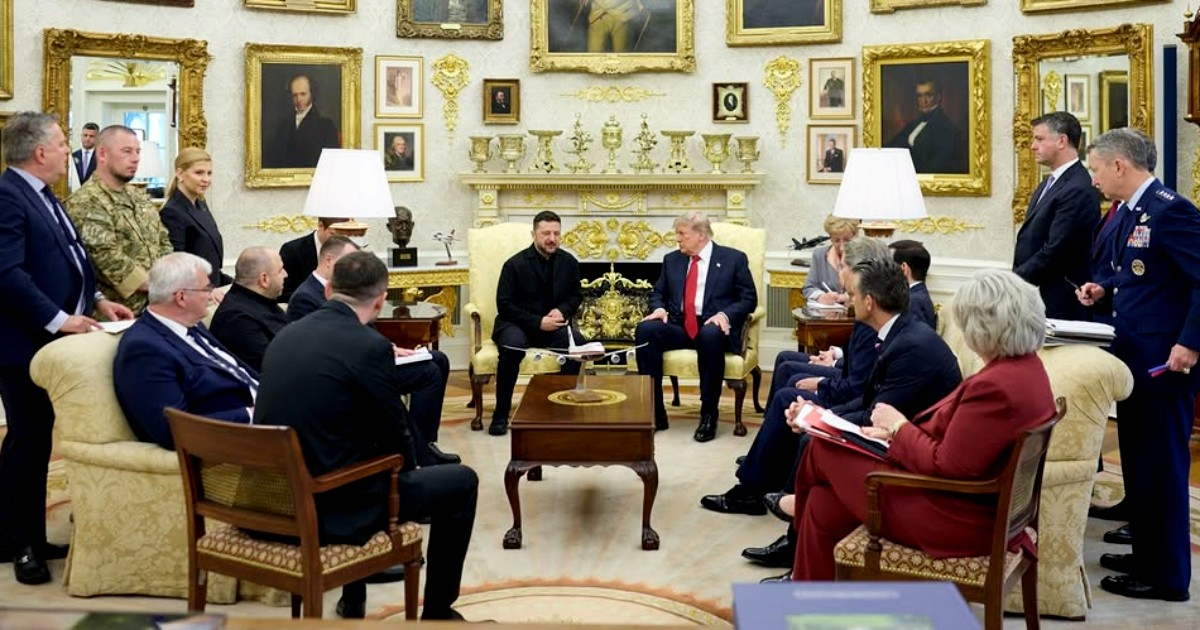
On Tuesday, Donald Trump hosted Ukrainian President Volodymyr Zelenski in the Oval Office of the White House for a private meeting that lasted approximately one hour.
Following the discussion, an official message was shared on the White House's X account: "It was a significant honor to welcome President Zelenski of Ukraine. We covered numerous topics. The meeting went very well!"
This presidential statement is particularly striking considering the months of open hostility, public snubs, and a relationship that hit rock bottom in February 2025.
Zelenski described the meeting as "a good discussion," highlighting that they explored the licensing for producing Patriot interceptors within Ukraine, along with "several other ideas."
The leaders agreed that their teams would continue working on the proposals discussed, although the meeting did not result in any concrete security commitments or a signed peace agreement, as reported by the BBC.
Zelenski's visit to Washington was also prompted by his attendance at the funeral of Republican Senator Lindsey Graham. Graham, a staunch supporter of aid to Ukraine in the Senate, passed away on July 11, 2026, after returning from a trip to Kyiv.
The stark contrast with the recent past is hard to ignore. On February 28, 2025, Trump, Vice President JD Vance, and Zelenski were involved in one of the most dramatic diplomatic confrontations of Trump's presidency: a public fallout in the Oval Office that ended with a canceled lunch and press conference, and the Ukrainian leader leaving the White House prematurely.
During that meeting, which was intended to sign an agreement on Ukrainian minerals that went unsigned, Trump warned Zelenski about "toying with World War III," while Vance criticized discussing matters in front of the American press.
Just days before this clash, on February 19, 2025, Trump referred to Zelenski as a "dictator with no elections" on his social media platform Truth Social, ignoring the martial law imposed after the 2022 Russian invasion that constitutionally prevents elections in Ukraine. Zelenski countered by stating that Trump lived in a "bubble of misinformation."
Following the confrontation, Trump temporarily suspended military aid to Ukraine as a means of pressuring negotiations with Russia, although it was resumed weeks later.
Evolution of Diplomatic Relations
Throughout 2025, the relationship evolved erratically: a meeting at the Vatican in April described as "very productive," the announcement of Patriot missile shipments in July contingent on European payment, and accusations of "zero gratitude" from Trump in November.
In May 2026, a ceasefire between Russia and Ukraine was announced, facilitated by the Trump administration, marking a new diplomatic phase where Tuesday's meeting represents the warmest moment between the two leaders since Trump's return to power in January 2025.
Peace negotiations with Russia remain on the table despite Vladimir Putin's hesitations, and Ukraine aims to secure local production of defensive weaponry as a long-term security guarantee, a goal that now seems to, at least in tone, have Washington's backing.
Key Aspects of the U.S.-Ukraine Relations
What was the main focus of the meeting between Trump and Zelenski?
The meeting primarily focused on discussing the production licenses for Patriot interceptors in Ukraine, along with several other strategic ideas.
Why did Zelenski visit Washington?
In addition to the meeting with Trump, President Zelenski visited Washington to attend the funeral of Senator Lindsey Graham, a prominent supporter of aid to Ukraine.
How has the relationship between Trump and Zelenski evolved?
The relationship has been characterized by ups and downs, including public confrontations and temporary suspension of aid, but recently it appears to be improving, especially after a ceasefire between Russia and Ukraine.