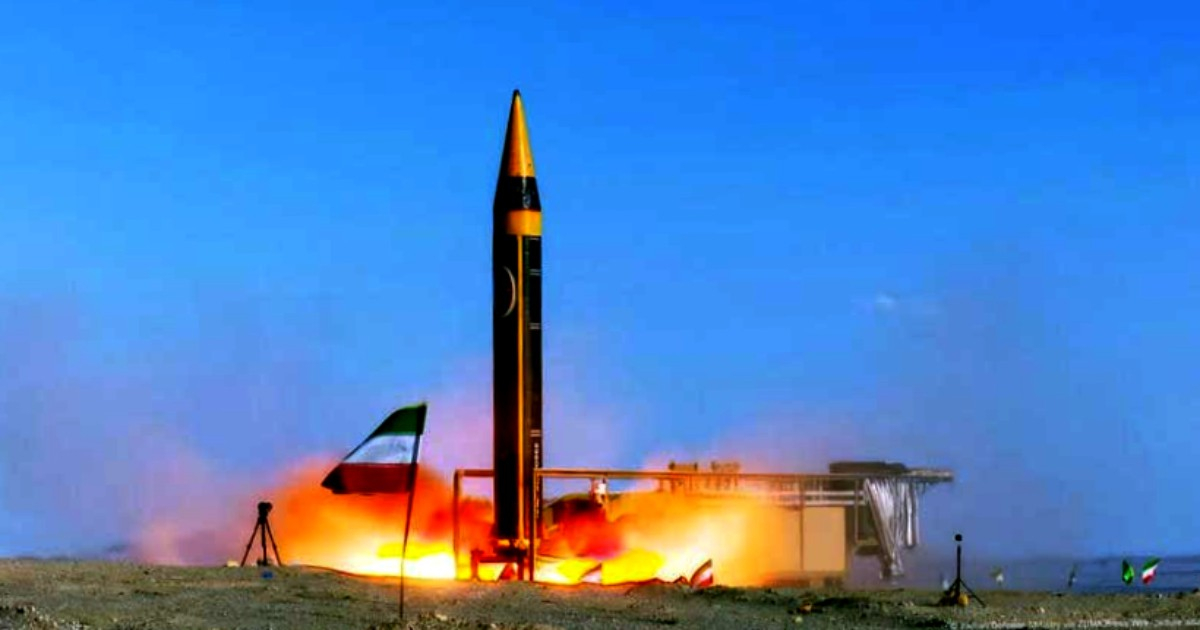
On Wednesday, the Iranian Revolutionary Guard Corps launched a barrage of ballistic missiles targeting U.S. military positions in the Middle East. However, the United States Central Command (CENTCOM) reported that the attack, intended as a surprise, was completely thwarted.
According to CENTCOM's official statement, the missile strike occurred at 5:45 p.m. Eastern Time. "Iran's Revolutionary Guard Corps launched multiple ballistic missiles from Iranian territory in an attempted surprise attack against U.S. forces stationed in the Middle East," the statement detailed.
"All Iranian missiles were successfully intercepted. U.S. forces remain vigilant and in a heightened state of readiness," CENTCOM added.
Separately, the Jordanian military confirmed intercepting five missiles over its territory, as reported by DW. "Anti-air defenses intercepted five missiles launched from Iran targeting Jordanian territory early Wednesday morning. The missiles were intercepted and neutralized following established engagement protocols," stated a brief release from the Jordanian Armed Forces, which reported no casualties or damage.
The IRGC claimed responsibility for the attack, asserting it was a "response to the aggressive actions of the U.S. military" against Tehran. The Times of Israel suggested that Iran might have launched up to 12 missiles aimed at a U.S. command center in Jordan, potentially targeting the Muwaffaq Salti airbase, although CENTCOM did not specify the target in its statement.
This Iranian missile strike comes in direct retaliation to joint precision strikes executed by the U.S. and Saudi Arabia against the Popular Mobilization Forces (PMF), pro-Iranian Shiite militias in Iraq, the day before.
CENTCOM indicated these strikes were in response to over 30 drone attacks in the preceding 72 hours, targeting logistical and armament sites in eastern Iraq. The PMF reported at least 20 fatalities and strikes in provinces such as Basra, Diyala, Salahuddin, Nineveh, and Karbala, condemning the operation as a "very dangerous escalation" and a violation of Iraqi sovereignty.
For the first time, Saudi Arabia directly participated in military operations against pro-Iranian militias on Iraqi soil, signaling a new dimension in the ongoing conflict.
This missile salvo occurred just two days after U.S. President Donald Trump announced a halt to airstrikes against Iran to explore diplomatic negotiations. Trump had expressed "possibilities of an agreement," yet cautioned that military operations would resume if talks failed. However, Tehran denied any direct negotiations with Washington, stating that their interactions were limited to regional mediators, highlighting the fragility of any peace efforts.
Jordan has been significantly affected since the breakdown of the ceasefire between Washington and Tehran. On July 17, Iranian missiles and drones struck the Muwaffaq Salti base, resulting in the deaths of two U.S. soldiers and leaving another missing. By July 22, the Pentagon confirmed the death of Sergeant Angel S. Rampersad, increasing the toll to three casualties linked to that attack.
The conflict has intensified following the collapse of a ceasefire declared on June 14, 2026. Trump officially ended the ceasefire on July 8, with the U.S. launching a new wave of airstrikes against Iran on July 14. In response, Iran formally suspended its commitments under the agreement on July 18, leaving the conflict in full escalation at the time of Wednesday's attack.
With Saudi Arabia's entry into direct military operations and Iran's latest strike on Jordan, the confrontation between Washington and Tehran threatens to engulf more nations in the region.
Key Questions About Iran's Missile Attack on U.S. Bases
Why did Iran launch missiles at U.S. bases in the Middle East?
Iran launched missiles as a retaliatory action against joint U.S. and Saudi precision strikes on pro-Iranian militias in Iraq.
How did the U.S. respond to Iran's missile attack?
The U.S. intercepted all the Iranian missiles, maintaining a high alert status for its forces in the region, according to CENTCOM.
What was the impact of the missile attack on Jordan?
Jordan's military intercepted five missiles over its territory, with no reported casualties or damage.