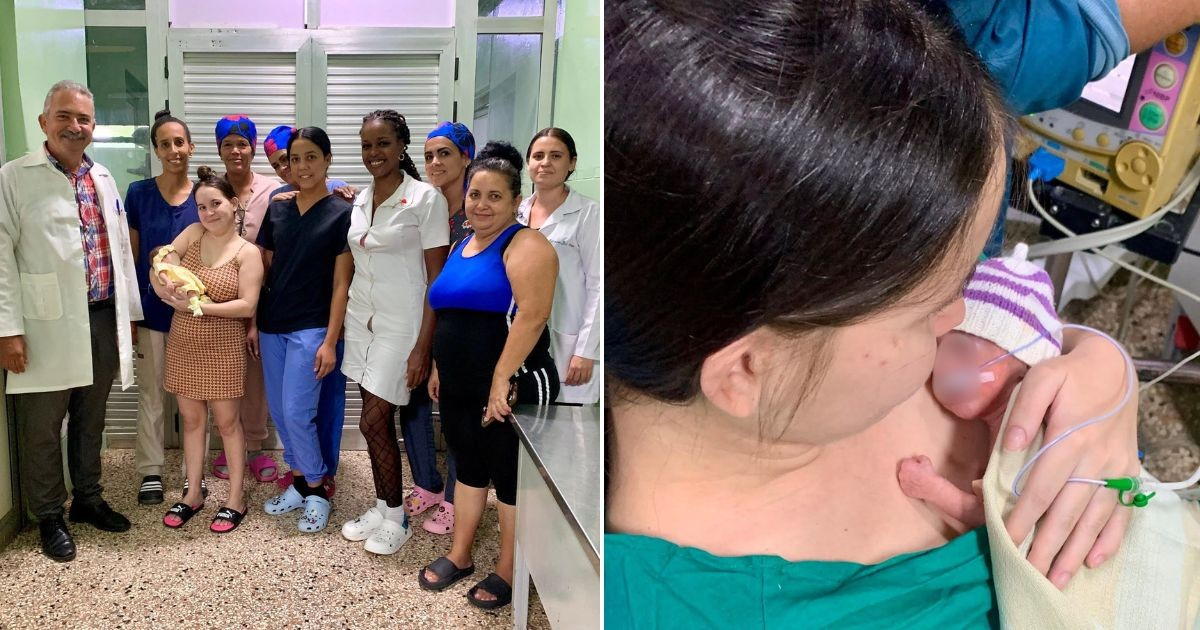
Weighing only 770 grams and born at 27.1 weeks, Patricia entered the world on the brink of survival.
After spending 82 challenging days, she was finally discharged from the Intensive Care Unit at Iván Portuondo General Teaching Hospital in San Antonio de los Baños, Artemisa, reuniting with her mother in the shared accommodation ward.
Medically classified as an extremely premature infant, Patricia faced numerous hurdles since birth. She required mechanical ventilation and extended oxygen therapy to breathe independently.
As of the latest update, Patricia is showing promising progress, gaining weight steadily and being exclusively breastfed—a remarkable achievement for a baby who started life under such precarious circumstances.
Her mother, María Fernanda Piney Crespo, expressed profound gratitude to the medical team that supported her daughter through each critical phase.
"I will always be thankful to the fantastic Neonatology team at Iván Portuondo hospital for saving my little warrior, for their love and dedication. For all the strength they gave me not to give up, for the hope and faith. Thank God for always holding my daughter's hand," wrote the emotional mother.
Patricia's journey is not just a medical narrative; it is the story of a family clinging to hope during nearly three months of uncertainty, while a baby weighing less than a kilogram fought to stay alive.
Her story gains significance against the backdrop of international statistics, which indicate that the survival rate for babies born at 27 weeks ranges from 40% to 80%, depending on available resources and neonatal care quality.
Moreover, Patricia's survival unfolds amid a particularly challenging period for maternal and infant health in Cuba.
The infant mortality rate concluded 2025 at 9.9 per 1,000 live births, marking the highest figure in over two decades, compared to 4.0 recorded in 2018—a cumulative increase of 148%.
The Cuban government itself acknowledged an unprecedented structural crisis in the healthcare system in 2025, with only 30% coverage of essential medications.
In this context, the survival of a 770-gram baby in a provincial hospital becomes even more significant, although the greatest credit belongs to those at the cradle's side: the dedicated medical team and a mother who never lost faith.
Understanding Premature Infant Survival in Cuba
What challenges do extremely premature infants face?
Extremely premature infants, like Patricia, often face breathing difficulties, require mechanical ventilation, and need prolonged oxygen therapy to survive. They may also struggle with feeding and gaining weight.
How does Cuba's healthcare crisis affect infant survival rates?
Cuba's healthcare crisis, marked by limited medication availability and systemic issues, challenges the survival rates of infants, especially those born prematurely. Despite these obstacles, dedicated medical teams continue to strive for the best outcomes.