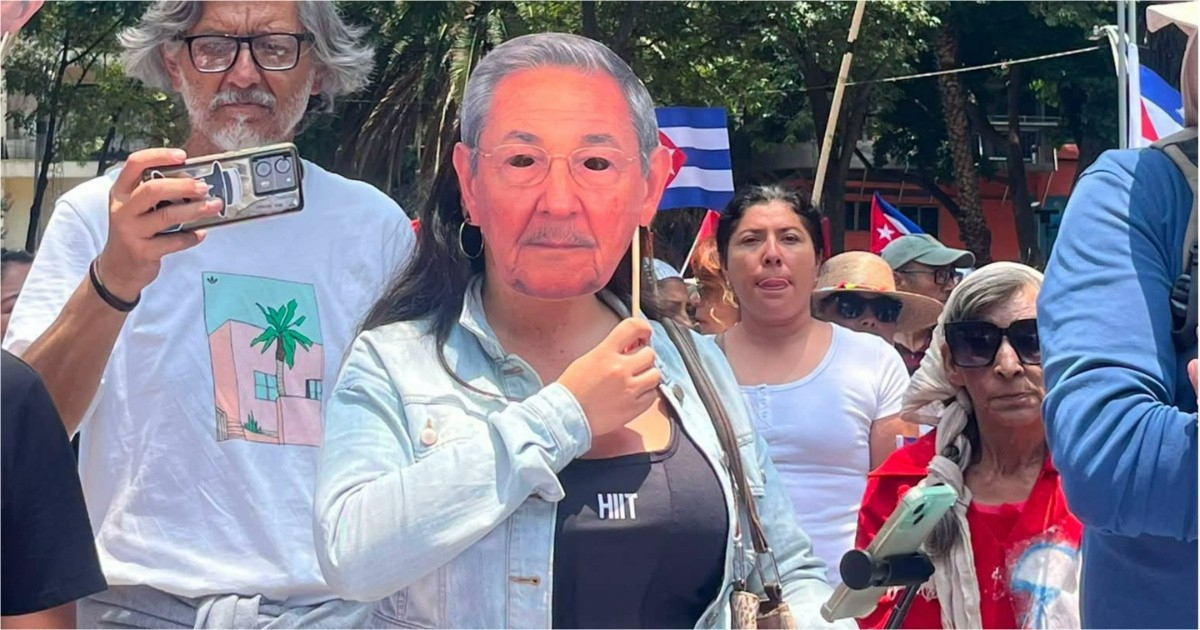
A photograph captured this Sunday during a pro-regime march in Mexico City has sparked a reaction from Cuban journalist José Raúl Gallego. He highlighted the irony of a young participant wearing a mask of Raúl Castro, without realizing such an act could cost her freedom if done in Cuba.
The image, shared on Facebook by the Mexican Movement of Solidarity with Cuba, depicts the young woman donning the mask alongside the slogan "I am Raúl" resonating through Mexico City's streets, surrounded by Cuban and Palestinian flags.
Gallego quickly responded with a public statement, describing the incident as "the result of a complete ignorance of the Cuban reality by those in Mexico who march for the dictatorship, believing they are supporting Cuba."
The Irony of Unawareness
The journalist explained that the young woman was unknowingly portraying "La China," a historical nickname for Raúl Castro, stemming from his physical features. "There she is, with all the innocence in the world, making a spectacular representation of 'La China,' one of Raúl Castro's historical nicknames, an act that would land her in jail in Cuba if she attempted such a stunt," he wrote.
The irony pointed out by Gallego has a concrete legal basis. Cuba's Penal Code (Law 151/2022) classifies contempt as a crime, punishing those who insult or offend a public official with six months to a year in prison. The penalties for high-ranking leaders, like the president or members of the Council of State, are even more severe.
Legal Repercussions
Amnesty International warned in December 2022 that this penal code "presents a terrifying panorama" and that its regulations are systematically used to suppress dissent and penalize any public criticism of the government.
The march, organized by the Mexican Movement of Solidarity with Cuba and the group Va por Cuba, was held to commemorate the 73rd anniversary of the attack on the Moncada and Carlos Manuel de Céspedes barracks, under the slogan "No to the war against Cuba!" The procession moved from the Hemiciclo a Juárez to the former U.S. Embassy on Paseo de la Reforma.
The event was not without controversy: it concluded with a group of participants vandalizing the Cuauhtémoc Borough Hall, a building protected as a historical heritage site.
Gallego's Critical Voice
Gallego, a journalist and researcher born in Camagüey in 1986, was expelled from the University of Camagüey in 2018 for publishing in independent media. He is a frequent critical analyst of Cuban reality from exile.
Raúl Castro ruled Cuba from 2008 to 2018 and remains a central figure in the regime. In Cuba, regime supporters have gathered in Mexico on several occasions to express their support for the dictatorship, but rarely has an image so vividly illustrated the gap between those who march and the reality faced by Cubans on the island.
Cuban President Miguel Díaz-Canel publicly thanked participants on X: "Thank you #Mexico. Once again at the forefront of the dignity of Our America. To all who marched for #Cuba this July 26, the grateful embrace of a people who have always found solidarity in the noble and generous Aztec land. #CubaIsNotAlone."
Understanding the Cuban Penal Code and Its Implications
What is the Cuban Penal Code's stance on insulting public officials?
The Cuban Penal Code (Law 151/2022) categorizes contempt as a crime, with punishments ranging from six months to a year in prison for insulting or offending a public official. Higher penalties apply to top leaders like the president or Council of State members.
Why did José Raúl Gallego criticize the Mexican march participant?
José Raúl Gallego criticized the participant for wearing a Raúl Castro mask, highlighting the irony that such an act, considered a form of protest in Cuba, could lead to imprisonment under Cuban law.