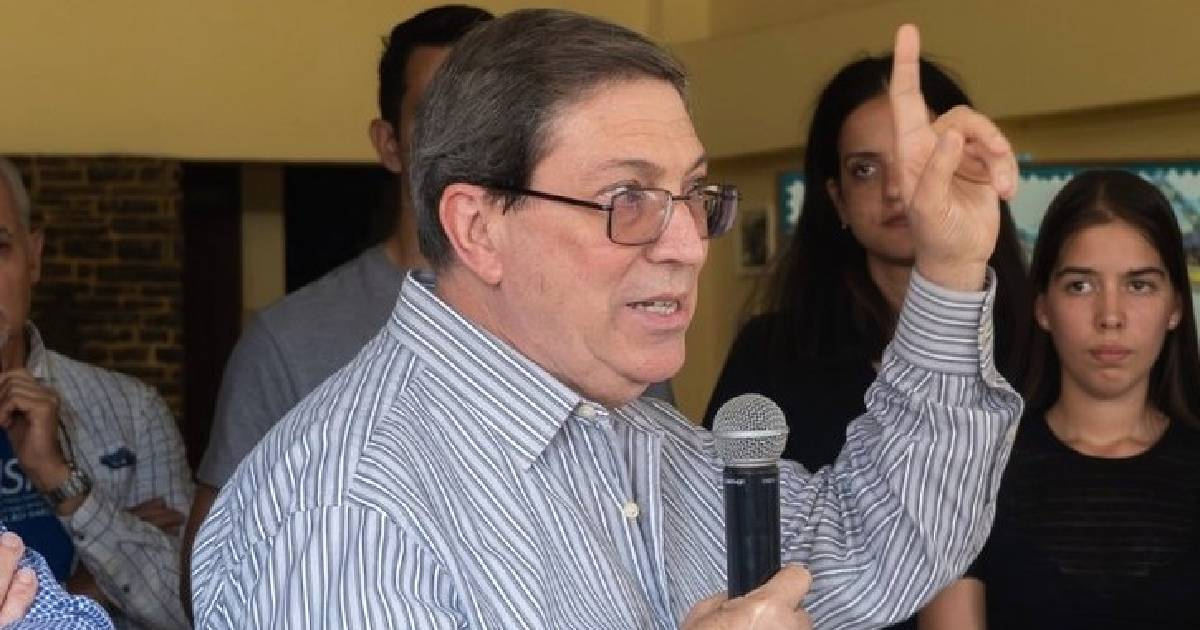
Bruno Rodríguez Parrilla, the Cuban regime's foreign minister, took to social media this past Saturday to congratulate Volker Türk on his reappointment as the UN High Commissioner for Human Rights. In his message, Rodríguez boldly declared Cuba's "commitment to promoting and protecting all human rights," a statement starkly at odds with the reality documented by independent organizations on the island.
The UN General Assembly extended Türk's mandate on Friday with 144 votes in favor, 10 against, and 13 abstentions, as reported by Reuters from the vote in New York. This extension will see him through until October 11, 2030, marking him as the first High Commissioner to serve two full terms.
Rodríguez's message underscored principles of "non-discrimination, dialogue, and cooperation" as the supposed foundation of Cuba's engagement with UN human rights mechanisms.
Contradictions Between Words and Actions
The hypocrisy in Rodríguez's message is glaring against the backdrop of data from international watchdogs. In May 2026, Prisoners Defenders documented 1,281 political prisoners in Cuba, a figure described as a historic high. Meanwhile, the Cuban Observatory for Human Rights (OCDH) reported at least 1,949 repressive actions in the first half of the year, with over 300 occurring within the prison system.
In June 2026 alone, Cubalex recorded 319 repressive events, with violations against imprisoned individuals being the most common, totaling 138 incidents that month.
Human Rights Watch, in its 2026 World Report, highlighted that Cuban authorities frequently denied medical care to inmates, subjected them to overcrowded and unsanitary conditions, and restricted visits and access to adequate food and water. Amnesty International echoed these findings, noting ongoing systematic repression, arbitrary detentions, and torture in Cuba.
International Forums and Political Maneuvers
Rodríguez consistently utilizes international platforms like the UN to deflect criticism, often highlighting US sanctions and portraying Cuba as a victim, all while downplaying internal repression. On July 7, he attempted to silence the US representative at the UN, who was displaying photos of Cuban political prisoners. The following day, Rodríguez claimed that there are no "images of violent repression" in Cuba.
The choice to praise Türk is strategic. In June 2026, Türk stated that US sanctions were causing "widespread harm to the population" of Cuba, describing the island as "drowning under US sanctions," statements that Havana has leveraged as international validation. However, Türk has not publicly condemned the Cuban government's human rights violations, despite UN-affiliated organizations documenting such abuses.
Discrepancies Between Words and Reality
While the Cuban foreign minister celebrates multilateralism and international protective mechanisms, the regime convened an extraordinary UN session in June to protest US sanctions. Meanwhile, at least 23 individuals died in Cuban prisons during 2025, many due to lack of medical care.
Understanding Cuba's Human Rights Reality
What is the current situation of political prisoners in Cuba?
As of May 2026, there are 1,281 documented political prisoners in Cuba, a record high according to Prisoners Defenders.
How has the UN responded to Cuba's human rights situation?
While the UN has extended Volker Türk's mandate as High Commissioner for Human Rights, there has been no direct public condemnation of the Cuban government's human rights abuses by Türk.
What are the main criticisms against the Cuban regime regarding human rights?
Critics point to systematic repression, arbitrary detentions, torture, denial of medical care to prisoners, overcrowding, and unsanitary prison conditions.