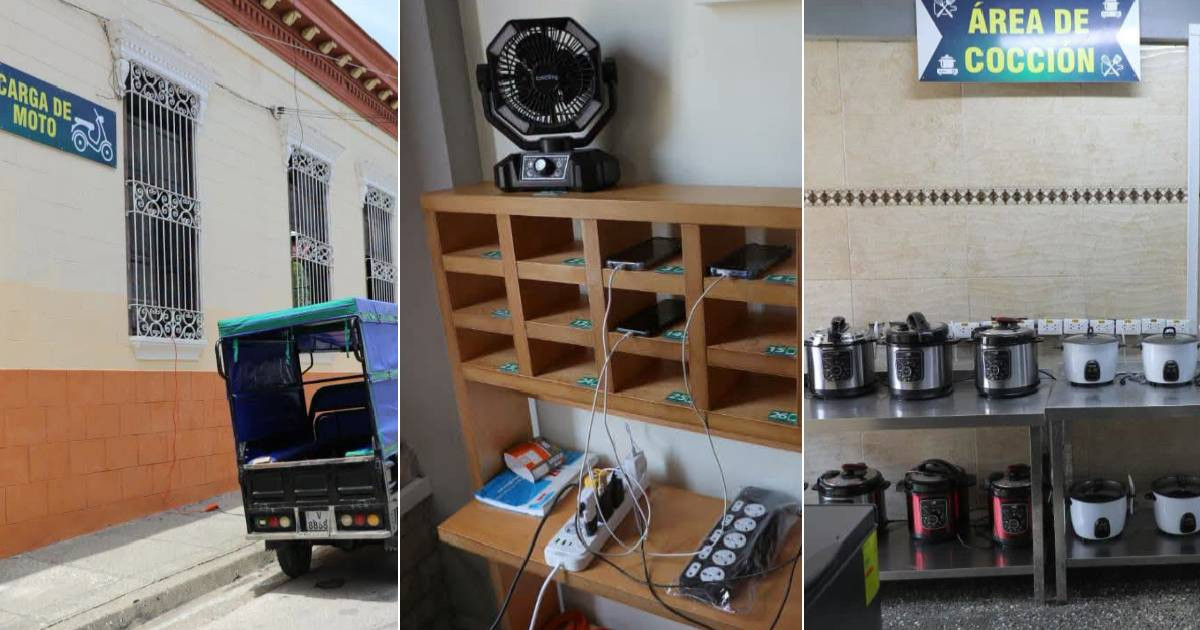
On Sunday, the pro-government page "Mi Guantánamo" unveiled images of a newly established Community Charging and Service Center in the city. These facilities have been designed to provide residents with a place to prepare food and charge devices during the extended blackouts plaguing the province.
The photos reveal a center at the intersection of Martí and Crombet streets, fully outfitted with horizontal freezers, a two-door refrigerator, electric rice cookers, and pressure cookers set on stainless steel shelves.
The site also boasts a numbered station for charging mobile phones, featuring at least 30 identified compartments equipped with cables and power strips.
Outside, a sign designates the location as a Community Charging and Service Center and includes specific directions for charging electric motorcycles with solar energy.
This initiative is part of a provincial plan to build about 20 such centers across Guantánamo city, with two facilities per Popular Council and a reported investment of nearly 25 million pesos, as stated by the official Granma newspaper in May.
According to Granma, each center will feature approximately 30 kilowatts of solar panel power and 60 kilowatts of battery storage.
In addition to phone charging, the centers will offer spaces to cook with up to 10 rice cookers and 10 multipurpose appliances, as well as television service. The investment merges resources from state-run companies and private micro, small, and medium enterprises (mipymes).
The government has presented this program as a response to the prolonged blackouts caused by a fuel shortage, with plans to gradually expand the model to other municipalities in the province, complemented by new "solar stations" for electric vehicles.
The creation of these centers highlights the severe energy crisis in Guantánamo, a province reliant on a single 110-kilovolt line from Santiago de Cuba for its power supply, where power outages have become a daily occurrence.
This line failed on June 11, leaving the entire province without service. At that time, the Electric Company admitted to having eight damaged transformers with no available replacements.
Guantánamo's political leadership urged a reduction in the number of citizen complaints about the electrical service on Saturday, even as the province records over 150 complaints daily and has endured months of blackouts, leaving residents without electricity for up to 33 hours at a time.
The phenomenon of solar-powered energy service stations, popularly known as "solar stations" and independent from the National Electric System, has spread across Cuba.
Santa Clara led the charge with the country's first installation in April, and it announced the upcoming opening of its third solar center in the Sandino neighborhood, offering some services free of charge.
In contrast, Holguín saw controversy over the rates ranging from 50 to 500 Cuban pesos per hour for its first solar station, "El Girasol," just days ago.
Matanzas is planning nine collective charging points throughout the province, and there are announcements for one of these installations in the heart of Havana's Vedado district.
The National Electric System has experienced eight total blackouts over 18 months and faces significant generation deficits as well as blackouts lasting over 24 hours, the direct result of decades of underinvestment and the halt of Venezuelan crude shipments since January of this year.
Understanding Guantánamo's Energy Solutions
What is the purpose of the Community Charging and Service Centers in Guantánamo?
These centers are designed to provide residents with facilities to cook food and charge devices during extended blackouts, aiming to mitigate the impact of energy shortages in the province.
How are these centers powered?
Each center is equipped with around 30 kilowatts of solar panel power and 60 kilowatts of battery storage, making them largely independent from the National Electric System.
What additional services do the centers provide?
Besides device charging, the centers offer cooking facilities with rice cookers and multipurpose appliances, as well as television services, contributing to the community during power outages.