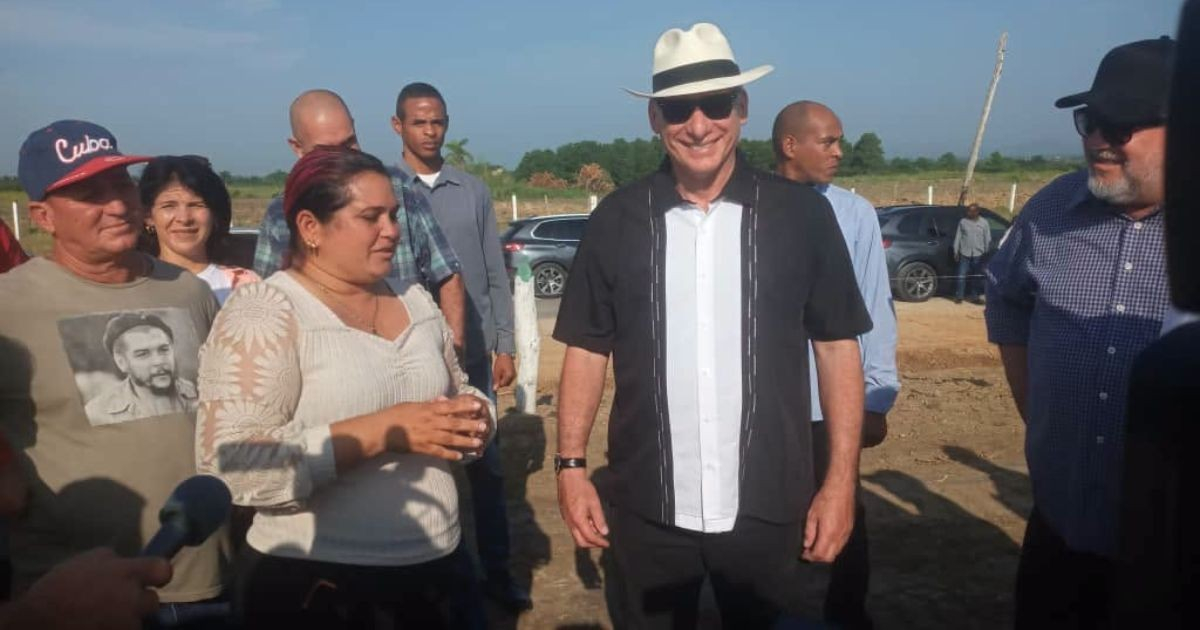
Cuban writer Armando Añel released a satirical piece on Sunday featuring an imaginary interview with Miguel Díaz-Canel. This political humor imagines the Cuban leader answering questions from RT journalist Oliver Zamora about his striking outfit in Pinar del Río: a white Panama hat, dark sunglasses, and a black shirt with white accents.
The inspiration for this piece was Díaz-Canel's actual appearance in the western province on Saturday, as part of the events leading up to the 73rd anniversary of the Moncada and Carlos Manuel de Céspedes barracks assaults. Social media users quickly likened his look to a "1930s gangster," sparking a flood of memes and jokes comparing him to characters like The Godfather, figures from the Cuban animated film "Vampires in Havana," and a mix between Compay Segundo and a mafia boss.
An activist noted online that "whoever advises him must hate him deeply, suggesting such gangster-like attire from the 1930s as a way to express their disdain," adding that "all he's missing is a good Cuban cigar."
The Dialectics of Style
In Añel's narrative, Díaz-Canel speaks in a lofty revolutionary pseudophilosophy. When the fictional Zamora inquires if his attire was a message to Washington, the imagined leader confidently replies, "Not exactly. The recipient is apparent. Truly important messages never reach where they seem to aim. If they are too direct, they shift from strategic to utopian."
Regarding the dark sunglasses, Añel's Díaz-Canel offers an unmatched tactical explanation: "So it wouldn't be clear if I was watching. A leader who watches can be observed. But a leader who seems not to watch compels others to think." The character concludes that geopolitics "begins with the pupil."
The Panama hat also undergoes a dialectical analysis. "A Panama hat isn't from Panama but Ecuador," the fictional leader reasons. "Identity is quite relative. Now, the Gulf of Mexico is supposedly the Gulf of America... yet it always was. Its identity didn't change, only its chronology. Never do today what you can defer to tomorrow."
Organized Spontaneity and Socialism
When Zamora asks if the memes his look generated were planned, the response comes swiftly: "In Cuba, we plan even spontaneity. Organized improvisation is one of the pillars of creative socialism."
This episode surfaced just days after Díaz-Canel was ridiculed for a real interview with RT on July 20, where he paraphrased Eduardo Galeano—who in turn paraphrased Argentine filmmaker Fernando Birri—with a metaphor about utopia and the horizon. The answer was widely seen as evasive amid the crisis, leading to parodies by comedian Ulises Toirac and actor Armando Tomey, among others.
The pattern persists: in June, Díaz-Canel became meme fodder for appearing disheveled on television; on July 16, his Levi's jeans during an industrial visit once again made him a trending topic. All this occurs while Cuba faces a severe energy crisis with prolonged blackouts, food and medicine shortages, and social unrest starkly contrasting with the fanfare of official events. Pinar del Río, chosen as the site for the main July 26 celebration for the fourth time in history, is not immune to this reality.
Philosopher or Mobster?
Añel's apocryphal interview concludes with a direct question: Does he prefer to be considered a philosopher or a mobster? The imagined Díaz-Canel pauses, smiles, and responds, "I am a kind of dialectical synthesis between metaphor and menace. An explicit threat intimidates. An implicit threat unsettles. But an incomprehensible threat forces the enemy to think." He adds, with a final smile, that the time the enemy spends pondering could be used "to capture Bruno Rodríguez in New York. They might think of many things."
Understanding the Satire Behind Díaz-Canel's Imaginary Interview
What is the purpose of Armando Añel's apocryphal interview with Díaz-Canel?
The interview serves as a satirical critique of Díaz-Canel's public appearances and the Cuban government's handling of political and social issues, using humor to highlight the absurdity of certain situations.
Why did Díaz-Canel's attire in Pinar del Río spark such a reaction on social media?
His outfit, reminiscent of a 1930s gangster, stood out amid an official event, leading to widespread ridicule and comparisons to fictional characters, emphasizing the disconnect between the government's image and the country's ongoing crises.