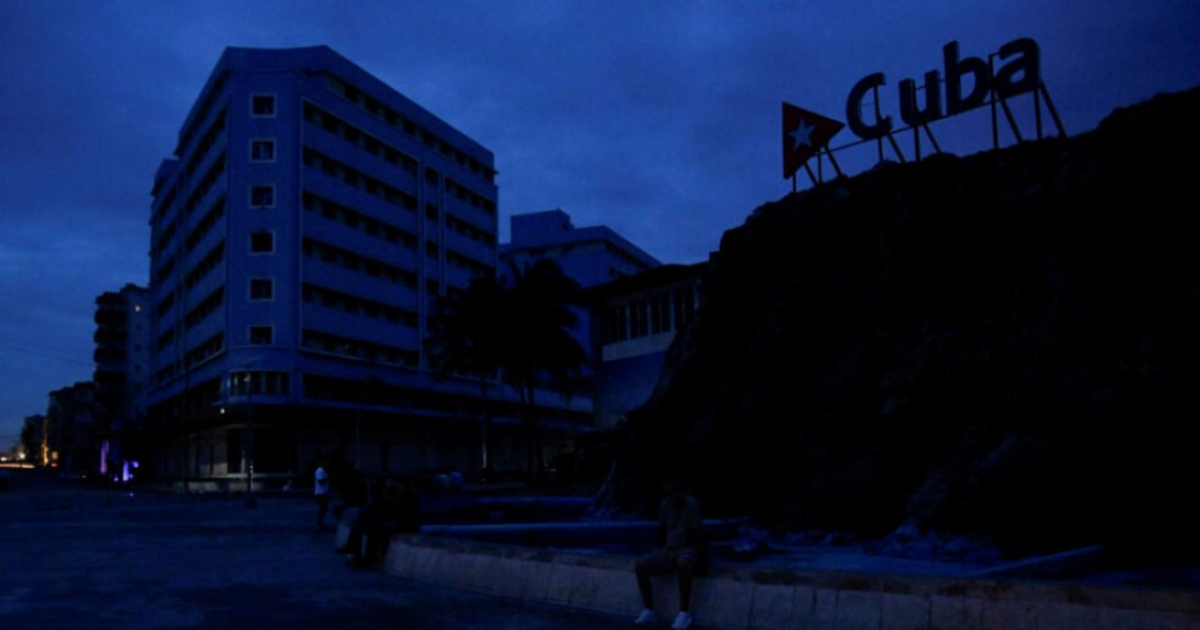
On Sunday, Cuba is grappling with a significant power shortfall, coinciding with the 73rd anniversary of the Moncada Barracks attack. The Electric Union of Cuba (UNE) has projected an electricity deficit of 2,080 MW during peak hours, with an available capacity of just 1,150 MW against an estimated demand of 3,200 MW.
The day began with a fresh setback at the country's largest power plant. At 1:07 AM, the UNE reported on Facebook that Unit 1 of the Antonio Guiteras Thermoelectric Plant in Matanzas was disconnected from the National Electric System (NES) due to a leak in the economizer.
This facility has experienced at least 17 unplanned outages in 2026 alone, mainly due to boiler and economizer breakdowns, making it a striking emblem of Cuba's thermal energy collapse.
Saturday saw continuous electrical service disruptions nationwide, with the most severe impact reaching 1,883 MW at 9:40 PM, affecting all provinces.
Widespread Plant Outages and Maintenance
Besides the Guiteras plant, several other units are also out of service, including Unit 6 of the Máximo Gómez Thermoelectric Plant (Mariel), Unit 6 of the Diez de Octubre Plant (Nuevitas), Unit 2 of the Lidio Ramón Pérez Plant (Felton), and Unit 3 of the Antonio Maceo Plant (Renté).
Currently undergoing maintenance are Unit 3 of the Ernesto Guevara De La Serna Plant (Santa Cruz), Units 5 and 6 of the Antonio Maceo Plant (Renté), and Unit 5 of the Diez de Octubre Plant (Nuevitas).
The situation is exacerbated by the distributed generation sector, where 106 plants are offline due to fuel shortages. This includes the Regla Barge, the Melones Barge, and the Mariel and Moa Central Fuel Stations.
Renewable Energy Insufficient Amid Crisis
The 54 solar photovoltaic parks managed to produce 5,258 MW/hour on Saturday, with a peak power output of 876 MW, which is inadequate to counterbalance the thermal energy collapse.
The political context adds another layer to Sunday's energy crisis. In anticipation of July 26, Havana experienced an unusually steady power supply, which activists and citizens viewed as a government tactic to prevent unrest on this politically sensitive date.
Earlier in the week, the Cuban Resistance Assembly called for a nationwide protest, resulting in demonstrations across several Havana neighborhoods, including Lawton, San Agustín, La Coronela, La Lisa, Centro Habana, and San Miguel del Padrón.
On Saturday, numerous uniformed officers from the Ministry of the Interior (MININT) were deployed in El Diezmero, located in the San Miguel del Padrón municipality.
Record-Breaking Power Deficits in July
July 2026 has been the most challenging month for the NES this year. On July 8, the largest historical deficit of 2,341 MW was recorded, and the system collapsed entirely on July 6, 10, and 14, leaving approximately 9.6 million people without power during each incident.
The projected deficit for July 26 — a day marked by the regime's significant commemorative event in Pinar del Río — is alarmingly close to this record, while millions of Cubans endure extended blackouts during a government-declared work recess.
Cuba's Energy Crisis: Key Questions and Answers
What is causing the current power shortages in Cuba?
The power shortages are mainly due to frequent breakdowns at major thermal power plants, fuel shortages affecting distributed generation, and insufficient renewable energy output.
How has the government responded to the energy crisis?
The government has attempted to maintain power supply in politically sensitive areas and has increased security presence to mitigate potential protests. However, overall solutions to the energy infrastructure issues remain limited.
What impact do these power outages have on daily life in Cuba?
Extended power outages disrupt daily activities, including cooking, communication, and business operations, significantly affecting the quality of life and economic productivity.