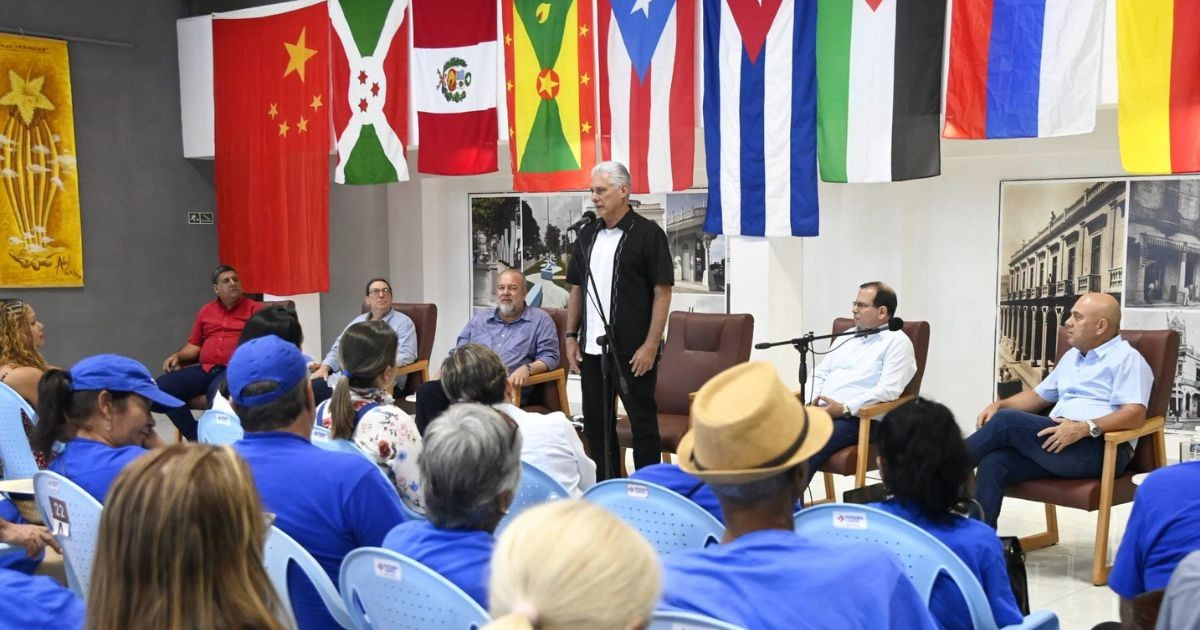
As Cuba grapples with an unprecedented energy crisis—experiencing power outages up to 15 hours daily in Havana and power cuts lasting as long as 87 hours in certain provinces—Miguel Díaz-Canel met with international solidarity groups in Pinar del Río this Saturday. The gathering was part of the National Rebellion Day celebrations, marking the 73rd anniversary of the Moncada Barracks assault. Cubans on social media were quick to react.
The Cuban Presidency's official Facebook page described the meeting as "emotional" and highlighted four main points from Díaz-Canel's speech: sovereignty and self-determination, the impact of the U.S. embargo, logistical barriers to receiving supplies, and the "resilience and dignity" of the Cuban people. The event was attended by the Cuban Institute of Friendship with the Peoples (ICAP) and the Pastors for Peace movement, which emphasized that "Cuba is not alone."
Díaz-Canel labeled the petroleum blockade as a "collective punishment," alleging that fear of repercussions prevents shipping companies from delivering food and equipment to Cuban ports. Ironically, the regime presented data at the event that underscores its own failures: infant mortality has skyrocketed—from 4.0 per 1,000 live births in 2018 to 9.9 in 2025, a 148% increase—and the surgical waiting list exceeds 100,000 people, including over 10,000 children.
The stark contrast between the logistics of the event—microphones, chairs, flags from dozens of countries, international delegations—and the daily struggles of Cubans without electricity or fuel sparked a flood of ironic comments. One succinct remark captured the sentiment perfectly: "There's fuel for that."
Other users were equally blunt. One commented, "Independence and sovereignty are utopias that don't feed me, I'm hungry." Another simply asked, "Until when?" A third urged, "Just leave already!" Some mocked the leader's travel arrangements: "I heard that after this tour, he's getting on a plane and leaving." Another sarcastically questioned, "How's the utopia going over there?"
One detailed comment summed up the feelings of many: "A government is not judged by the number of speeches it delivers or the narrative it constructs, but by its ability to ensure the basics: security, justice, health, education, infrastructure, and opportunities for its people."
Energy Crisis Highlights Government Failures
The numbers surrounding the energy crisis are staggering. On July 23, the day before the main event, the electric shortfall reached 2,315 MW, with only 1,070 MW available to meet a demand of 3,200 MW. On that day, 106 distributed generation plants were shut down due to lack of fuel. The historical deficit record had been set just days earlier on July 8, with 2,341 MW, leaving about 73% of the country simultaneously without power.
In April 2026, Díaz-Canel himself openly admitted that Cuba "lacks fuel for almost everything." The country produces only 40,000 barrels of oil per day domestically, against a need for 110,000, and has gone nearly four months without receiving imported oil on a regular basis.
Pinar del Río was chosen as the central venue for the event for the fourth time in history—the previous occasions being in 1976, 2000, and 2017—a decision announced on June 27 by the PCC's Political Bureau. The Ministry of Labor confirmed a work recess for July 25, 26, and 27. Despite widespread shortages, the regime managed to prepare the Pinar del Río plaza for the propaganda show. The event also coincides with the centennial of Fidel Castro's birth, which the officialdom imbued with special symbolism, though for many Cubans, the most telling symbol of the day was different: a country without power that found fuel for the solidarity performance.
Understanding Cuba's Energy Crisis
What is causing the energy crisis in Cuba?
Cuba's energy crisis stems from a severe shortage of fuel, compounded by outdated infrastructure and a lack of imports due to geopolitical tensions and economic sanctions.
How has the energy crisis affected daily life in Cuba?
The energy crisis has led to prolonged power outages, disrupting daily activities, affecting healthcare services, and hindering economic productivity.
What measures is the Cuban government taking to address the crisis?
The Cuban government is engaging in diplomatic efforts to secure fuel imports and exploring alternative energy sources, although these measures have yet to significantly alleviate the crisis.