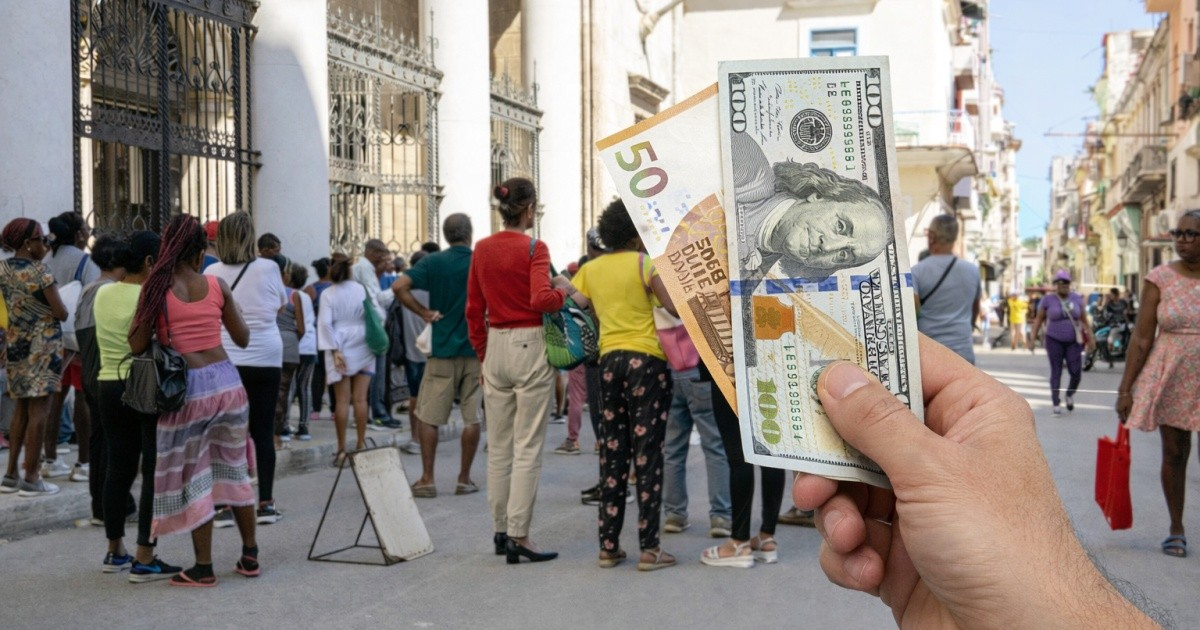
As of 8:00 PM local Cuban time, the black market for foreign currency in Cuba wrapped up this Saturday, July 25, without any notable fluctuations in its key indicators.
The U.S. dollar closed the day valued at 674 Cuban pesos, unchanged from the previous day, while the euro also remained stable at 785 pesos. The MLC (Freely Convertible Currency), though lacking comprehensive data at this time, is informally priced around 480 pesos, showing a slight uptick from the prior session, a change that should be viewed cautiously.
Dollar's Weekly and Monthly Performance
On Saturday, the U.S. dollar was priced at 674 Cuban pesos (CUP), holding steady since the previous session. This apparent stability belies a weekly upward trend; just a week ago, the dollar was exchanged at 664 pesos, marking a 10-peso increase, or a 1.5% rise.
Over the past month, the dollar's value has climbed 14 pesos from 660 CUP, though this shift may partly reflect adjustments in the index's methodology.
Euro's Market Dynamics
The euro ended the day at 785 Cuban pesos (CUP), with no change from the previous session. Despite this short-term calm, the euro has seen significant gains over the week, climbing 20 pesos from 765, a 2.6% increase.
In the past month, the euro has risen 30 pesos from its 755 CUP value recorded 30 days ago—a 4% increase, though such comparisons should be made cautiously. Currently, the euro holds its highest position of the last 30 days, maintaining its status as the most expensive currency in Cuba's parallel market, surpassing the dollar by 111 pesos.
MLC's Cautious Rise
The MLC closed at an indicative rate of 480 Cuban pesos (CUP), though data in this segment is sparse. This represents a 10-peso increase from the previous session's reported figures.
Over the past week, the MLC has surged 50 pesos from 430 CUP, an 11.6% rise that should be considered cautiously due to the limited availability of transaction data.
In the last month, its exchange rate has fluctuated between a low of 399 and a high of 543 pesos. Without physical presence, its use is confined to state-run stores that accept it, limiting its circulation compared to cash currencies.
Exchange Rate Disparities
The exchange rates are as follows: USD to CUP is 674, EUR to CUP is 785, and MLC to CUP is 480 (indicative value with limited data). The official exchange rates set by the Central Bank of Cuba (Segment III) remain significantly lower, at 601 CUP per dollar and 684 CUP per euro, far from the practical rates prevalent in the informal market.
Although Segment III was introduced as a more flexible exchange mechanism, its official rates continue to fall short of meeting the real demand for foreign currency among the Cuban populace.
The gap between official and informal rates underscores the ongoing shortage of foreign currency within the state banking system and the high demand for dollars and euros among citizens, whether for emigration, importing goods, saving, or purchasing in the private sector.
In a climate of sustained inflation, low state salaries, and increasing partial dollarization of the economy, every fluctuation in the informal market directly impacts domestic prices and the purchasing power of Cubans.
The CiberCuba Exchange Rate is an index of the Cuban informal market, produced through the automated analysis of thousands of currency exchange postings on Telegram and Facebook groups. This calculation excludes atypical offers and spam, weights each transaction by its recency, and consolidates a representative value that updates several times daily.
U.S. Dollar (USD) to Cuban Peso (CUP) conversion according to Saturday, July 25, 2026 rates: 1 USD = 674 CUP, 5 USD = 3,370 CUP, 10 USD = 6,740 CUP, 20 USD = 13,480 CUP, 50 USD = 33,700 CUP, 100 USD = 67,400 CUP.
Euro (EUR) to Cuban Peso (CUP) conversion according to Saturday, July 25, 2026 rates: 1 EUR = 785 CUP, 5 EUR = 3,925 CUP, 10 EUR = 7,850 CUP, 20 EUR = 15,700 CUP, 50 EUR = 39,250 CUP, 100 EUR = 78,500 CUP, 200 EUR = 157,000 CUP.
Understanding the Cuban Currency Market
Why is there a significant difference between official and informal exchange rates in Cuba?
The disparity is due to the persistent shortage of foreign currency in the state banking system and the high demand for dollars and euros by the population for various needs, including emigration and personal savings, which the official system cannot satisfy.
How does the CiberCuba Exchange Rate index work?
This index is created by analyzing thousands of currency exchange posts in Telegram and Facebook groups, automatically filtering out atypical offers and spam, and updating multiple times daily to reflect a representative market value.