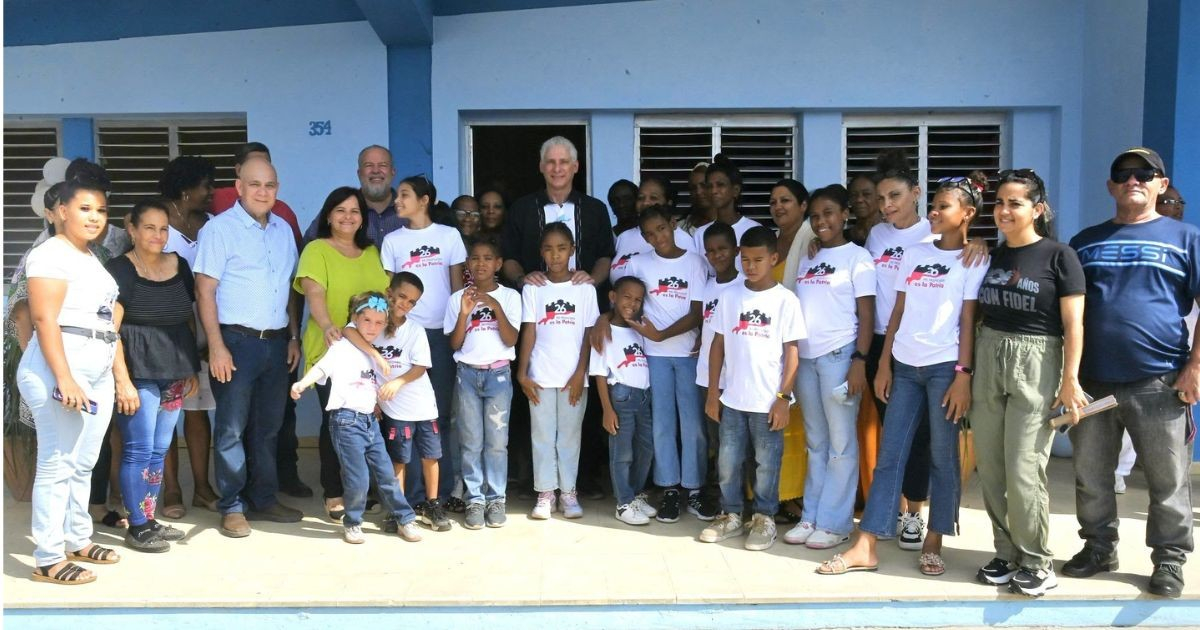
This past Saturday, Miguel Díaz-Canel embarked on a tour through various locations in Pinar del Río during an official visit tied to preparations for the 73rd anniversary of the attacks on the Moncada and Carlos Manuel de Céspedes barracks. A moment that prominently captured the regime's propaganda machine was his appearance alongside a group of children at the inauguration of a children's home.
The official Facebook account of the Cuban Presidency portrayed the day under the title "Pinar del Río at the Heart of the Presidential Agenda: A Journey through Development and Social Sensitivity," featuring images of the leader cutting a red ribbon surrounded by children in white T-shirts bearing the slogan "My Moncada is the Homeland."
The newly inaugurated home, named "Hermanos Saíz," is said by officials to provide shelter to 25 at-risk children lacking parental responsibility. Photos show Díaz-Canel smiling among the youngsters, in a scene the regime described as evidence of its "commitment to childhood" and the country's "social priorities." Notably absent from any official publication was mention of the severe humanitarian crisis affecting Cuban children.
This crisis is highlighted by stark statistics: according to the World Food Program (WFP), 48.5% of Cuban schoolchildren aged six to eleven do not receive a meal or snack at their educational centers. Meanwhile, UNICEF reports that 9% of children under five in Cuba suffer from severe child food poverty.
Infant mortality closed 2025 at 9.9 per 1,000 live births, the highest rate in over two decades, and the Cuban Conflict Observatory recorded 71 reports of child labor and begging in 2025.
Political Use of Children in Cuba
The use of children’s images in political events follows a documented pattern by the regime, especially on commemorative dates. Díaz-Canel has frequently employed this tactic, from meetings with young pioneers at the Revolution Palace to publications on Children's Day, consistently framed in an ideological backdrop.
Beyond the children's home inauguration, the leader's itinerary included visiting the "Santiago Miguel Cabañas Perojo" photovoltaic solar park, boasting 21 megawatts, in the municipality of Consolación del Sur, marking twelve operational parks in the province. He also toured the farm of tobacco grower Isabel Cristina Barbosa Díaz, who transformed land overrun with marabou into productive areas using solar irrigation, achieving 70% export-quality tobacco.
The stark contrast between this solar initiative and the province's electrical reality is telling: Pinar del Río fell into complete darkness on March 12, 2026, due to a transmission line failure from Mariel, and in recent months, Cuba's power generation deficit has often exceeded 2,000 MW, despite the installation of 133 solar parks nationwide.
Díaz-Canel also paid homage to martyrs Luis and Sergio Saíz Montes de Oca at the monument at the entrance of the Pinar del Río University, where he distributed Communist Youth Union and Communist Party of Cuba membership cards to local youth and workers.
Pinar del Río was chosen as the national central site for the July 26th event by the PCC Political Bureau on June 27, 2026, marking the fourth time since 1959 that the province hosts this ceremony. The Pinar del Río Revolution Square was outfitted with lighting, banners, and technical setups dedicated to Fidel and Raúl Castro, while on social media, Cubans questioned the propagandistic use of children amid an unprecedented humanitarian crisis.
Key Issues Surrounding Díaz-Canel's Visit to Pinar del Río
What was the purpose of Díaz-Canel's visit to Pinar del Río?
The visit was part of preparations for the 73rd anniversary of the attacks on the Moncada and Carlos Manuel de Céspedes barracks, and included several stops showcasing development projects and social initiatives in the region.
How does the regime use children in its propaganda?
The regime often features children in political events and imagery to convey a sense of commitment to social priorities and ideology, using these images to reinforce its narrative.
What is the state of the humanitarian crisis affecting children in Cuba?
The humanitarian crisis is severe, with almost half of school-aged children lacking meals at school and a significant percentage of young children suffering from severe food poverty, amid rising infant mortality rates.