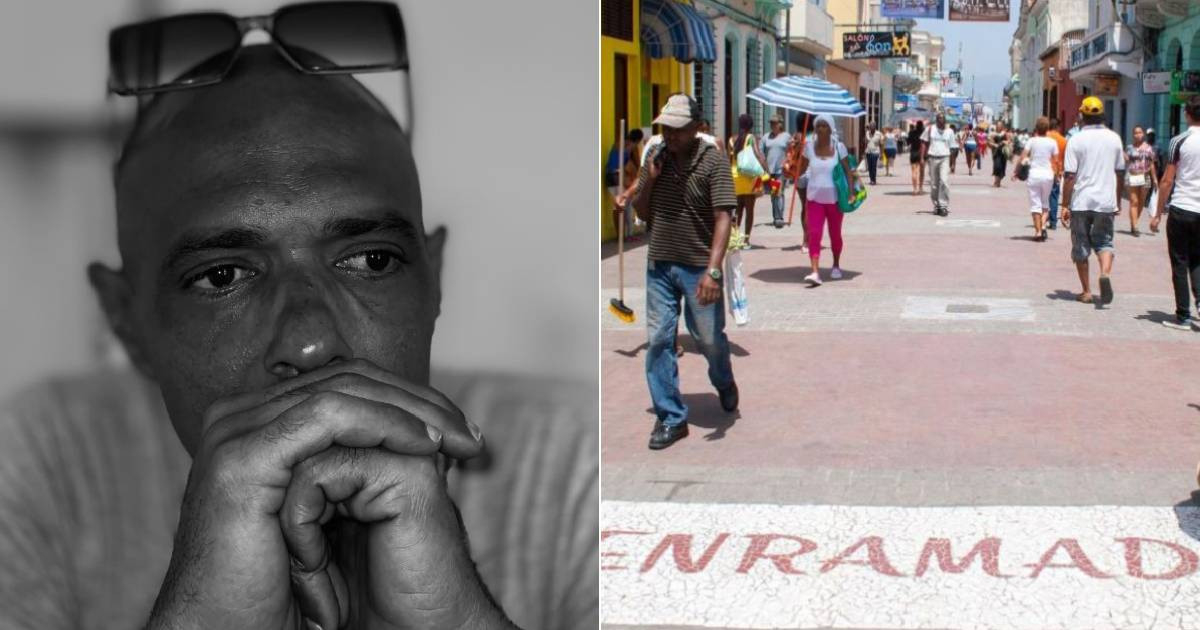
On Friday, Santiago-based writer and activist Yasser Sosa Tamayo shared his thoughts on Facebook, arguing that the most significant harm inflicted by Cuba's crisis isn't the power outages. Instead, it's the normalization of deteriorating living conditions and the collective numbing of the people's capacity for outrage.
"The worst thing that happened to Cuba wasn't the blackouts. It was the day we stopped questioning if this was truly living," Sosa wrote in a post that quickly spread across social media, garnering hundreds of reactions.
The activist detailed how Cubans gradually adjusted to increasing hardships. Initially, they stopped making plans that depended on electricity, later learned to live without essential medicines, and eventually began bidding farewell to their children at airports, uncertain of when they would reunite.
"That was the real blackout. Not the one in the cities, but the one that dimmed our ability to be outraged," the author asserted.
The post paints a vivid picture of life in today's Cuba, depicting scenes like a mother timing meals with electricity availability, a grandfather enduring pain because falling ill is a luxury, and a child growing up believing that studying in the dark is a normal part of childhood.
One of the most shared passages describes families who no longer set an extra plate at the table but instead place a cellphone there, so it feels like their emigrated child is still dining with them.
The imagery resonated with many. "These lines reflect my everyday life, all of it, including the phone on the table as a reminder that my son's place remains, no matter the distance," one reader commented.
Other users encapsulated their reactions to the post. "Indeed, we are the living dead," wrote one commenter.
Another user claimed the current situation is even worse than during the Special Period. "I can't sleep a single night when there's power; my food spoils, and my entire being aches," she expressed.
In his reflection, Sosa directly blamed the government for turning scarcity into a necessity-driven norm.
"We were convinced to be thankful for what should always have been a right. A little bit of electricity. A bit of water. A morsel of food. As if dignity could be rationed by the hour," he argued.
The post emerged amid one of the most critical moments of Cuba's energy crisis. This month, the National Electric System has collapsed multiple times, with ongoing blackouts lasting more than 24 hours in numerous areas across the nation.
Sosa Tamayo has previously highlighted Cuba's social decline through specific stories. In April, he recounted the plight of a 14-year-old boy selling sweets in a Santiago de Cuba park to help his mother.
In May, he encountered a 77-year-old grandmother trekking nearly 15 kilometers at dawn, pushing a cart to sell okra and make ends meet.
By September 2025, he found his former chemistry teacher sleeping in the corridor of a hair salon in Santiago at the age of 79, without family or support.
For the activist, these narratives are part of the same phenomenon he criticizes in his latest reflection—a "blackout" that impacts not only the power grid but also the dignity and capacity of a society to reject a reality defined by sheer survival as normal.
"A people can endure darkness. What they should never accept is forgetting that they were born to live with dignity, not to adapt to mere survival," he concluded.
Understanding the Real Impact of Cuba's Crisis
What is the core message of Yasser Sosa Tamayo's post?
Sosa's post highlights that the true harm in Cuba's crisis is not the frequent blackouts but the societal acceptance of deteriorating living conditions and the loss of collective outrage.
How have Cubans adapted to worsening conditions?
Cubans have gradually adjusted by foregoing plans that require electricity, coping with medicine shortages, and emotionally preparing to part with family members who emigrate.
Why does Sosa blame the government for the current situation?
Sosa accuses the government of making scarcity an accepted norm, convincing people to be grateful for minimal access to basic necessities that should inherently be their rights.
What examples does Sosa use to illustrate the crisis?
Sosa recounts stories of a young boy selling sweets to support his family, an elderly woman pushing a cart for miles to sell produce, and a retired teacher living without support, all exemplifying the broader societal decline.