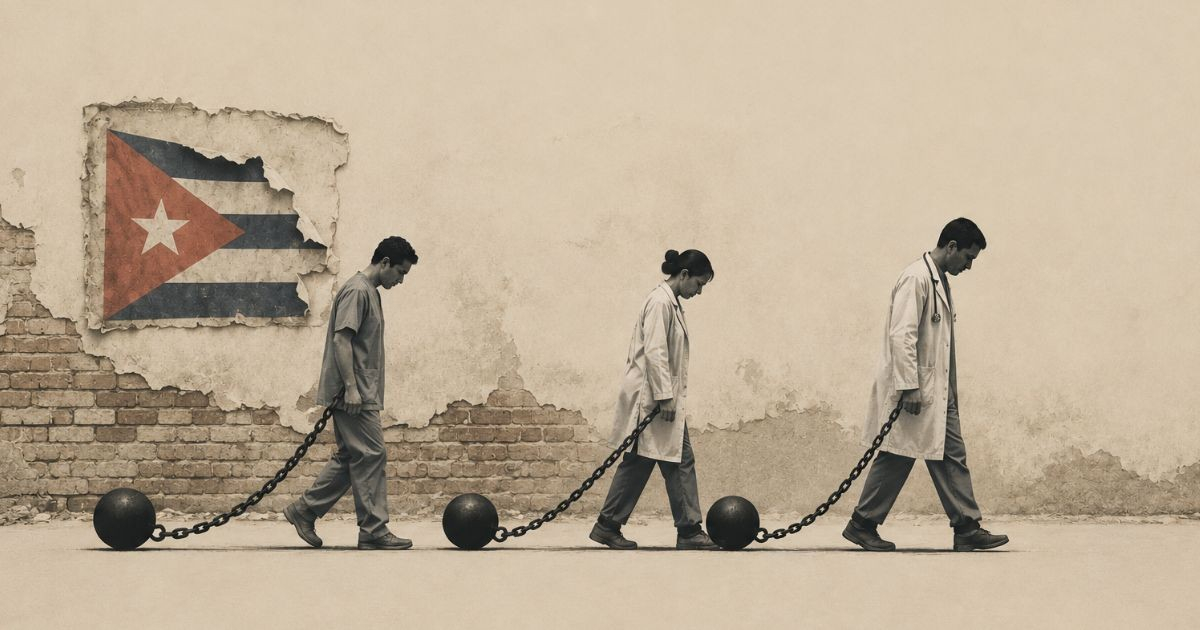
A Cuban doctor named Raícesa Mora shared a powerful statement on Instagram this past Saturday, condemning the Cuban regime's medical missions program as a "complete lie" and a form of "trafficking of Cuban medical professionals."
The video, posted by the account @magjorgecastro, was released just a day after the United States sanctioned the two state-run organizations overseeing the program—the Comercializadora de Servicios Médicos Cubanos (CSMC) and the Unidad Central de Cooperación Médica (UCCM)—as well as Cuba's Minister of Public Health, José Ángel Portal Miranda, and UCCM Director, Gretza Sánchez Padrón.
Exposing the Exploitation of Cuban Medical Professionals
"The Cuban dictatorship government sells [the missions] to the world as acts of heroism, altruism, solidarity, benevolence, when in reality, it's all lies," Mora declares in her account.
The doctor elaborates on the exploitation mechanism: Cuban doctors sent abroad receive just 20% or less of the salary that host countries pay to Cuba for their services. "What they are doing is exploiting Cuban medical workers, blackmailing them, coercing them, dragging them far from their homes," she exposes.
Additionally, other forms of control are imposed: "They take their passports, keep them under surveillance, and deny them contact with nationals of the country where they are stationed."
The High Cost of Defection
Those who decide not to return to Cuba face severe consequences: "If these doctors choose not to return to their country, they are barred from entering Cuba for eight years."
Mora is adamant about the use of the funds generated by the program: "Not a single peso has been invested in improving Cuban healthcare," instead, it has been used "to fill the coffers and pockets of the dictators."
International Pressure and Response
This testimony emerges amid the most intense international scrutiny the program has faced in decades. In April 2026, the Inter-American Commission on Human Rights (IACHR) released a 199-page report—based on 71 testimonies—documenting forced labor, withholding of documents, confiscation of wages, and reprisals against doctors and their families, recommending American countries withdraw from the Cuban medical missions program.
In April 2025, the European Parliament approved an amendment labeling Cuban medical brigades as "modern slavery" and "forced labor."
According to U.S. State Department estimates, the program generates over $4.9 billion annually for the regime.
The sanctions imposed on July 24 were grounded in Executive Order 14404, signed by Donald Trump on May 1, 2026, as part of a sustained pressure campaign that has led to a dozen countries either terminating or reducing their contracts with Cuba since February 2026.
In response, Miguel Díaz-Canel called Cuban doctors on missions "heroes" in an effort to counteract the impact of the sanctions and testimonies like Mora's.
Mora concluded her denunciation unequivocally: "They traffic in people, profit from modern slavery, which is the trafficking of Cuban medical professionals. Cuba is a dictatorship; down with communism, homeland, life, and freedom."
Understanding the Cuban Medical Missions Controversy
What are the Cuban medical missions?
The Cuban medical missions are programs where Cuban doctors are sent abroad to provide healthcare services, often in exchange for financial compensation to the Cuban government.
Why are the Cuban medical missions controversial?
They are controversial because they have been accused of exploiting Cuban doctors, providing them with only a fraction of the salaries paid by host countries, and imposing strict controls over their freedom and movement.
What actions have been taken against the Cuban medical missions?
The United States has sanctioned Cuban entities and officials involved in the program, and international bodies like the IACHR have called for countries to withdraw from the missions, citing human rights abuses.