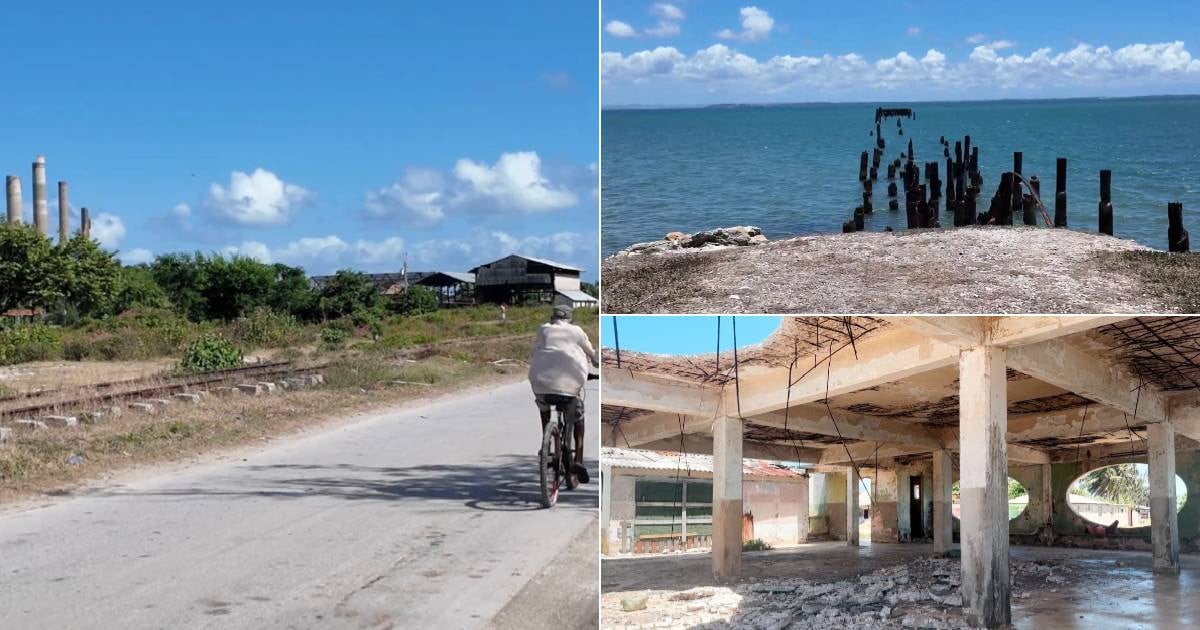
A recently released video by Leo's Travel on YouTube reveals the desolate state of Preston, officially named Guatemala, located in the Mayarí municipality of Holguín. Once a thriving sugar hub, this town has deteriorated into a landscape of decaying structures and ruins.
The video captures the remnants of the sugar mill, the crumbled remains of the Miramar Hotel, the corroded and abandoned Alta Cocina restaurant, and the dilapidated 120-bed hospital, which was regarded as one of the most modern in the region during the 1940s.
The Rise of an Industrial Town
Founded in 1905 as an industrial project by the Nipe Bay Company, a branch of the United Fruit Company, Preston emerged along the Nipe Bay. Its inaugural sugar harvest in 1907 yielded 97,320 sacks of sugar over 132 days. The town was named after Andrew W. Preston (1846-1924), a key figure in the American company.
Designed to mimic the urban planning of American industrial cities, its streets were marked with letters, and neighborhoods bore names like Brooklyn, New York, and Washington. The wooden stilt houses with spacious porches and tiled roofs were home to a diverse population of Cubans, Jamaicans, Haitians, Bahamians, Trinidadians, Chinese, and Spaniards.
The Fall Under Castro's Rule
When Fidel Castro (1926-2016) seized power, the United Fruit Company's properties were nationalized in 1960, and the sugar mill was renamed Guatemala, in tribute to former Guatemalan president Jacobo Árbenz (1913-1971). Although the state continued to operate the industry for several decades, the final blow came on June 3, 2002, when the mill signaled its closure with 93 whistles, ceasing production permanently.
This shutdown was part of the Álvaro Reynoso Task, which led to the closure of 71 of Cuba's 156 sugar mills, leaving more than 100,000 workers unemployed. This decision accelerated the economic and social decline of numerous communities reliant on the sugar industry.
"Imagine living in a town where generations have dedicated themselves to sugar cane cultivation and processing, and suddenly, it's all taken away," the video's creator reflects.
Nostalgia and Decline
Comments on the video express nostalgia from those who witnessed the town's former prosperity. "These were very prosperous towns," one user noted. Another lamented, "They destroyed Cuba." A local resident shared, "I am from that town and enjoyed its beauty immensely."
The video concludes with a contemplation on the town's memory. "It is now called Guatemala, but for many, it will always be Preston. As long as someone remembers where the mill stood, where their grandfather worked, or the sound of the trains, Preston won't be forgotten, but transformed."
A Broader Picture of Ruin
Preston's fate is not unique. In Holguín, other sites like the Urbano Noris sugar mill, José Martí Vocational School, El Mambisito children's park, and the former Holguín-Gibara railway station, now a garbage dump, remain in decay.
The town's decline mirrors the collapse of Cuba's sugar industry. The 2024-2025 harvest ended with less than 150,000 tons of sugar, a production lower than that of 1899, just after Cuba's War of Independence. In Holguín, production didn't reach 10% of the planned target.
Today, Preston's residents endure frequent power outages, water shortages, and limited internet access. Despite the name change over sixty years ago, most still refer to the town by its original name.
The Decline of Cuba's Sugar Industry: Key Questions Answered
What led to the decline of Preston, formerly a thriving sugar town?
The decline began with the nationalization of the sugar mills under Fidel Castro's regime, especially after the closure of the mill in 2002 as part of the Álvaro Reynoso Task, which significantly impacted the local economy and employment.
How has the closure of sugar mills affected Cuban communities?
The closures led to widespread unemployment and economic decline in communities that were heavily dependent on the sugar industry, resulting in social and infrastructural decay.
Why do residents continue to call the town Preston instead of Guatemala?
Despite the official name change, the original name, Preston, remains integral to the town's identity and history, reflecting the residents' connection to its past prosperity.