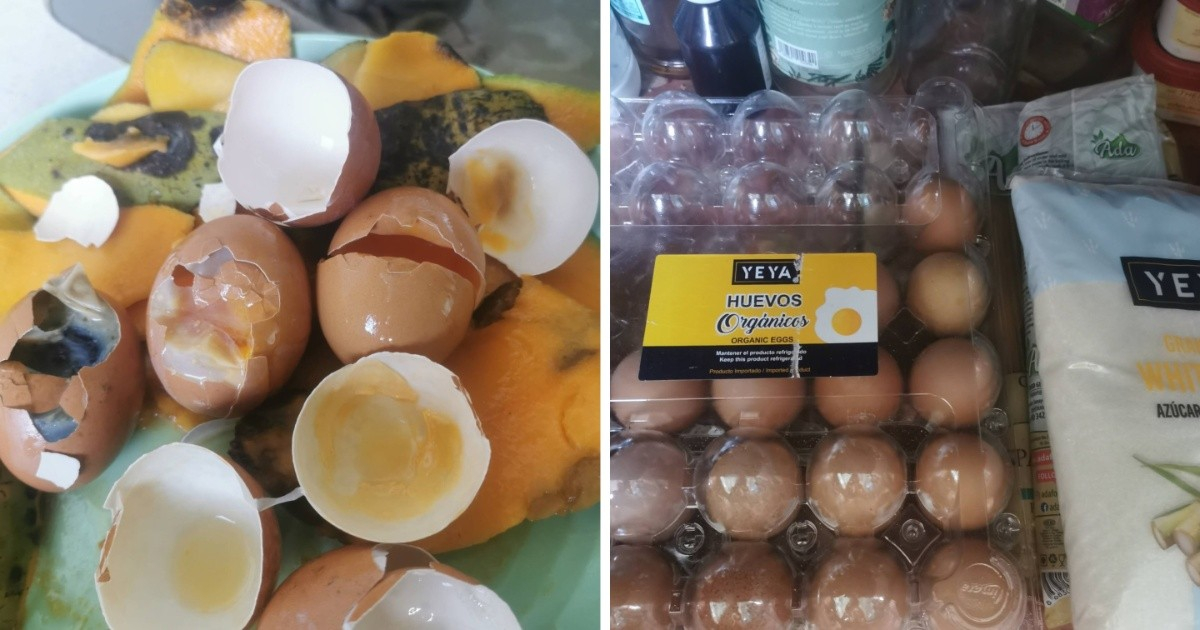
A Cuban woman named Sofia QRosabal expressed her anger and frustration on Facebook this Thursday after receiving rotten eggs sent by her husband from abroad through the agency Supermark23. This isn't the first instance of such an occurrence.
"I never thought I'd reach the point of feeling this much anger and helplessness. These are rotten eggs, apparently what Cuban families deserve," she lamented, sharing photos of a carton from the brand YEYA—imported organic eggs—and decomposing eggshells.
Sofia explained that she had to throw away six spoiled eggs and noted this isn't a new issue; she had previously sent photos to her partner to document it, but this time she chose to make it public.
The High Cost of Spoiled Goods
What pains her the most isn't just the waste, but the cost per egg. "From what I can reason, when something spoils, it's been sitting in warehouses for months waiting to be sold in foreign currency, while thousands of families barely get by day to day, and purchasing 30 eggs costs them a month's salary—it's heartbreaking," she expressed.
Her argument is backed by statistics: in 2025, the average monthly salary in Cuba was 6,930 Cuban pesos, which equates to between $11 and $17 at the informal exchange rate, according to the National Office of Statistics and Information (ONEI).
In the informal market, a carton of 30 eggs costs around 3,000 pesos, and in stores operating in foreign currency, it can reach six dollars.
A Widespread Crisis
Sofia also recalled buying cartons in cafeterias for 3,300 pesos, discovering more than half of the eggs were spoiled, with no recourse, as the store owner was also unaware of how long they had been stored in the small business from which they were purchased.
"I know what it's like not to have even one egg to feed my children, and I'll never forget that," she wrote.
"Now I think about that family who bought only two eggs at 110 pesos each so their child wouldn't eat just rice, only to find they were rotten when they got home."
Her complaint directly targets the commercial chain: "Agency and small business owners just want to sell, we pay, and nobody cares what happens afterward."
Food Insecurity in Cuba
This isn't an isolated incident. In March, a pregnant woman in Santiago de Cuba confronted a storekeeper distributing rotten eggs through the ration book. In June, residents scavenged rotten eggs from the streets, driven by hunger.
The underlying issue is an unprecedented food crisis: the ration book system is practically collapsing, and even government officials have admitted their inability to ensure the provision of oil, chicken, or yogurt through the rationed basket.
In Havana, children have gone over two months without meat or ground meat from the rationed system.
Cuba imports between 70% and 80% of its food, and with the breakdown of state distribution, millions of families rely on shipments from abroad paid in dollars.
That these products arrive rotten, as they did for Sofia, starkly highlights the situation: "In Cuba, we're starving and suffering in countless ways, but... is it fair that products paid for in dollars arrive in this state? Who cares? They just need to sell, the rest doesn't matter to them."
Understanding Cuba's Food Supply Crisis
What is the average monthly salary in Cuba?
In 2025, the average monthly salary in Cuba was 6,930 Cuban pesos, which is approximately between $11 and $17 at the informal exchange rate.
Why are eggs in Cuba so expensive?
Eggs are costly in Cuba due to limited supply and reliance on imports. A carton of 30 eggs can cost around 3,000 pesos in the informal market and up to six dollars in foreign currency stores.
How does the food crisis affect Cuban families?
The food crisis in Cuba affects families by limiting access to basic goods, with many relying on expensive imports or inadequate state distributions. This has led to widespread food insecurity and hardship.