Some metaphors illuminate. Others end up consuming those who utter them.
When Miguel Díaz-Canel addressed a question about resolving Cuba's crisis, he invoked the famous image of utopia "on the horizon," likely thinking he was elevating the dialogue. However, this prompted Cubadebate, four days later, to issue an extensive explanation of the leader's intent. If a statement requires an ideological rescue squad, the issue might not lie with the audience.
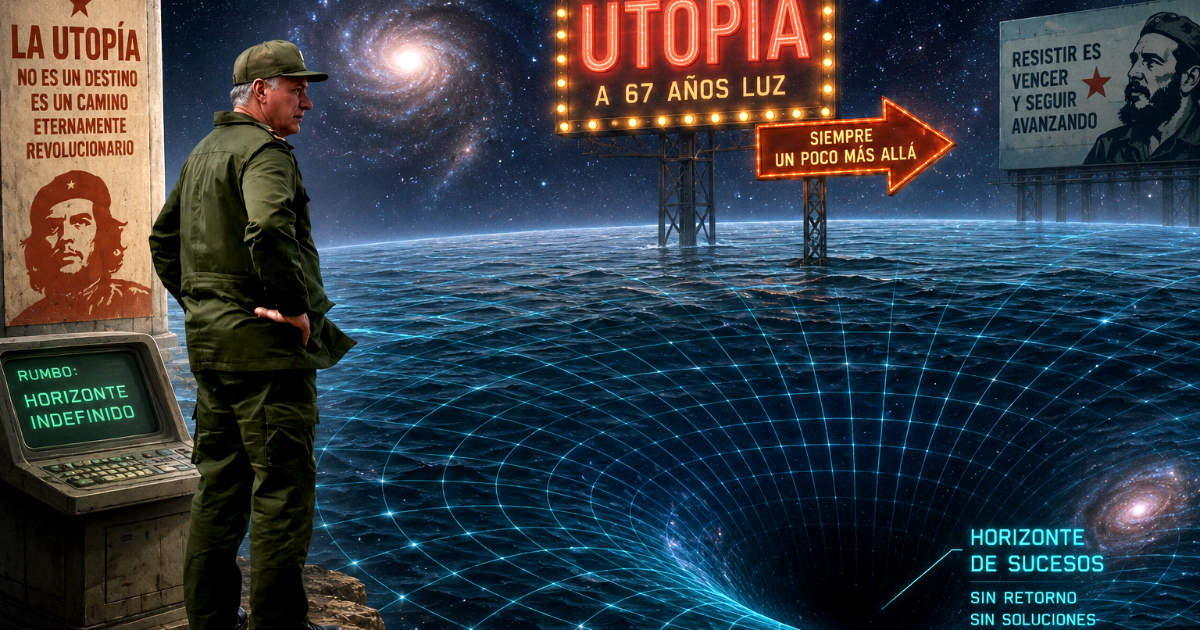
The story takes an unexpected turn. Perhaps Díaz-Canel was not referring to Eduardo Galeano's horizon, but rather to a more fitting concept for Cuba in 2026: the event horizon.
The Event Horizon of Cuban Reality
In astrophysics, the event horizon is the boundary surrounding a black hole. Once crossed, there's no going back; not even light can escape. Everything is trapped by gravity so intense that space and time cease to behave normally.
Doesn't this eerily describe the Cuban economy and reality?
In Dr. Díaz-Canel's universe—let's not forget his doctorate in Technical Sciences—the laws of physics seem altered. Salaries lose their value as inflation increases. Production vanishes without a trace. Foreign investments are theorized but never observed in reality. Time itself gains peculiar traits: solutions are always in the future while sacrifices exist only now.
A Revolutionary Theory
Neither Albert Einstein nor Stephen Hawking ventured so far. It takes a revolutionary schooled at Ñico López to devise a theory where prosperity travels at the speed of a promise, never reaching the present.
Perhaps that's why Cubadebate rushed to the appointee's aid with an unprecedented scientific mission: proving that a black hole is, in fact, a beacon. Their article suggests that utopia is not about arriving, but about the journey. The "revolution" is not a destination but a continuous path. If the horizon keeps receding after nearly seven decades, it's not a failure of the model but proof of its extraordinary vitality.
It's a fascinating theory. The problem with propaganda is that it sometimes reveals more than intended.
The Reality of Contemporary Cuba
"The same path that brought us here," Cubadebate proudly proclaimed in defense. Here? That question is a refutation in itself.
For the "here" of contemporary Cuba is not a socialist utopia but a nation plagued by blackouts, shortages, mass emigration, and wages reduced to a few hard currencies per month. If this is the final stop of the revolutionary journey, the propagandist inadvertently penned the most devastating summary of its results.
Perhaps Díaz-Canel's real mistake wasn't misquoting Galeano—or mistakenly attributing the phrase to Lenin in a barely audible murmur—but choosing the wrong metaphor.
Today's Cuba no longer seems to be heading toward a horizon. It resembles a country ensnared in an event horizon, where everything that enters—talent, savings, hope, or youth—vanishes beneath the immense gravity of a system incapable of escaping itself.
Not even the light of propaganda can escape it.
Understanding Cuba's Event Horizon
What is an event horizon in astrophysics?
An event horizon is the boundary surrounding a black hole, beyond which nothing can escape, not even light, due to intense gravitational pull.
How does the concept of an event horizon relate to Cuba's current situation?
The event horizon metaphorically describes Cuba as a nation where talent, resources, and hope disappear into an inescapable system, similar to how light cannot escape a black hole's gravity.
Why did Cubadebate have to explain Díaz-Canel's use of the horizon metaphor?
Cubadebate issued a lengthy explanation to clarify Díaz-Canel's metaphor of the horizon, suggesting that the public misunderstood his intent, indicating that the statement needed ideological clarification.