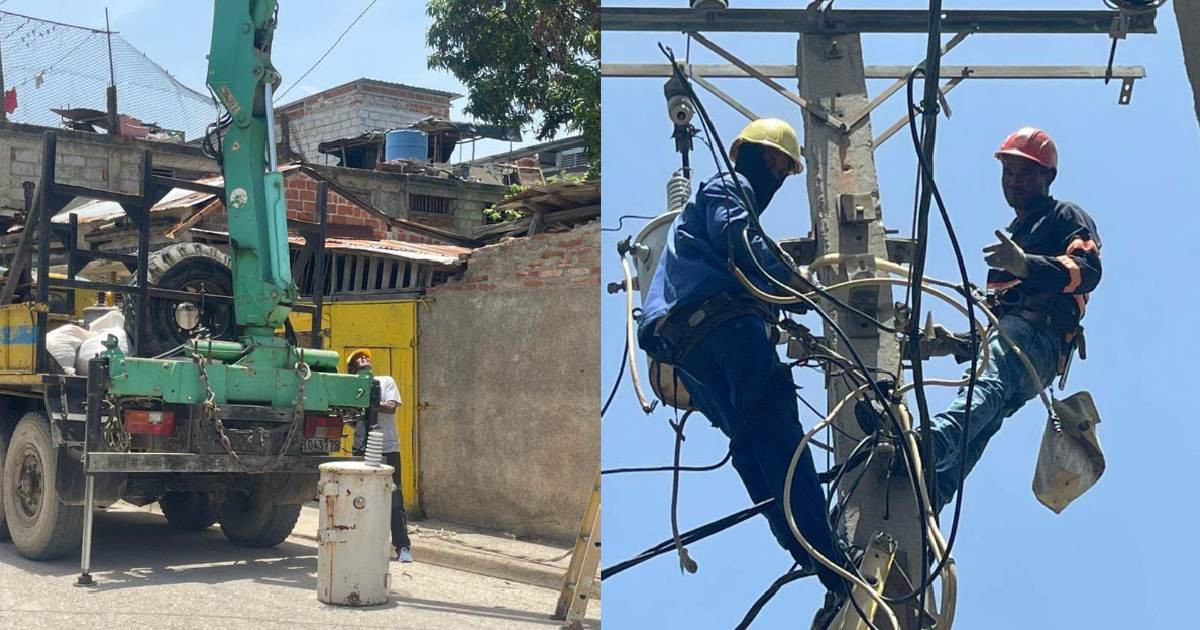
The political leadership in Guantánamo has urged a reduction in the number of public complaints regarding electricity service, despite the province experiencing over 150 daily grievances and enduring months of blackouts that have left residents without power for up to 33 hours at a time.
According to a report from Radio Guantánamo, this call was made during a crucial meeting to assess the operational, economic, and social status of the area. The meeting was led by Yoel Pérez García, the first secretary of the Communist Party of Cuba (PCC) in the eastern province, alongside Governor Alis Azahares Torreblanca.
Organizational Failures Highlighted
The PCC argued that numerous complaints are not solely due to the challenging electricity situation nationwide. Instead, they pointed to organizational inefficiencies among line crews and a lack of local response capabilities as primary issues.
Despite acknowledging the daily tally of more than 150 complaints, the meeting concluded that this number "can and should be reduced with quicker action, more effective work, and better organization," according to the official report.
Infrastructure Challenges in Guantánamo
Adding to this dilemma is the breakdown of several transformers across various municipalities in the province. Authorities have promised the imminent arrival of new equipment as a partial remedy.
Guantánamo relies on a single 110 kV high-voltage line to connect to the National Electric System through Santiago de Cuba. Any malfunction in this line results in a complete blackout for the province.
In June, a fault in this line left the entire province without power for over 24 hours, with some areas experiencing up to 33 hours of outage. Previously, in April, outages were so lengthy that residents resorted to banging pots in protest, as they only received electricity for 45 minutes to an hour each day.
Government's Alternative Solutions
Faced with the inability to ensure home electricity supply, the government recently designated over 60 plazas and public spaces as collective TV viewing areas under the "Summer with My People" program, offering this as an alternative for Guantánamo's blackouts.
National Crisis Exacerbates Local Struggles
The national scenario further complicates the provincial picture. Last Thursday, Cuba faced near-record power shortages, with a 2,315 MW deficit recorded at 9:10 pm, close to the all-time high of 2,341 MW on July 8.
July stands as the most critical month in Cuba's electrical history, with generation availability at just 1,070 MW against a demand of 3,200 MW. Additionally, 106 distributed generation plants are out of service due to fuel shortages.
Despite the PCC's calls for fewer complaints, the reality in Guantánamo is that each day over 150 families contact authorities to report a service that the government itself admits it cannot reliably provide.
Understanding Guantánamo's Electricity Crisis
Why are there so many complaints about electricity in Guantánamo?
The high volume of complaints is due to persistent power outages, with residents experiencing blackouts sometimes lasting up to 33 hours. Organizational failures and inadequate response capabilities also contribute to the issue.
What is the main cause of power outages in Guantánamo?
Guantánamo relies on a single high-voltage line to connect to the national grid. Any malfunction in this line can lead to a complete blackout for the province, compounded by breakdowns of local transformers.
How is the government addressing the power crisis in Guantánamo?
The government has initiated the "Summer with My People" program, designating public spaces as TV viewing areas to offer alternatives during blackouts. They also plan to introduce new equipment to address transformer failures.