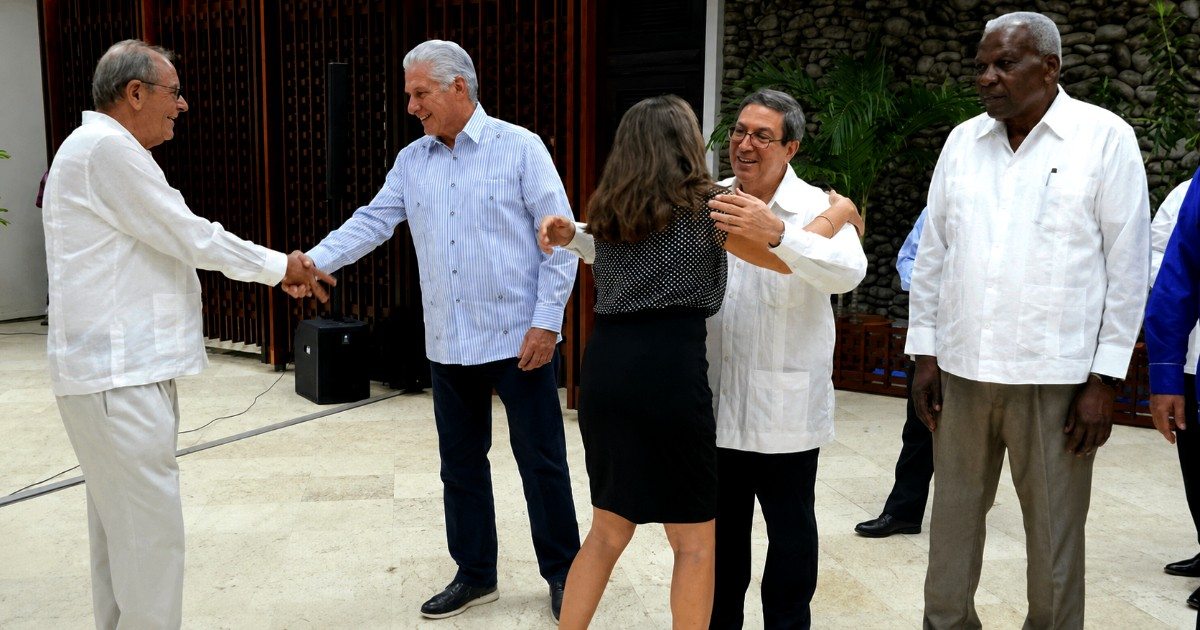
As millions of Cubans struggle without electricity, clean water, or medication, Miguel Díaz-Canel led the swearing-in of 26 new regime ambassadors on Friday. This high-profile event took place in Havana, with the Foreign Ministry showcasing it on social media with its usual triumphalist tone.
The gathering featured the nation's top officials: Esteban Lazo Hernández, the president of the National Assembly; Manuel Marrero Cruz, the prime minister; and Roberto Morales Ojeda, the secretary of Organization for the Central Committee of the Communist Party.
The ceremony coincided with another record-breaking power outage in Cuba, hitting 2,315 MW at 9:10 PM, just shy of the 2,341 MW peak on July 8, when nearly 73% of the country was plunged into darkness simultaneously.
Throughout 2026, Cuba has faced at least four total collapses of its National Electrical System. In provinces like Matanzas, power interruptions have lasted up to 87 consecutive hours, with blackouts exceeding 20 hours a day in many regions.
In April 2026, the United Nations (UN) described the impact of the Cuban crisis as "systemic and increasingly severe," affecting health, water, sanitation, education, transportation, and telecommunications. A million people rely on water delivered by tanker trucks.
The state budget for 2026 was approved with a deficit of 74.5 billion Cuban pesos, with revenues of 484.121 billion against expenses of 550.590 billion. Meanwhile, the minimum wage for state workers equates to a meager $4.65 a month.
Amid this collapse, the regime allocates foreign currency and human resources to expand its diplomatic network abroad. Critics interpret this as a clear indication of the regime's true priorities: maintaining its power apparatus and international influence while the populace lacks basic necessities.
Cuban diplomacy extends beyond mere international representation. According to a 100-page report published by the U.S. Department of State on July 21, titled "Cuba: The Capital of 21st Century Communism," the regime has upheld a global network of political influence, espionage, and subversion for nearly seven decades.
The report highlights that Cuba hosts 18 signal intelligence facilities, with operations linked to China and Russia. It identifies the Cuban Institute of Friendship with the Peoples (ICAP) as the central hub of this network.
Cuban Foreign Minister Bruno Rodríguez Parrilla dismissed the report as a "slanderous pamphlet," but the document underscores the view that the regime's diplomatic missions serve purposes far beyond conventional representation: they are tools for internal legitimization, garnering external support, and, according to Washington, covert influence platforms.
This practice is not new. In 2018, Díaz-Canel presided over the swearing-in of 22 mission heads in a similar ceremony, and in August 2025, he rewarded Johana Tablada de la Torre by appointing her ambassador alongside her husband, Eugenio Martínez Enríquez, head of mission in Mexico.
These ceremonies also serve an internal propaganda function: they project an image of institutional normalcy and international engagement that starkly contrasts with the harsh reality faced by the Cuban people.
Understanding Cuba's Diplomatic and Domestic Challenges
What are the current challenges faced by the Cuban population?
Cubans are dealing with severe shortages of electricity, clean water, and medicines, alongside frequent blackouts and a struggling economy.
How is the Cuban regime responding to the crisis?
Despite the domestic hardships, the regime is focusing on expanding its diplomatic network, which critics argue shows misplaced priorities.
What role does Cuban diplomacy play internationally?
Cuban diplomacy goes beyond representation; it's part of a broader strategy involving political influence, espionage, and international alliances.