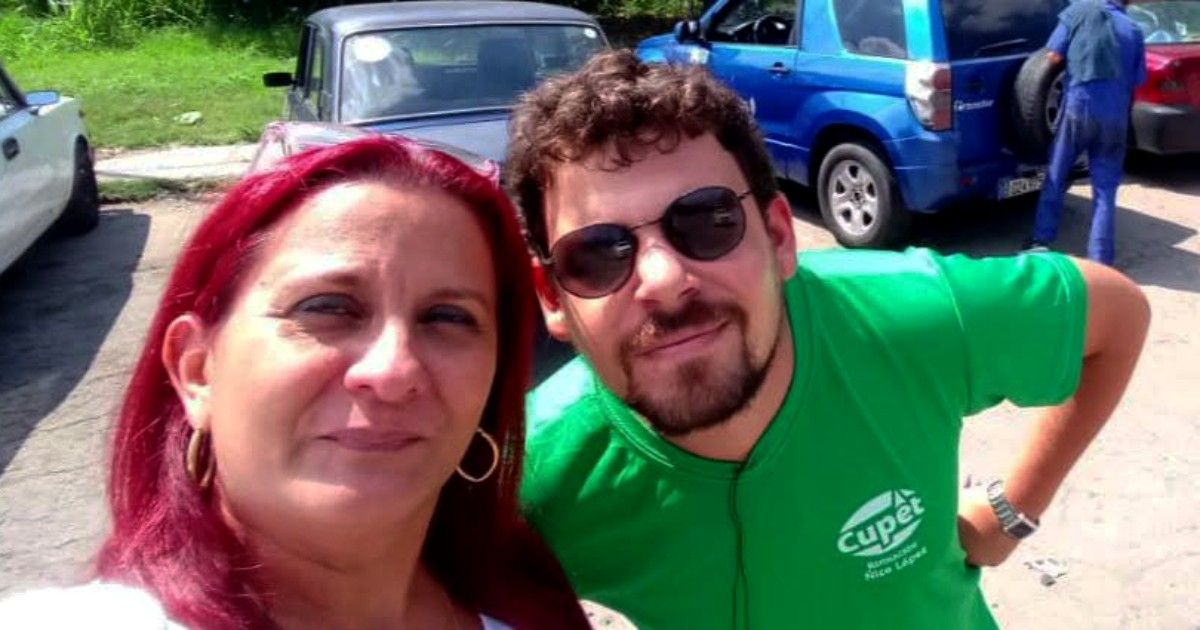
Michel Torres Corona, a vocal propagandist and host of the pro-government show 'Con Filo', took to Facebook on Saturday to post a photo with Gretza Sánchez Padrón—recently sanctioned by the U.S. Department of State—captioned "My photo with the sanctioned one," openly challenging Washington to add him to their next sanctions list.
Gretza Sánchez Padrón was appointed on July 23 by the State Department due to her role as the head of the Central Unit for Medical Cooperation (UCCM), a Ministry of Public Health agency responsible for recruiting and managing professionals sent abroad.
In the same round, the U.S. also sanctioned Health Minister José Ángel Portal Miranda, the UCCM itself, and the Cuban Medical Services Marketer S.A. (CSMC), which Washington labeled as "Cuba's main source of foreign currency," with estimated revenues exceeding $4.9 billion annually.
Defiant Stance Against Sanctions
Rather than remaining silent, Torres Corona turned his acquaintance's sanction into a public provocation. "Seeing her name among the new list of those sanctioned by the U.S. government—and their hysterical, deceitful, and repulsive Secretary of State—only makes me envious. I'm missing that distinction... let’s see if they dare!" he wrote.
The provocation wasn't just verbal. In the image, Torres Corona is seen wearing a shirt bearing the logo of CUPET, Cuba’s state oil company, and he emphasized that this choice was intentional: "I’m wearing a CUPET shirt in the photo, and it’s completely on purpose."
This reference directly points to the U.S. sanctions imposed on CUPET in June 2026 under Executive Order 14404, signed by President Donald Trump on May 1 of that year.
Anti-Imperialist Rhetoric
The post concluded with anti-imperialist slogans: "You won’t get through, Yankee bastards! No one surrenders here! Down with imperialism! Long live free Cuba!"
Torres Corona is one of the regime’s most active spokespeople on social media, though his recent career has been marked by clashes with the very regime he supports.
In April 2026, he was censored by state television after criticizing Sandro Castro. On July 10, he published an article in the Uruguayan portal Mate Amargo titled "The Crab and the Vampire," where he questioned Raúl Guillermo Rodríguez Castro acting as a regime negotiator with Washington without holding any elected position.
U.S. Sanctions Escalate
The U.S. has maintained a steady increase in sanctions against Cuba throughout 2026: on July 13, ten more Cuban entities were designated, including the Ministry of Tourism, the Rapid Response Brigades, and the Territorial Troops Militias. The July 23 round expanded to include the healthcare and energy sectors, targeting CEINPET, ENERSA, and EINARBO S.A.
The State Department reiterated that the medical missions program constitutes forced labor and human trafficking, indicating that the regime retains between 50% and 95% of the salaries paid by host countries.
Back in April 2026, the Inter-American Commission on Human Rights reached similar conclusions in a 199-page report, recommending that American states review or suspend their participation in the program.
The State Department's July 23 statement clarified that "the ultimate goal of the sanctions is not to punish, but to foster a positive change in behavior" of the Cuban regime.
Understanding U.S. Sanctions on Cuba
What prompted the U.S. to sanction Cuban entities recently?
The U.S. sanctioned Cuban entities, including those in the healthcare and energy sectors, due to their involvement in forced labor and human trafficking, particularly through the medical missions program.
Who is Michel Torres Corona and why is he challenging U.S. sanctions?
Michel Torres Corona is a propagandist and TV host known for his support of the Cuban regime. He is challenging U.S. sanctions in a provocative manner, seeking to draw attention to himself and his stance against U.S. policies.
What are the implications of U.S. sanctions on Cuba's economy?
U.S. sanctions target key Cuban entities, potentially crippling their ability to generate foreign currency, which is crucial for the country’s economy. This can lead to severe financial constraints on the Cuban regime.