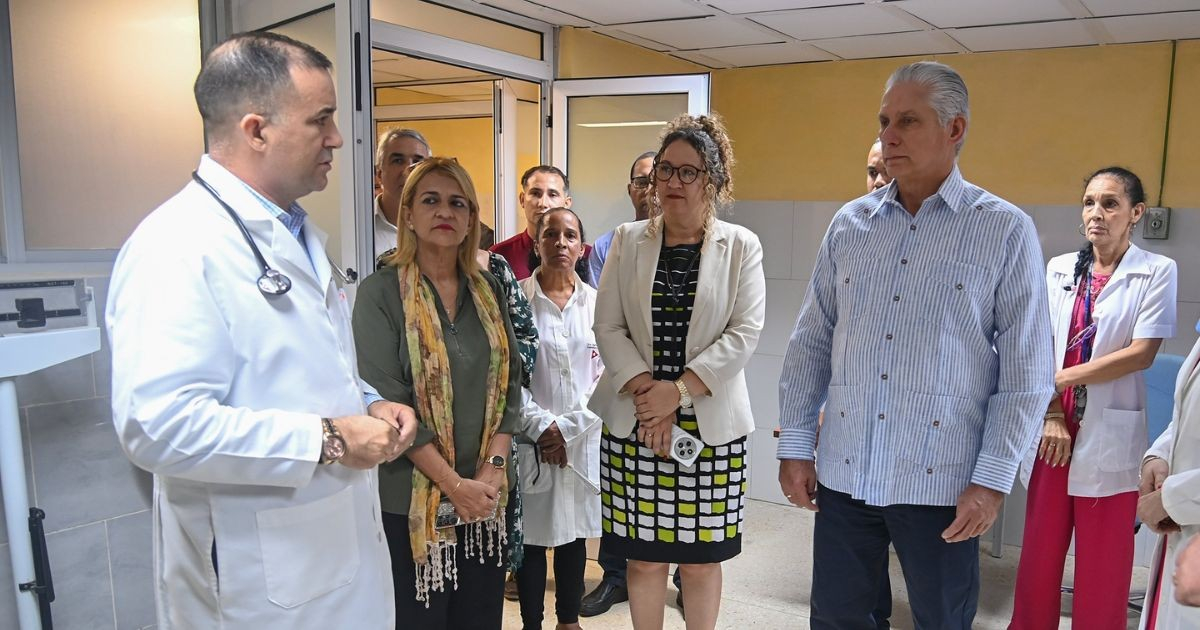
On Friday, Cuban leader Miguel Díaz-Canel paid a visit to the "Joaquín Albarrán Domínguez" teaching hospital in Havana, using the platform to extol the "heroism" of healthcare professionals. This came just a day after the U.S. imposed sanctions on the Minister of Public Health and the central components of Cuba's medical missions program.
Addressing the hospital staff and administrators, Díaz-Canel painted a dramatic picture of the circumstances faced by healthcare workers. He acknowledged, "Our doctors and nurses arrive at their posts each day after enduring long nights without electricity, often traveling on foot due to fuel shortages."
However, what Díaz-Canel describes as heroism is more accurately the consequence of decades of systemic neglect under the authoritarian regime he leads.
José Ángel Portal Miranda, the very Minister of Public Health, admitted to the Associated Press in February 2026 that Cuba's healthcare system was "on the brink of collapse." Further, in July 2025, he had recognized a "structural crisis without precedent" before the National Assembly, with only 30% of essential medications available.
Statistics verify the collapse: out of 651 essential medicines, 461 are out of stock, more than 96,000 surgeries are pending, and hospitals experience power outages lasting up to 20 hours daily, according to reports from May and June 2026.
Infant mortality, another point raised by Díaz-Canel during his visit, rose from 4.0 per 1,000 live births in 2018 to 9.9 in 2025, reaching 14 per 1,000 in Havana during the early months of 2026.
The Reality Behind the Heroism
Even as the regime touts the valor of its domestic healthcare workers, it simultaneously dispatches them on international missions where the state retains 60% to 97.5% of their earnings, according to an April 2026 report by the Inter-American Commission on Human Rights (IACHR), which drew from 71 testimonies of professionals sent to 109 countries.
These same doctors, who walk to work in Cuba, survive on salaries equivalent to around $16 per month, while the medical services export program generated billions of dollars in 2025, deploying tens of thousands of professionals to over 50 countries.
The U.S. State Department sanctioned Minister Portal Miranda, the Central Unit of Medical Cooperation (UCCM), its director Gretza Sánchez Padrón, and the Cuban Medical Services Trading Company (CSMC) on Thursday. It labeled the missions program as "forced labor" and "human trafficking."
This latest round of sanctions, based on Executive Order 14404 signed by Donald Trump on May 1, 2026, targeted nine entities and two individuals linked to the regime.
Global and Technological Context
The European Parliament had previously approved an amendment in April 2025, describing Cuban medical brigades as "modern slavery" and "forced labor," aligning with the IACHR's conclusions.
During his visit to the hospital, Díaz-Canel also discussed the implementation of artificial intelligence and electronic medical records, suggesting these tools could significantly improve staffing issues, one of the hospital's challenges.
On the same day as the presidential visit, the Ministry of Public Health confirmed via its social media account on X that Minister Portal Miranda's personal account had been hacked, marking a second blow for the health ministry within 48 hours.
Cuban internet users reacted to Díaz-Canel's statements, highlighting the disparity between official rhetoric and daily reality: doctors working without gloves, hospitals plunged in darkness, and patients dying while waiting for medicines the state cannot provide, as the regime profits by exporting this workforce globally.
Understanding U.S. Sanctions on Cuba's Health Ministry
What prompted the U.S. sanctions against Cuba's Health Ministry?
The U.S. imposed sanctions due to allegations of "forced labor" and "human trafficking" within Cuba's medical missions program.
How do these sanctions impact Cuba's healthcare system?
The sanctions could exacerbate existing challenges within Cuba's healthcare system by restricting resources and limiting international collaboration.
How has the Cuban regime responded to these sanctions?
The Cuban regime has dismissed the sanctions, continuing to highlight the dedication of its healthcare workers while criticizing U.S. policies.