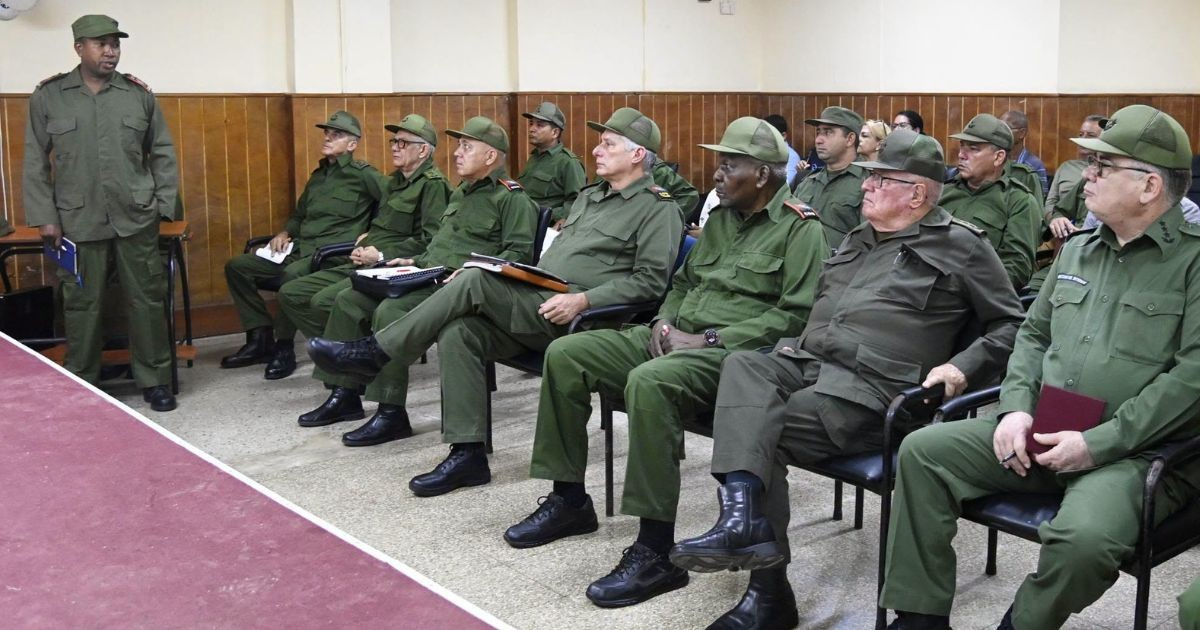
As the 73rd anniversary of the assault on the Moncada Barracks approaches—a pivotal date for the Cuban regime—Miguel Díaz-Canel, Cuba's leader, made a visit to the "Libertad" Defense Zone in Marianao, Havana. During this visit, he reiterated the regime's focus on strengthening territorial military structures.
Dressed in olive green military attire and a National Defense Council cap, Díaz-Canel addressed assembled military and civilian leaders. He highlighted two strategic pillars: defensive mobilization and ongoing economic reforms.
Emphasizing Defense Preparedness
Focusing on defense, Díaz-Canel emphasized that "preparing for defense and increasing combat readiness for the so-called War of All the People is a fundamental task," citing an alleged threat of U.S. aggression as justification.
He underscored the importance of completing territorial defense structures, safeguarding the populace, and updating combat plans to reflect the nation's current situation.
Economic Reforms Amidst Crisis
On the economic front, Díaz-Canel announced the approval of 80 transformations ready for implementation, a number set to exceed 100 by next week, according to his statement.
He declared that measures aimed at "unleashing productive forces, strengthening the business system, and granting greater autonomy to municipalities and companies" are prioritized to improve the balance between wages and prices.
These 80 initiatives are part of a broader package of 176 transformations endorsed by the National Assembly on June 18 and 19, 2026. The regime presents this as the most significant structural reform package since the Special Period.
Included are private banking, lifting the cap on micro, small, and medium enterprises (MSMEs) to over 100 workers, a greater openness to foreign investment, and a gradual shift from universal subsidies to targeted aid.
Propaganda Versus Reality
In Marianao, Díaz-Canel also listed achievements attributed to his administration: incorporation of renewable energy sources, creation of new water reservoirs, expansion of banking services for retirees, renovation of Family Care Systems, and restoration of facilities "in celebration of July 26."
Nevertheless, the reality starkly contrasts with official propaganda. Cuba is experiencing one of its worst economic crises in decades in 2026, with blackouts exceeding 24 hours in several provinces, fuel and food shortages, and a 5% GDP decline in 2025, accumulating a 15% contraction since 2020.
Analysts suggest that Díaz-Canel's municipal tour is also a strategy to quell social dissatisfaction amid fears of potential popular unrest.
Díaz-Canel's Reforms and Cuba's Economic Crisis
What are the key elements of Díaz-Canel's economic reforms?
The reforms include private banking, removal of limits on MSME sizes, increased foreign investment, and a shift from universal subsidies to targeted assistance.
How is Cuba's current economic situation affecting its citizens?
Cubans are facing severe challenges, including long blackouts, scarcity of basic goods like fuel and food, and a significant decline in the economy with a 15% GDP decrease since 2020.
Why is Díaz-Canel focusing on defense mobilization?
Díaz-Canel is emphasizing defense as a priority, citing potential U.S. aggression, in an effort to bolster military readiness and maintain regime stability.