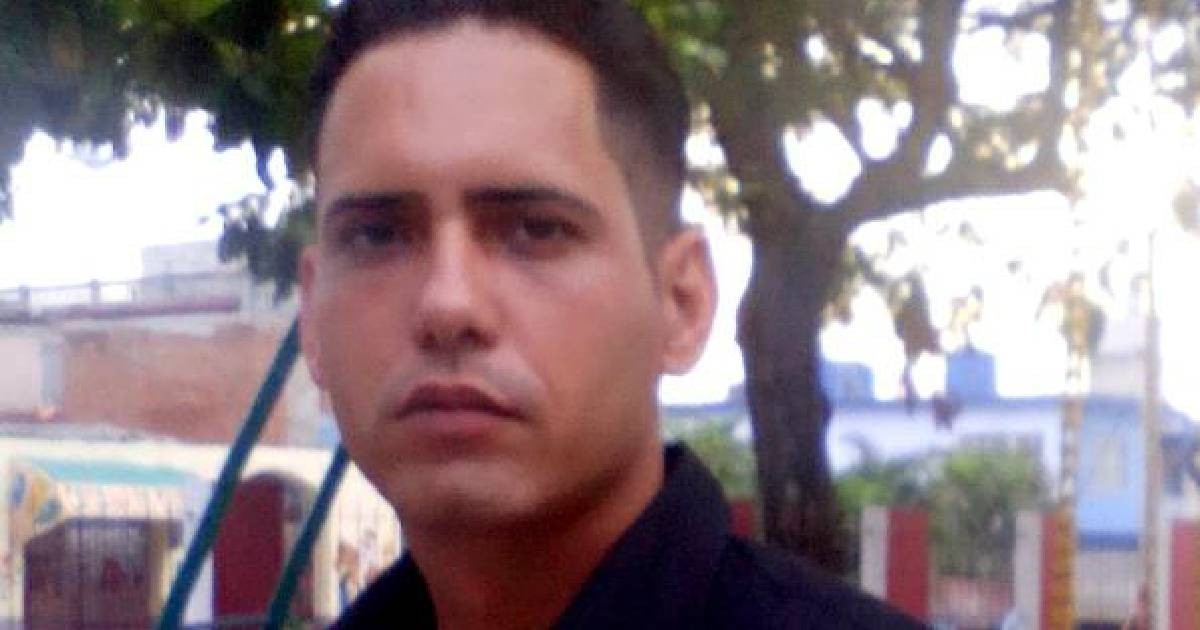
Yosvany Rosell García Caso, a political prisoner from Holguín, has firmly rejected the Cuban government's offer to release him in exchange for leaving the country. Rosell, who was sentenced to 15 years in prison for his involvement in the July 11, 2021 protests, stands resolute in his decision.
His wife, Mailin Rodríguez Sánchez, shared this news on Tuesday through a video she posted on Facebook. In the video, she relayed the message her husband conveyed during their weekly phone call.
Mailin explained that prison authorities altered the usual timing of Yosvany's call—from 9 a.m. to 11 a.m.—to inform him about the exile condition. "They didn't let him call at the regular time to prevent him from telling me that they were going to exile him, which he completely refuses," she stated.
Yosvany's message, delivered via his wife, was unequivocal: "Why should I leave my homeland? The ones who should leave are the communists who have ruined this country."
Mailin Rodríguez Sánchez publicly supported her husband's decision, adding her own perspective: "They should leave. We don't have to go anywhere. We want Cuba to be prosperous, for our children to have a bright future, just like everywhere else in the world."
The family concluded their stance with a declaration of principles: "We refuse to leave Cuba. God, homeland, life, and freedom."
Yosvany Rosell's case is marked by a history of defiance. In October 2025, he embarked on a hunger strike lasting over 39 days, which resulted in critical health issues, including kidney failure, necessitating his transfer to a prison ward in a Holguín hospital.
On January 26, 2026, the Inter-American Commission on Human Rights granted precautionary measures in his favor—case number MC-1242-25—demanding that the Cuban state ensure his safety, well-being, and access to appropriate medical care.
Yosvany's situation is not unique; the Cuban regime routinely uses a "prison or exile" strategy, which UN special rapporteurs criticized in March 2026. Félix Navarro and his daughter Saylí Navarro also turned down a similar offer in May 2026, while Luis Manuel Otero Alcántara was released and exiled to the United States in July.
According to Prisoners Defenders, as of July 9, 2026, Cuba had 1,306 political prisoners, including 40 minors. Human Rights Watch noted that the mass releases announced by the regime in 2026 did not decrease this number, as political prisoners were deliberately excluded.
Mailin Rodríguez Sánchez concluded her statement with a poignant message that reflects her family's determination: "Today, we are enduring genocide—a slow death. Every Cuban is suffering. But we want our country to be free. We want it to be great."
Understanding Yosvany Rosell's Refusal
Why did Yosvany Rosell reject the Cuban government's offer?
Yosvany Rosell rejected the offer because he firmly believes he should not abandon his homeland. He argues that those responsible for the country's deteriorating state, namely the communists, should be the ones to leave.
What are the precautionary measures granted to Yosvany Rosell?
The Inter-American Commission on Human Rights granted precautionary measures to ensure Yosvany Rosell's safety, integrity, and access to proper medical treatment, as outlined in case MC-1242-25.
What is the common practice of the Cuban regime regarding political prisoners?
The Cuban regime often employs a strategy known as "prison or exile," which pressures political prisoners to choose between remaining incarcerated or leaving the country. This approach has been criticized by international organizations, including the UN.