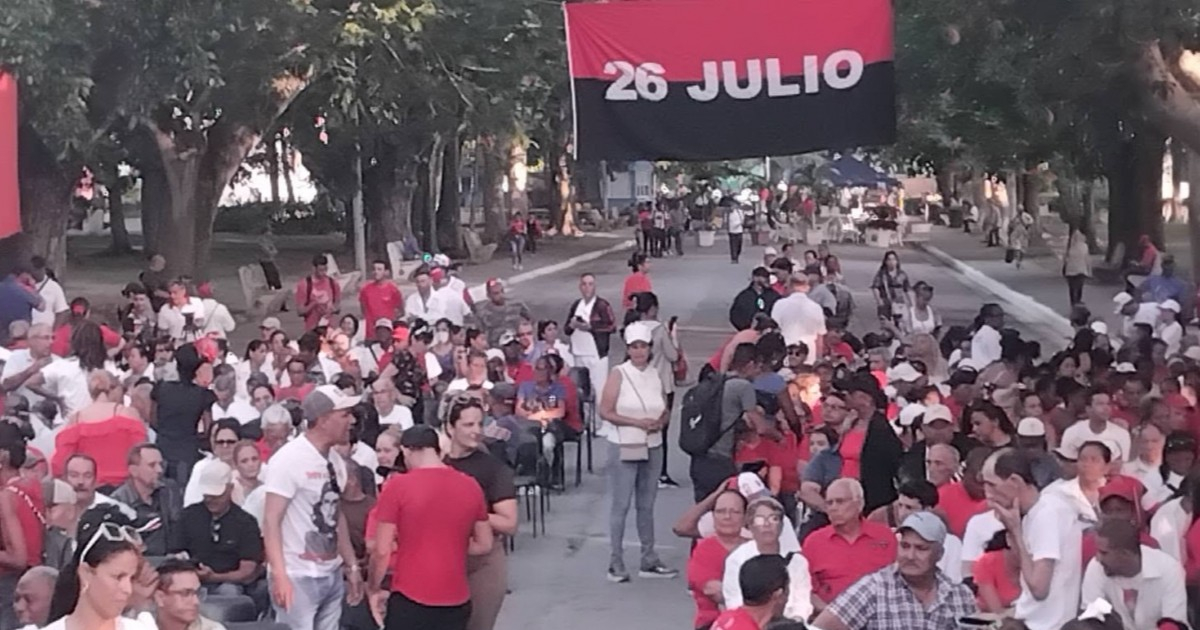
Yahily Hernández Porto, a correspondent for the state-run newspaper Juventud Rebelde in Camagüey, took to Facebook to mock Cubans protesting the socialist regime. She used the July 26 celebrations as a platform to ridicule those demanding change from the streets.
"Suffer, Traitors! To the couch liberators, Yankee lovers, traitors, and imperialist weaklings: Here I am in a 26/7 uprising," she wrote, embellishing her post with four laughing emojis.
Hernández Porto attended the provincial event at Camagüey's Casino Campestre, which she described as "the largest urban park in Cuba," where the regime commemorated the 73rd anniversary of the Moncada attack and paid tribute to Fidel Castro's centenary.
"The gathering is fraternal and rebellious, historic and thrilling, Cuban and mambí. We love you! Homeland or Death! We shall overcome!" she emphasized.
A Pattern of Mockery
This post is not an isolated incident for this state journalist. Back in March 2026, Hernández Porto faced criticism for portraying the "reverbero"—an improvised emergency stove—as a "symbol of domestic resilience," rather than acknowledging it as a sign of the energy crisis plaguing the population.
The sarcasm of this official correspondent starkly contrasts with a reality the regime cannot completely hide: Cuba is experiencing its worst crisis since the Special Period, with an electrical system operating at a deficit of between 1,780 and 2,215 MW. Blackouts extend over 30 hours in some areas, affecting more than 70% of the country simultaneously.
Escalating Protests Amidst Crisis
In this context, public protests have reached unprecedented levels. The Cuban Conflict Observatory recorded 107 street demonstrations in June, a historic record. Meanwhile, Cubalex reported 253 protests and 319 repressive events during the same month.
Slogans have evolved from demands for electricity to calls for freedom and an end to the dictatorship. The regime's response has involved militarization, arrests, and internet blackouts.
The mockery by Hernández Porto fits into a broader pattern of official propaganda that clashes with reality.
Discontent in the Provinces
The national central event for July 26 was assigned to Pinar del Río, sparking widespread indignation on social media as the province suffers from power outages exceeding 20 hours daily, with over 40,000 families without homes, and only 63% of Hurricane Ian damages resolved.
In Matanzas, PCC First Secretary Mario Sabines Lorenzo celebrated the province being declared "Outstanding" in the Moncada emulation, while admitting that "50 to 60 hours without electricity sometimes accumulate in some circuits of our province." Social media reacted swiftly: "Outstanding Matanzas, in blackouts!" users quipped.
Holguín, chosen as the provincial site for July 26 despite residents receiving just three hours of electricity for every 39 or 40 of blackout, elicited a similar response: "What are the achievements? No power, no water, no garbage collection; that's why we earned the site," wrote a user online.
While state media celebrates events and chants "Homeland or Death! We shall overcome!" the Cuban economy has contracted between 15% and 23% since 2019, the dollar surpasses 600 pesos in the informal market, and more than a million Cubans have left the island since 2021.
Understanding the Cuban Crisis and Protests
Why are Cubans protesting?
Cubans are protesting against widespread power outages, economic hardships, and the lack of freedom under the current regime. The protests have evolved from demands for electricity to calls for greater liberties and an end to the dictatorship.
What is the significance of July 26 in Cuba?
July 26 marks the anniversary of the 1953 attack on the Moncada Barracks led by Fidel Castro, a pivotal event in the Cuban Revolution. It is commemorated with official celebrations, but also serves as a reminder of ongoing struggles for many Cubans.