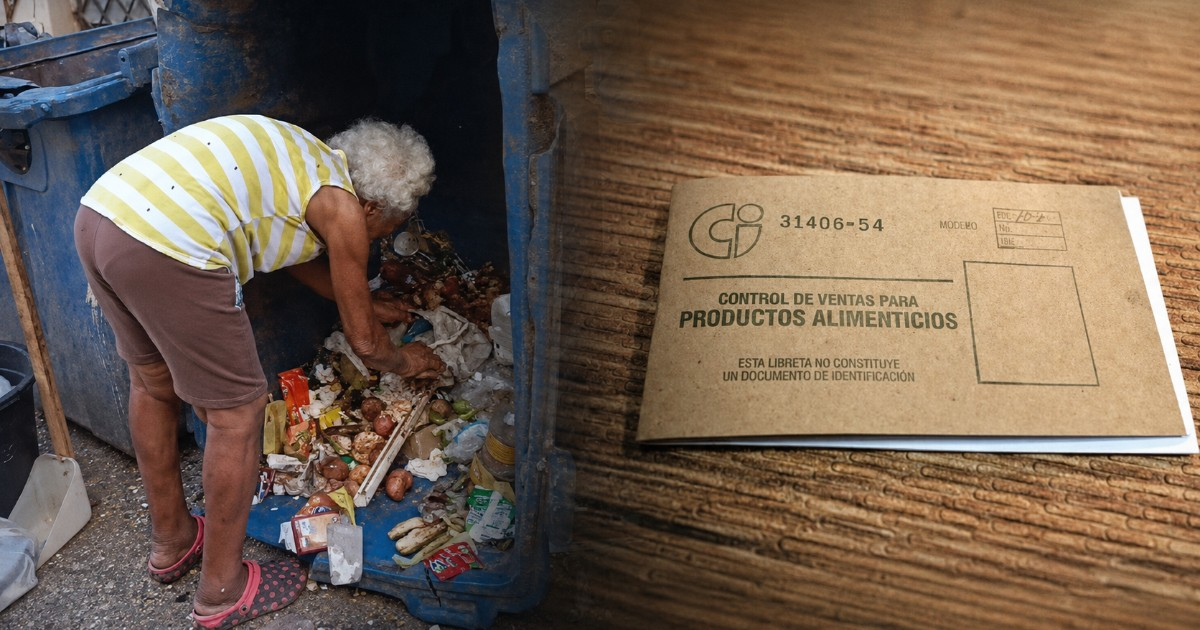
The Food Monitor Program (FMP), an independent organization tracking food (in)security in Cuba, released an analysis this Thursday claiming that the 176 economic measures introduced by the regime in June signify not a structural reform, but a historic rupture. The government is now shifting the burden of survival onto the citizens without restoring the political freedoms that have been restricted for decades.
The report, titled "Privatization of Survival: From a Totalitarian Welfare State to a State Managing Scarcity," delves into the food crisis through the lens of the so-called social contract.
The Breakdown of the Social Contract
According to the FMP, since 1959, the regime took on the role of providing basic goods in exchange for centralizing political power, limiting citizen autonomy, and controlling production means. The system's legitimacy relied on its ability to ensure basic living conditions. However, the organization believes this agreement no longer holds.
The new economic measures, rather than addressing the root causes of the crisis, place the risk squarely on individuals, who must navigate a fragmented, inflationary market with no guarantees. The analysis argues that the social contract isn't merely weakened; it has disintegrated as authorities fail to ensure regular and sufficient access to essential nutrients.
The Collapse of Food Security
The FMP outlines the decline. In the 1970s and 1980s, Cuba's apparent food security was not due to efficient internal production but to resource transfers and subsidies from the Soviet Union and the Council for Mutual Economic Assistance. This support allowed for the distribution of basic foods at symbolic prices while masking the country's low agricultural productivity.
The end of this support during the 1990s’ Special Period marked the first major visible fracture in the state-citizen relationship. Scarcity transitioned from an occasional issue to a structural component of the system.
The Shift to Individual Responsibility
The subsequent opening to tourism and increasing reliance on remittances exacerbated inequalities, creating a tiered food system. While an elite connected to the state, tourism, or foreign currency could access imported goods, much of the population was stuck with a diet mainly composed of low-nutrient carbohydrates.
Access to proteins and micronutrients became dependent on foreign remittances rather than citizenship status. The FMP dismisses the notion that scarcity is solely due to the U.S. embargo or issues with traditional suppliers, instead highlighting the government's failure in food production, distribution, and management.
Dependence on External Factors
Despite official rhetoric framing food sovereignty as political resistance, Cuban agriculture remains reliant on imported fuel, fertilizers, machinery, and other inputs. Centralization, bureaucracy, lack of incentives for producers, and inability to meet market needs have led to sustained productivity declines.
Cuba claims sovereignty but depends heavily on imports and external aid to stave off further nutritional deterioration. The report emphasizes the outsourcing of risk. Unable to maintain subsidies and distribution guarantees, the state encourages micro, small, and medium enterprises (MSMEs), private businesses, remittances, and individual effort to meet needs it once officially managed.
Economic Disparities and Social Control
When the private sector underproduces or sets prohibitive prices, the government stops responding by providing food and labels the issue as part of market regulation. Consequently, survival shifts from a state responsibility to an individual's economic capability.
This shift has created a dual-speed economy. On one side is the state sector, paying increasingly devalued Cuban peso wages; on the other is a growing private and informal market with prices directly or indirectly pegged to foreign currencies. As a result, the value of labor no longer hinges on professional preparation, productivity, or hours worked but on the ability to capture dollars or other foreign currencies, disproportionately affecting state workers, retirees, and families without remittances.
The Erosion of the Ration Book System
The analysis also discusses the de facto dismantling of the ration book system. According to the FMP, this is happening through reduced quantities and frequency of distributed products, declining quality, and the forced redirecting of consumers to informal markets or MSMEs with exorbitant prices.
Food insecurity thus becomes not just a distribution issue but one of purchasing power. Those without foreign currency, savings, or overseas family support face malnutrition and progressive health decline.
Contextually, the FMP's 2025 Food Insecurity Survey revealed that 96.91% of respondents lacked adequate food access. About 33.9% of households reported at least one member going to bed hungry in the past 30 days, up from 24.6% in 2024. Additionally, 79.4% of participants reported spending 80% or more of their income on food. Another report highlighted critical food insecurity levels in Havana, Matanzas, Cienfuegos, Guantánamo, and Santiago de Cuba.
Food Scarcity as a Control Mechanism
The FMP warns that scarcity might serve as a tool for social and political control. When the state retains the ability to decide who receives certain products, when, and at what price, food access becomes a form of institutionalized dependence. The daily struggle for food consumes time, energy, and mental capacity, leaving people with fewer resources to organize, challenge authority, or participate in protests.
Economically, the report describes inflation as a regressive tax that disproportionately affects those without foreign currency assets. State salaries continually lose purchasing power, while basic foods like proteins, fats, and complex carbohydrates are treated as luxury items. Citizens must choose between food, medicine, basic services, or other household needs. State wages no longer enable basic subsistence, shattering the old principle of working in exchange for minimal security.
Possible Scenarios and Future Outlook
The FMP considers the 176 measures as reactive attempts to manage scarcity rather than solving low productivity, import dependency, fiscal deficit, or the Cuban peso's devaluation. The organization outlines three possible scenarios: deepening the crisis if centralized planning persists; transitioning to a mixed economy with greater producer autonomy; or a radical transformation driven by a society unable to bear the system's human cost.
The document concludes that the social contract cannot be restored solely through fiscal adjustments, monetary controls, or subsidy cuts. Prioritizing production, economic autonomy, and citizen rights over ideology and centralized control is essential.
According to the FMP, the ultimate paradox is a system striving for total control over its citizens' lives but losing control over sustaining them.
Understanding Cuba's Economic Challenges
What are the main factors contributing to food insecurity in Cuba?
The main factors include the government's failure in food production, distribution, and management, reliance on imports, and external aid. Additionally, economic measures have shifted the burden of survival onto individuals.
How has the Cuban economy created a dual-speed system?
A dual-speed economy has emerged due to a state sector paying in devalued Cuban pesos and a private/informal market with prices tied to foreign currencies. This system affects the value of labor, primarily impacting those without foreign currency access.
What role does food scarcity play in social control in Cuba?
Scarcity is used as a mechanism of social and political control by determining who gets access to certain products, potentially creating dependence on the state and limiting citizens' capacity to organize and protest.