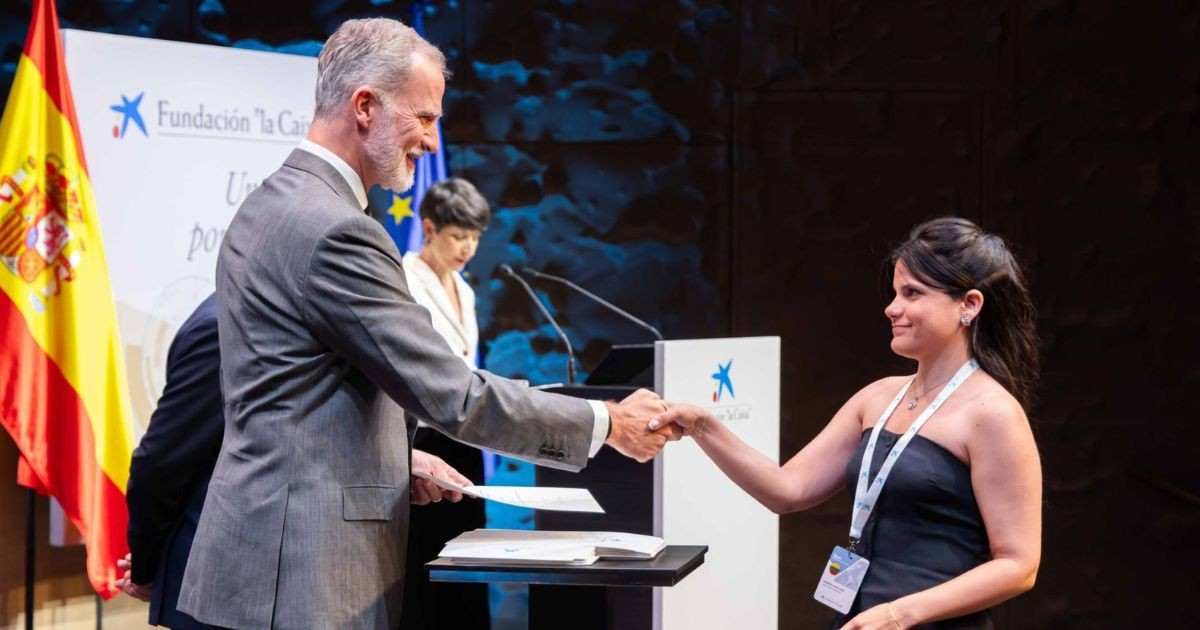
In early October, Gabriela Díaz Díaz, a young woman originally from Cárdenas, Cuba, received one of the prestigious 100 international postgraduate scholarships from King Felipe VI. These scholarships are part of the 44th edition of the program offered by the “la Caixa” Foundation, and Gabriela stands out as the sole Cuban among the class of 2025.
The award ceremony took place at CaixaForum Madrid, where the 100 selected university students were gathered from a pool of 1,101 eligible applicants. The selection process included a competitive evaluation through peer review and personal interviews.
Gabriela's Academic Journey
Born on January 23, 1999, Gabriela completed her primary education at Óscar Rodríguez School, secondary education at ESBU José Martí, and pre-university at IPVCE Carlos Marx, all located in Cárdenas.
After moving to Spain, she pursued a degree in English Studies at the University of Castilla-La Mancha from 2021 to 2024, where she developed a keen interest in historical linguistics, sociolinguistics, and cognitive linguistics.
From November 2024 to June 2025, she was awarded a Collaborative Scholarship by the Spanish Ministry of Education, during which she worked with the research group Emotions Across Time, Languages, and Cultures (EMOTLC), led by Dr. Javier E. Díaz-Vera.
Research Focus and Scholarship Details
Her research explores how emotional expressions construct identity, particularly examining how "otherness" is articulated through emotional metaphors and metonymies in various cultural and linguistic contexts.
The scholarship funds her enrollment in the international master's program in Sociolinguistics and Multilingualism, which she is pursuing at Vytautas Magnus University in Kaunas, Lithuania, and Johannes Gutenberg University in Mainz, Germany.
Each scholarship is valued at approximately 100,000 euros, covering full tuition, a monthly stipend for living expenses, travel costs, and access to a network of over 6,700 professionals from the Foundation’s Alumni Association.
International Recognition and Program Impact
During the ceremony, King Felipe VI praised the recipients, stating, "Your talent and personal abilities will shape your path," adding that he found it "inspiring" to see young individuals with "a future full of possibilities and opportunities" to develop their vocations.
Among the 100 scholarship recipients, five hail from non-Iberian countries, including Argentina, Cuba, Italy, Lebanon, and Serbia, highlighting the program's international reach.
The universities with the highest number of scholars are Cambridge (10), Columbia (nine), the London School of Economics and Political Science (eight), ETH Zurich (five), Harvard (five), and Oxford (five).
Since its inception in 1982, the “la Caixa” Foundation has invested over 229 million euros in the international education of 4,177 students, with 10 million euros allocated specifically for the 2025 cohort.
Gabriela's achievement joins the ranks of other Cuban diaspora youth who have attained international academic success, showcasing the potential of Cuban talent when given opportunities denied by their country's regime.
Frequently Asked Questions about the "la Caixa" Scholarship Program
What is the value of each "la Caixa" scholarship?
Each scholarship is worth about 100,000 euros, covering tuition, living expenses, travel costs, and access to a professional network.
How many students were selected for the 2025 scholarship program?
A total of 100 students were selected for the 2025 scholarship program from 1,101 eligible candidates.
Which universities have the most "la Caixa" scholarship recipients?
The universities with the highest number of scholarship recipients include Cambridge, Columbia, the London School of Economics, ETH Zurich, Harvard, and Oxford.